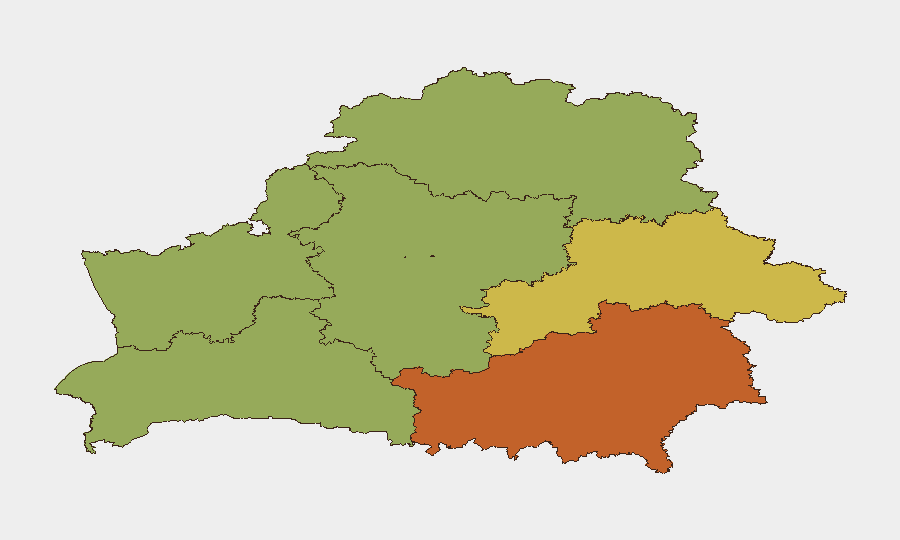
Situation Summary
Belarus remains a low-to-moderate global security risk (rank #156, score 4/10) with fragmented threat exposure concentrated in border regions and the capital. The most recent tracked event—a 13 June Armed Forces public statement—has not yet generated corroborating incident reports in open sources. Overall security posture reflects baseline political constraints and Russia-Belarus military integration rather than acute instability.
Key Developments
Constraint on reporting: GeoBit's live web research has not identified verifiable, time-stamped security incidents specific to Belarus within the 24–48 hours preceding this brief. The Armed Forces statement of 13 June appears in the event feed but lacks independent corroboration or detail sufficient to assess substance or operational impact. Older developments (e.g., ongoing Russia–Belarus military cooperation, economic coordination visits, nuclear posturing rhetoric) remain contextual background rather than current incidents.
Recommendation: Security teams requiring incident confirmation for this period should cross-reference primary sources—Reuters, AP, Belsat, and verified Belarus-focused OSINT channels on X/Telegram—directly, and flag any specific incident candidates to GeoBit for rapid verification and multi-source correlation.
Highest-Risk Areas
Homyel Region (risk 75) and Minsk (risk 68) drive the sub-national risk landscape, with Mahilyow Region (62) and Brest Region (55) as secondary concerns. Homyel's elevated score reflects its proximity to the Ukraine border and Russian military staging; Minsk concentrates political sensitivity, regime-stability dependencies, and foreign presence. Hrodna and Vitsebsk regions carry lower but persistent scores tied to border proximity and logistical vulnerabilities. Corporate assets and personnel in Minsk face the highest absolute exposure due to population density and concentration of business activity; frontier regions require heightened due-diligence for cross-border movement and supply-chain continuity.
How GeoBit Would Assist
AOI Monitoring & Early Warning with persistent watch over Homyel, Minsk, and Mahilyow regions would detect emerging protests, military movements, or infrastructure incidents within 4–24 hours. OSINT fusion combining Telegram/X intelligence, official statements, and independent media would rapidly corroborate or debunk incident reports, eliminating single-source noise. Conflict & Military tracking and Network & Actor Analysis enable real-time mapping of security-force posture and regime-aligned actor activity, supporting duty-of-care assessments for expat and asset safety.
7-Day Outlook
No imminent escalation is signaled in current data, but the Armed Forces statement warrants monitoring for follow-up orders, exercises, or border activity over the next 7 days. Military rhetoric and Russia-Belarus coordination remain high-volume but stable; any deviation toward emergency mobilization, sudden curfew, or cross-border incident would constitute material shift. Security teams should maintain baseline alert posture and confirm communications protocols for rapid evacuation or sheltering if regional conflict dynamics shift.
Next update: 2026-06-15 or on confirmed incident.
Highest-Risk Areas — Ranked
| # | State / Region | Risk |
|---|---|---|
| 1 | Homyel Region | 75 |
| 2 | Minsk | 68 |
| 3 | Mahilyow Region | 62 |
| 4 | Brest Region | 55 |
| 5 | Hrodna Region | 52 |
| 6 | Minsk Region | 48 |
| 7 | Vitsebsk Region | 45 |
Sources
Previous Daily Briefs
A new Belarus brief is written every day — each with its own risk map and downloadable CSV. Here's the last week; use the calendar to go further back.
📅 Browse every day by calendar →
Highlighted days have a brief. Tap a day for that day's map & analysis, or “csv” for that day's dataset ($5).