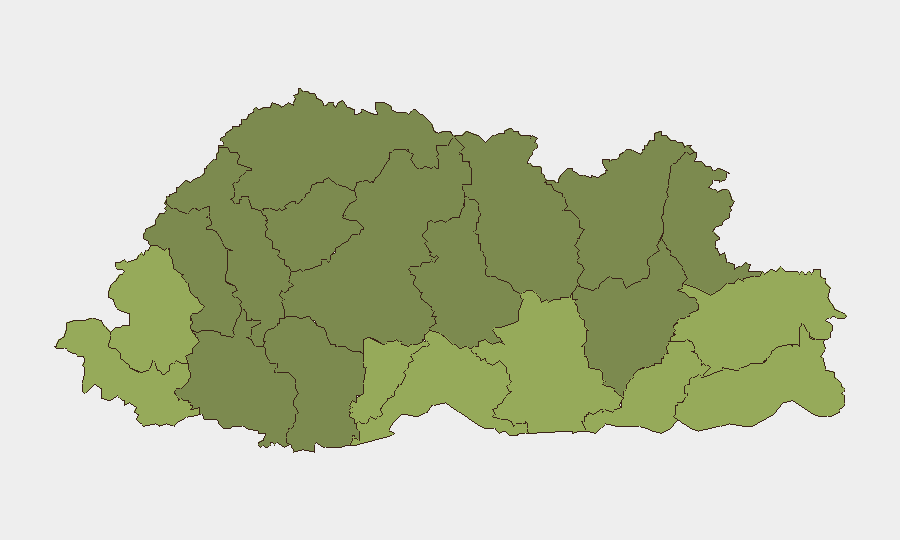
Situation Summary
Bhutan remains in a stable security posture with no acute incidents reported in the last 24–48 hours. The country's composite threat score of 2 and single tracked event reflect a low-risk operating environment relative to the region. Border districts—particularly Samtse, Sarpang, and Haa—carry elevated risk profiles, likely driven by geographic proximity to contested or sensitive areas, though no active escalation is currently documented.
Key Developments
- 2026-06-11 · Thimphu · Royal Bhutan Police Equipment Handover. Foreign partners conducted a formal capacity-building handover of patrol vehicles and firefighting equipment to the Royal Bhutan Police. This is a routine diplomatic and institutional-strengthening activity with no security incident component.
- 2026-06-11 · Thimphu · Bhutan International Travel Mart 2026 Launch. The country hosted the opening of a major international tourism and business event. No associated unrest, protests, or security disruptions were reported.
- 2026-06-11 · Nationwide · Public Statements. Two public statements attributed to Bhutan and one involving the Prime Minister were issued; open-source intelligence does not indicate these relate to acute conflict, instability, or policy rupture. Further context on their substance is not available from independent reporting.
No credible reports of civil unrest, crime spikes, border clashes, infrastructure disruption, or travel-risk events emerged in the 24–48 hour window.
Highest-Risk Areas
Samtse (58), Sarpang (55), and Haa (52) districts rank substantially above the national average and warrant elevated monitoring. These southwestern and western border areas likely reflect long-standing geopolitical sensitivities, including proximity to India and unresolved boundary questions or cross-border movement patterns. Pemagatshel (50) and Samdrup Jongkhar (48) in the east suggest comparable dynamics along the Indian frontier. By contrast, central and northern districts—including Thimphu, Punakha, and Lhuntse—carry substantially lower composite scores, indicating that acute risk is geographically concentrated in peripheral areas rather than the seat of government or major urban centers.
How GeoBit Would Assist
Corporate security and duty-of-care teams operating in Bhutan's border districts should employ Area-of-Interest Monitoring & Early Warning to detect shifts in border activity, civil-military posture, or political signaling in real-time. OSINT Fusion (combining social media, news, and SIGINT analysis across multiple languages) provides early detection of grassroots unrest or local incidents before they escalate or reach international media. For teams with assets in Samtse or Sarpang, Routing & Network Analysis enables identification of alternative supply and personnel routes to mitigate disruption risk from border-zone incidents.
7-Day Outlook
Bhutan's security trajectory over the next week is expected to remain stable absent major external shocks (e.g., India–China escalation or major policy shifts). Routine institutional and diplomatic activity—including tourism promotion and police modernization—will likely continue. Border districts should remain under steady, low-level monitoring; no acute trigger for escalation is currently visible.
Highest-Risk Areas — Ranked
| # | State / Region | Risk |
|---|---|---|
| 1 | Samtse District | 58 |
| 2 | Sarpang District | 55 |
| 3 | Haa District | 52 |
| 4 | Pemagatshel District | 50 |
| 5 | Samdrup Jongkhar District | 48 |
| 6 | Tsirang District | 45 |
| 7 | Zhemgang District | 42 |
| 8 | Trashigang District | 40 |
| 9 | Mongar District | 38 |
| 10 | Gasa District | 35 |
| 11 | Lhuntse District | 32 |
| 12 | Wangdue Phodrang District | 30 |
Sources
Previous Daily Briefs
A new Bhutan brief is written every day — each with its own risk map and downloadable CSV. Here's the last week; use the calendar to go further back.
📅 Browse every day by calendar →
Highlighted days have a brief. Tap a day for that day's map & analysis, or “csv” for that day's dataset ($5).