Situation Summary
Bulgaria remains a low-threat environment globally (rank #104) with a composite threat score of 11 across 11 tracked events. The primary security concern in the last 24–48 hours stems from political friction over EU sanctions policy rather than physical security incidents. An aviation technical incident from June 30 continues to be analyzed and discussed but posed no actual operational threat. Overall trajectory remains stable with no indicators of imminent escalation in civil unrest, terrorism, or organized crime.
Key Developments
- Sofia, July 3, 2026 – EU sanctions dispute
Bulgarian government announced opposition to the EU's 21st Russia sanctions package unless Patriarch Kirill and Lukoil executive Vagit Alekperov are removed from the sanctions list, citing energy-security concerns. This represents a policy friction point rather than a physical security incident but signals potential further EU–Bulgaria diplomatic tension.
- Burgas airspace, June 30, 2026 (ongoing coverage July 3–4)
LOT/Electra Airways Airbus A320 broadcast hijack transponder code 7500 en route from Warsaw to Tel Aviv, triggering interception by Bulgarian Air Force MiG-29 and Israeli jets and diversion to Burgas Airport. Bulgarian authorities confirmed the incident was caused by technical failure/pilot error with no actual hijacking or threat present; however, continued media analysis underscores aviation-security operational relevance for Bulgaria's airspace.
- Bulgarian–Turkish border region, "recently" (reported within last 48 hours)
Turkish security forces detained at least 66 irregular migrants at multiple locations near the Greek and Bulgarian borders. The timing and framing suggest ongoing migration-enforcement operations in the wider Bulgaria border region, consistent with established EU–Turkey border management protocols.
- Political/institutional activity, July 2–4
Signals include corporate and government disapprovals (July 3), opposition party statements concerning election-commission activity (July 4), and a university expulsion incident (July 3). None indicate acute security threat; reflect routine political and institutional processes.
Highest-Risk Areas
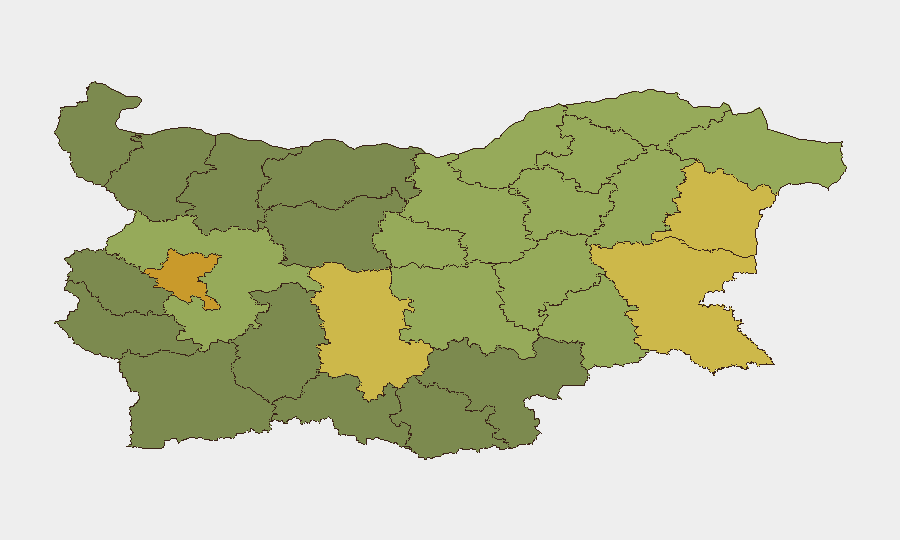
Sofia-City (risk 72) and Plovdiv (risk 68) drive the highest sub-national risk scores, followed by the coastal city of Varna (65) and port city of Burgas (62). These urban centers concentrate government, commercial, and international activity, making them focal points for political signaling, corporate disputes, and occasional civil discontent. Sofia-City's significantly higher score reflects its role as the capital and concentration of diplomatic, EU, and corporate presence; the broader Sofia district (58) and second-tier cities (Ruse, 55; Stara Zagora, 52) indicate that risk is urban-centric rather than dispersed across rural regions.
How GeoBit Would Assist
Security teams with people or assets in Bulgaria should employ AOI Monitoring & Early Warning on Sofia-City, Plovdiv, and Varna to detect rapid shifts in civil unrest or protest activity, and OSINT fusion (including X/Telegram, news, and entity extraction) to track political developments and sanctions disputes that may affect business operations or travel routing. Aviation tracking and persistent airspace monitoring would provide early notification of future technical incidents or air-traffic disruptions. Election monitoring and regime-stability assessment capabilities would support corporate duty-of-care teams tracking the July 4 opposition–commission dispute and any downstream policy shifts.
7-Day Outlook
No significant escalation is expected in the next seven days. Political friction over EU sanctions and migration enforcement will likely persist as baseline processes. The aviation incident, while resolved, may prompt temporary heightened security protocols at Burgas and Sofia airports; teams should monitor NOTAM updates and carrier communications for operational adjustments.
Highest-Risk Areas — Ranked
| # | State / Region | Risk |
|---|---|---|
| 1 | Sofia-City | 72 |
| 2 | Plovdiv | 68 |
| 3 | Varna | 65 |
| 4 | Burgas | 62 |
| 5 | Sofia | 58 |
| 6 | Ruse | 55 |
| 7 | Stara Zagora | 52 |
| 8 | Sliven | 50 |
| 9 | Shumen | 48 |
| 10 | Razgrad | 47 |
| 11 | Yambol | 45 |
| 12 | Dobrich | 44 |
Sources
Previous Daily Briefs
A new Bulgaria brief is written every day — each with its own risk map and downloadable CSV. Here's the last week; use the calendar to go further back.
📅 Browse every day by calendar →
Highlighted days have a brief. Tap a day for that day's map & analysis, or “csv” for that day's dataset ($5).