Situation Summary
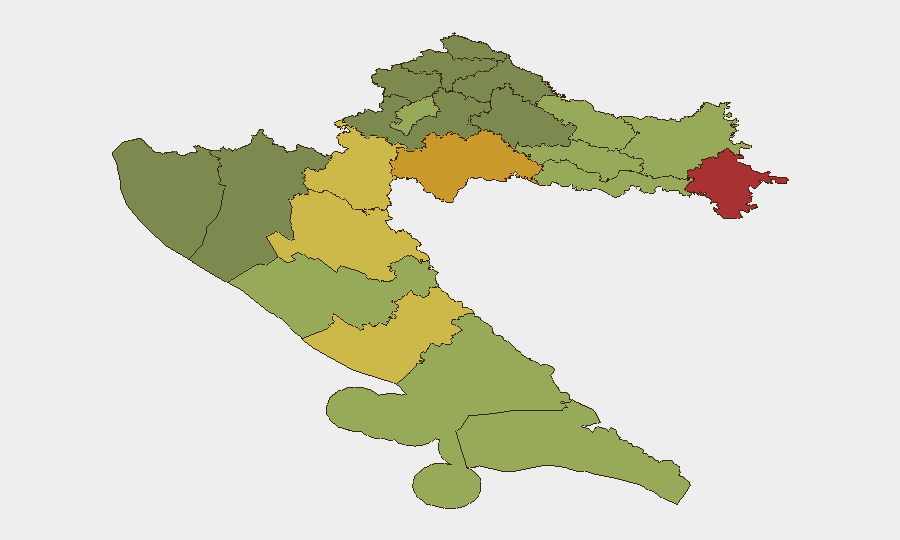
Croatia remains a moderate-risk environment globally (composite threat score 24, rank #null) with 14 tracked events in the current reporting window. The threat landscape is fragmented across multiple institutional actors—police, NATO, domestic government bodies, and regional neighbors—suggesting procedural or diplomatic friction rather than acute security breakdown. Sub-national risk concentrates heavily in the war-affected eastern borderlands, particularly Vukovar-Srijem County (risk 78) and Sisak-Moslavina County (risk 72), where historical tensions, legacy weapons proliferation, and cross-border dynamics persist.
Key Developments
- 2026-06-20 · Police Disapproval: Domestic law-enforcement body issued formal disapproval signal; no specific location or incident detail available in current intelligence, but timing suggests reaction to a policy, statement, or action within the last 24 hours.
- 2026-06-20 · NATO Public Statement: Alliance-level communication regarding Croatia; context insufficient to determine whether statement concerns NATO-Croatia cooperation, security assurance, or response to a regional event.
- 2026-06-20 · European Demand: An EU or European institutional actor issued formal demand directed at Croatian authorities or policy; subject and location not yet specified in open reporting.
- 2026-06-20 · Serbian Presidential Disapproval: Serbia expressed formal disapproval toward a Croatian presidential statement or action, indicating bilateral diplomatic friction as of today.
- 2026-06-18 · Domestic Investigation Initiated: Croatian authorities launched investigation into unspecified matter; suggests potential law-enforcement or judicial escalation in the prior 24 hours.
- 2026-06-18 · Rejection and Counter-Rejection Events: Multiple "reject" signals among Croatian, Canadian, and unnamed institutional actors indicate diplomatic or policy disagreement without military or violent indicators.
- 2026-06-18 · Internal Political Statement: Public statement issued between Croatian state entities, signaling domestic policy or procedural disagreement.
Note: Web research identified arrest and disorder incidents at the England–Croatia World Cup match in Texas (2026-06-18), not incidents within Croatia's borders. No verified domestic unrest, crime, or security incidents within Croatia itself are available from the last 24–48 hours in the provided intelligence.
Highest-Risk Areas
Eastern border regions dominate Croatia's sub-national risk profile. Vukovar-Srijem, Sisak-Moslavina, and Karlovac counties (risks 78, 72, and 68, respectively) face elevated threat from legacy conflict dynamics, weapons availability, and proximity to Serbia and Bosnia. These counties experienced direct combat during the 1990s wars and retain above-average rates of organized crime, irregular migration, and cross-border trafficking. The Adriatic coastal and island counties (Zadar, Šibenik-Knin, Split-Dalmatia) show moderate elevation (55–48 risk scores), likely reflecting maritime smuggling corridors and transnational organized-crime activity. Zagreb (risk 50) occupies the middle band, consistent with a capital city's exposure to protest, political targeting, and organized-crime networks.
How GeoBit Would Assist
Corporate security teams in Croatia would leverage Intel Sweep and OSINT fusion to monitor police, NATO, and Serbian state communications in real time and corroborate diplomatic signals with ground truth. AOI Monitoring & Early Warning on Vukovar-Srijem and Sisak-Moslavina counties would provide persistent watch for weapons trafficking, protest escalation, or cross-border incursions. Routing & Network Analysis would enable staff to identify and update alternative travel routes around eastern counties during periods of elevated bilateral tension with Serbia or Bosnia.
7-Day Outlook
The convergence of police disapproval, NATO statement, and Serbian–Croatian diplomatic friction within 24 hours suggests an unfolding policy or diplomatic dispute rather than imminent security breakdown. Expect continued institutional signaling (statements, investigations, rejections) over the next 7 days. Eastern border counties warrant elevated alertness; corporate duty-of-care protocols should remain active for personnel in or transiting Vukovar-Srijem and Sisak-Moslavina counties.
Highest-Risk Areas — Ranked
| # | State / Region | Risk |
|---|---|---|
| 1 | Vukovar-Srijem County | 78 |
| 2 | Sisak-Moslavina County | 72 |
| 3 | Karlovac County | 68 |
| 4 | Lika-Senj County | 65 |
| 5 | Šibenik-Knin County | 62 |
| 6 | Brod-Posavina County | 58 |
| 7 | Zadar County | 55 |
| 8 | Osijek-Baranja County | 52 |
| 9 | City of Zagreb | 50 |
| 10 | Split-Dalmatia County | 48 |
| 11 | Požega-Slavonia County | 45 |
| 12 | Virovitica-Podravina County | 42 |
Sources
Previous Daily Briefs
A new Croatia brief is written every day — each with its own risk map and downloadable CSV. Here's the last week; use the calendar to go further back.
📅 Browse every day by calendar →
Highlighted days have a brief. Tap a day for that day's map & analysis, or “csv” for that day's dataset ($5).