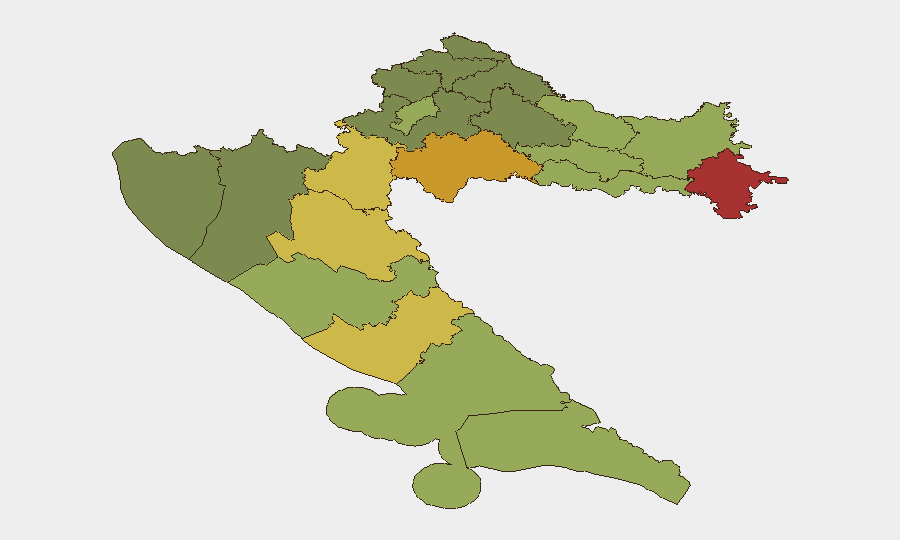
Situation Summary
Croatia remains a low-threat environment globally (rank #163, composite score 7), with no tracked major security events in the reporting period. However, localized criminality—fraud, petty violence, and weapons possession—persists at low frequency across urban and border zones. The sub-national risk profile is heavily weighted toward eastern border counties (Vukovar-Srijem, Sisak-Moslavina, Karlovac) and the Adriatic coast, reflecting legacy conflict-era vulnerabilities and organized crime activity. The overall trajectory is stable with no indicators of escalation.
Key Developments
- Bajakovo border crossing (Serbia border), 8 October 2026: Croatian police arrested two men suspected of defrauding a 69-year-old Zagreb resident of approximately €50,000; suspects were detained while attempting to cross into Serbia, with suspected proceeds recovered.
- Zagreb, 12 October 2026: Croatian authorities expanded an investigation into an alleged multimillion-euro toxic-waste disposal scheme; no immediate security threat to personnel or operations reported.
- Otišić (near Sinj, central Dalmatia), 9 October 2026: Sinj Mayor Miro Bulj reported to authorities that a Serbian nationalist gathering had occurred; police and intelligence services were notified. Independent confirmation of the event remains unavailable.
- Split, 12–13 October 2026: MED9 summit concluded without reported security incidents; minor traffic disruption occurred on the evening of 12 October due to summit activity and concurrent sporting events.
Highest-Risk Areas
Vukovar-Srijem, Sisak-Moslavina, and Karlovac counties dominate the risk profile (scores 78, 72, and 68 respectively), reflecting their geography along Serbia's border and residual conflict-era weapons caches, organized crime transit routes, and ethnic sensitivities. Lika-Senj and Šibenik-Knin counties (65 and 62) face similar exposure. Zagreb (rank 9, score 50) and the Adriatic coastal region register moderate risk driven by petty criminality, migrant trafficking, and urban crime. Eastern and southern border zones warrant elevated monitoring for cross-border fraud, smuggling, and weapons trafficking; central Dalmatia requires attention to nationalist political activity and organized crime.
How GeoBit Would Assist
Security teams should deploy AOI Monitoring & Early Warning on Vukovar-Srijem, Sisak-Moslavina, and Karlovac counties to detect weapons trafficking, organized crime signaling, and illicit border crossings. OSINT Fusion & Corroboration (Intel Sweep, X/Twitter & Telegram monitoring, multi-language search) would validate and contextualize reports of nationalist gatherings and border-zone incidents—as demonstrated by the unconfirmed Otišić event. Entity Extraction, Network & Actor Analysis enables tracking of fraud rings and cross-border criminal cells operating through border checkpoints (e.g., Bajakovo). Routing & Network Analysis supports journey planning for personnel transiting eastern counties or the Serbia border, identifying lower-risk corridors.
7-Day Outlook
No imminent escalation is expected. Border-zone criminality and low-level organized crime are likely to persist at current frequencies. Continued monitoring of eastern counties and coastal routes for weapons, fraud, and trafficking activity is warranted as a standard precaution. Personnel and asset security in Zagreb and Split-Dalmatia remain within normal risk parameters.
Highest-Risk Areas — Ranked
| # | State / Region | Risk |
|---|---|---|
| 1 | Vukovar-Srijem County | 78 |
| 2 | Sisak-Moslavina County | 72 |
| 3 | Karlovac County | 68 |
| 4 | Lika-Senj County | 65 |
| 5 | Šibenik-Knin County | 62 |
| 6 | Brod-Posavina County | 58 |
| 7 | Zadar County | 55 |
| 8 | Osijek-Baranja County | 52 |
| 9 | City of Zagreb | 50 |
| 10 | Split-Dalmatia County | 48 |
| 11 | Požega-Slavonia County | 45 |
| 12 | Virovitica-Podravina County | 42 |
Sources
Previous Weekly Briefs
A new Croatia brief is written every Monday, covering the week — each with its own risk map and downloadable CSV. Use the calendar to go further back.
- October 6, 2026
- September 29, 2026
- September 22, 2026
- September 15, 2026
- September 9, 2026
- September 3, 2026
- August 31, 2026
📅 Browse past briefs by calendar →
Highlighted days have a brief. Tap a day for that day's map & analysis, or “csv” for that day's dataset ($5).
Atlas — our AI intelligence desk — emails them this snapshot personally. Nothing else, no list.