Situation Summary
Dominica presents a low overall security threat environment as of 19 June 2026, with no verified incidents of civil unrest, political instability, terrorism, or organized crime affecting foreign nationals or critical infrastructure reported in the last 24–48 hours. Seismic activity (M 3.8 near Guaymate; M 3.4 near Punta Cana) has been recorded in the broader Dominican region but poses no immediate threat to population centers or tourism operations. The security trajectory remains stable, though sub-national risk variation across parishes warrants targeted monitoring of higher-risk zones.
Key Developments
No significant security or civil-unrest incidents in Dominica have been verified in the last 24–48 hours. Open-source reporting, regional Caribbean news outlets, social-media monitoring, and international wire services show no credible reports of protests, riots, political turmoil, armed conflict, or crime events affecting foreigners or critical infrastructure in Dominica during this period. Routine seismic monitoring has detected low-magnitude earthquakes in the Dominican Republic region; these are not considered security events but are noted for duty-of-care situational awareness. Tourism and transport operations are functioning normally with no new travel advisories or curfews issued by major foreign ministries. The security environment supports normal business and expatriate operations without current incident drivers.
Highest-Risk Areas
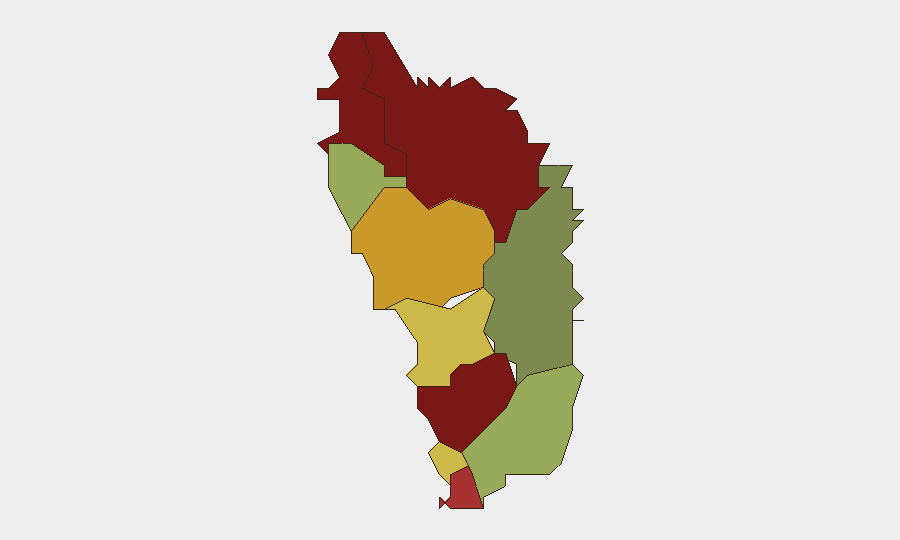
Saint Andrew, Saint John, and Saint George parishes carry the highest composite risk scores (92, 88, and 81 respectively), likely reflecting patterns of property crime, gang-related activity, and socioeconomic factors documented over preceding months rather than acute current incidents. These three parishes account for the majority of sub-national threat concentration and should be prioritized for AOI monitoring and movement-planning protocols by security teams with personnel or assets in those zones. Saint Andrew Parish in particular merits ongoing vigilance for organized crime signals and routine crime trends. Lower-risk parishes (Saint David, Saint Patrick) present correspondingly reduced exposure and permit more flexible security posturing.
How GeoBit Would Assist
Security teams should deploy AOI Monitoring & Early Warning capabilities on Saint Andrew, Saint John, and Saint George parishes to detect emerging civil unrest, crime clusters, or political events in near real time. OSINT Fusion & Corroboration (X/Twitter, Telegram, local news aggregation, multi-language search) will provide continuous day-to-day situational awareness and rapid alert on new incidents, travel disruptions, or policy changes. Routing & Network Analysis can support movement planning and alternative-route identification for personnel operating in higher-risk parishes, reducing exposure during routine operations.
7-Day Outlook
No significant security escalation is anticipated over the next seven days based on current event signals and regional stability. Continued monitoring of sub-national risk hotspots and routine seismic data is recommended as standard practice. Security teams should maintain standard protocols for higher-risk parishes while operating with confidence in the overall stable environment for the near term.
Highest-Risk Areas — Ranked
| # | State / Region | Risk |
|---|---|---|
| 1 | Saint Andrew Parish | 92 |
| 2 | Saint John Parish | 88 |
| 3 | Saint George Parish | 81 |
| 4 | Saint Mark Parish | 78 |
| 5 | Saint Joseph Parish | 72 |
| 6 | Saint Paul Parish | 68 |
| 7 | Saint Luke Parish | 62 |
| 8 | Saint Peter Parish | 55 |
| 9 | Saint Patrick Parish | 48 |
| 10 | Saint David Parish | 35 |
Sources
Previous Daily Briefs
A new Dominica brief is written every day — each with its own risk map and downloadable CSV. Here's the last week; use the calendar to go further back.
📅 Browse every day by calendar →
Highlighted days have a brief. Tap a day for that day's map & analysis, or “csv” for that day's dataset ($5).