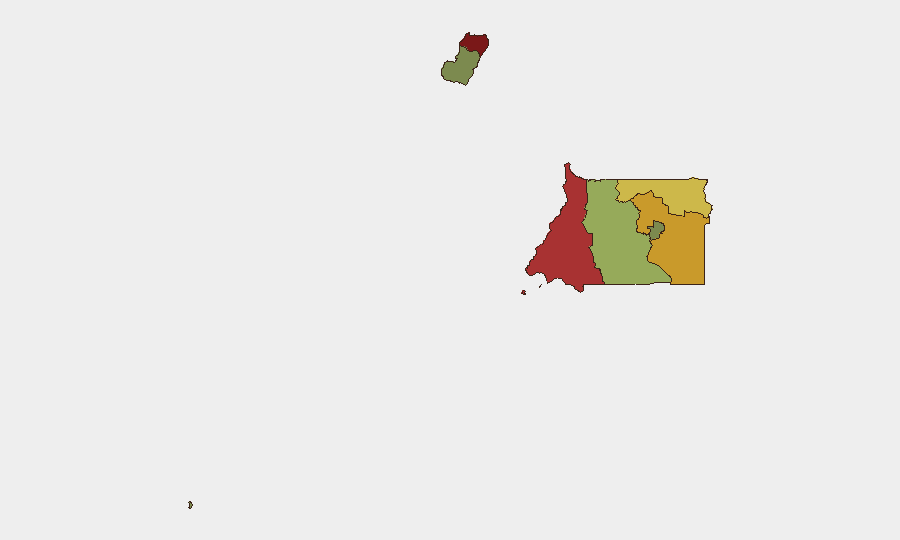
Situation Summary
Equatorial Guinea remains a low-threat environment globally (rank #182, composite score 2) with no confirmed security incidents, violence, civil unrest, or infrastructure disruptions documented in open sources during the last 24–48 hours. Sub-national risk is concentrated in three northern provinces—Bioko Norte, Litoral, and Wele-Nzas—where composite threat scores range from 72 to 85, reflecting persistent underlying vulnerabilities in crime, political stability, and institutional capacity. The country's security posture has not materially changed in the immediate reporting window, though baseline risks in the northern regions warrant continued monitoring by organizations with personnel or assets there.
Key Developments
No security, conflict, civil-unrest, crime, or infrastructure incidents meeting confirmation criteria (multiple independent sources, specifically dated within 24–48 hours) have been identified in Equatorial Guinea during 2026-06-15 to 2026-06-16. Web research, social-media OSINT, and major news feeds surface no fresh reports of violence, protests, arrests with security implications, military movements, or travel disruptions in the reporting window. Background activity (Russian military presence, bilateral cooperation agreements with regional partners, and the president's recent state visit to Zimbabwe) remains publicly visible but does not constitute new security events. Older incidents and longstanding institutional challenges are documented in baseline risk assessments but fall outside the current 24–48-hour window.
Highest-Risk Areas
Bioko Norte (risk 85) and Litoral Province (risk 78) together account for the majority of documented sub-national risk, driven by crime prevalence, weak law-enforcement capacity, and port/maritime vulnerabilities. Wele-Nzas Province (risk 72) in the southeast presents similar concerns, including border-security challenges and limited state authority. These three provinces should be the focus of duty-of-care monitoring for corporate personnel; Bioko Sur, Centro Sur, and the capital region (Djibloho, risk 15) present substantially lower threat profiles. Organizations operating in Bioko Norte or the Litoral should maintain heightened awareness of street crime, petty theft, and occasional civil-administration disruptions, though no acute crisis is evident.
How GeoBit Would Assist
Organizations with operations in Equatorial Guinea should deploy GeoBit's AOI Monitoring & Early Warning system to track the highest-risk provinces—particularly Bioko Norte and Litoral—with persistent alerts on security incidents, public statements by officials, and crowd-movement patterns. OSINT Fusion & Corroboration across social media, news feeds, and Telegram channels will provide real-time confirmation of any emerging threats, avoiding reliance on single-source or delayed reporting. Routing & Network Analysis can support alternative-route planning and journey risk assessment for personnel movements within the country, especially in or between high-risk provinces.
7-Day Outlook
No imminent escalation or deterioration is forecast for the next seven days; Equatorial Guinea's threat environment is expected to remain stable and low-intensity. Baseline risks in northern provinces will persist; corporate security teams should maintain standard duty-of-care protocols (personnel tracking, incident reporting, liaison with local authorities) rather than increase alert status. Continued monitoring of political statements and police activity in Bioko Norte and Litoral is recommended as a precautionary measure.
Highest-Risk Areas — Ranked
| # | State / Region | Risk |
|---|---|---|
| 1 | Bioko Norte | 85 |
| 2 | Litoral Province | 78 |
| 3 | Wele-Nzas Province | 72 |
| 4 | Kié-Ntem Province | 68 |
| 5 | Centro Sur Province | 45 |
| 6 | Bioko Sur | 38 |
| 7 | Djibloho | 15 |
| 8 | Annobón Province | 8 |
Sources
Previous Daily Briefs
A new Equatorial Guinea brief is written every day — each with its own risk map and downloadable CSV. Here's the last week; use the calendar to go further back.
📅 Browse every day by calendar →
Highlighted days have a brief. Tap a day for that day's map & analysis, or “csv” for that day's dataset ($5).