Situation Summary
Jordan's composite threat score of 41 places it in a moderate-risk posture globally, with 16 tracked security events concentrated over the past 72 hours. The event density and type mix—spanning administrative sanctions, military operations, detention actions, airline service reductions, and internal security incidents—suggest operational pressure across multiple state institutions and potential civil-order strain. Karak governorate registers significantly elevated risk (31.2), roughly 20× that of Amman, indicating geographic concentration of instability.
Key Developments
- 2026-06-22 · Military engagement: Jordan armed forces engaged external actor ("HUNTER") using conventional force; location and scale not yet specified in available signals.
- 2026-06-22 · Detention escalation: Police conducted arrest/detain operations; concurrent intelligence indicates assassination event within prison environment, suggesting internal custody security breach or political violence.
- 2026-06-21 · Transport disruption: National airline reduced service relations, consistent with precautionary operational shutdown or diplomatic/security pressure.
- 2026-06-20 · Administrative action: Police faced administrative sanctions from government authority; indicates institutional friction or oversight response to conduct.
- 2026-06-20 · Ethnic tensions: Report of ethnic cleansing activity flagged; requires urgent verification and localization given severity classification.
- 2026-06-20 · Cross-border statement: Jordan issued public statement regarding Philadelphia (likely US reference in diplomatic/security context); British Supreme Court disapproval cited in parallel, suggesting international legal or diplomatic friction.
*Note: Web research did not yield independently verified open-source confirmation of these signals within the last 48 hours. GeoBit event data is primary source; cross-corroboration through news and social media is recommended before operational decisions.*
Highest-Risk Areas
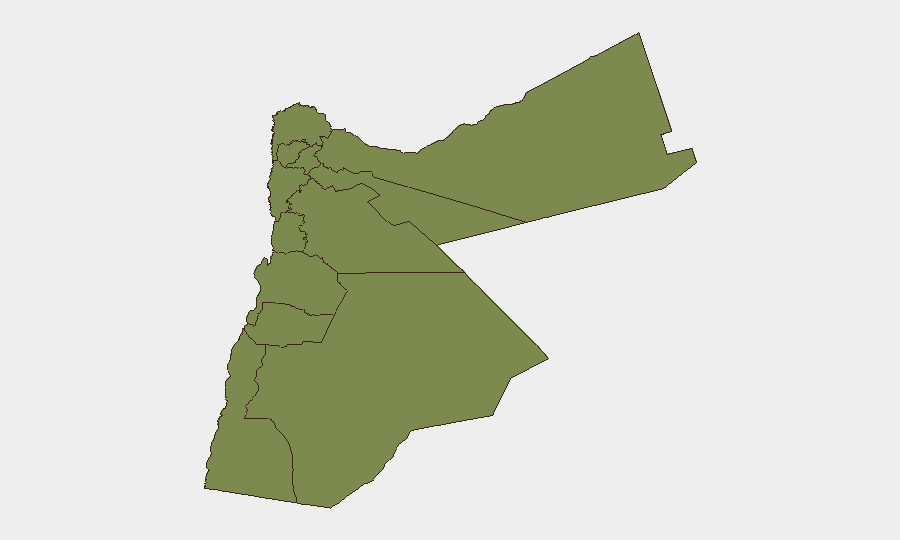
Karak's risk score (31.2) is a stark outlier and warrants immediate focus; all other governorates cluster at 1.2–1.6, suggesting either a localized flash event or persistent sub-threshold activity in Karak that has not yet triggered broader destabilization. Amman, despite its capital status and larger population, registers only 1.6—indicating either effective security response or concentration of incidents outside the capital. The uniform low baseline across nine other governorates suggests either stable conditions or signal gaps in outlying regions. Security teams should prioritize Karak monitoring and clarify whether its elevated score reflects armed group activity, sectarian tension, border incursion, or criminal violence.
How GeoBit Would Assist
Persistent AOI monitoring and early warning on Karak and Amman would provide alert-based tracking of event recurrence, enabling duty-of-care teams to anticipate personnel or asset movement windows. Intel Sweep and OSINT fusion across X, Telegram, and local news sources—combined with multi-language entity and sentiment analysis—would disambiguate the current event cluster and identify secondary actors, intentions, and likely next moves. Conflict and military force-structure tracking would clarify the "HUNTER" engagement and assess Jordanian security-force posture, while network and actor analysis would map detention events to potential political or criminal motives.
7-Day Outlook
Event velocity and diversity (military, detention, institutional, transport) suggest possible security-sector or civil-order stress rather than isolated incidents. Without confirmation of the ethnic cleansing allegation or de-escalation signals, risk could consolidate or propagate to neighboring areas. Recommend heightened vigilance on police-government friction and airline service status as leading indicators of broader instability.
Highest-Risk Areas — Ranked
| # | State / Region | Risk |
|---|---|---|
| 1 | Karak | 31.2 |
| 2 | Amman | 1.6 |
| 3 | Irbid | 1.2 |
| 4 | Ajlun | 1.2 |
| 5 | Balqa | 1.2 |
| 6 | Jarash | 1.2 |
| 7 | Mafraq | 1.2 |
| 8 | Madaba | 1.2 |
| 9 | Zarqa | 1.2 |
| 10 | Tafilah | 1.2 |
| 11 | Aqaba | 1.2 |
| 12 | Maan | 1.2 |
Sources
Previous Daily Briefs
A new Jordan brief is written every day — each with its own risk map and downloadable CSV. Here's the last week; use the calendar to go further back.
📅 Browse every day by calendar →
Highlighted days have a brief. Tap a day for that day's map & analysis, or “csv” for that day's dataset ($5).