Situation Summary
Latvia remains at low acute risk with no armed conflict, civil unrest, or major infrastructure failure reported in the past 24–48 hours. However, ongoing hybrid-threat concerns—particularly at critical energy infrastructure and along the Belarus border—combined with routine corruption investigations and residual storm damage in the east, sustain elevated baseline vigilance. The security posture is stable but operationally active.
Key Developments
- Latvia–Belarus border (multiple crossing points), eastern Latvia – 22 July 2026: Latvian State Border Guard and National Armed Forces dispersed an aggressive group of approximately five migrants attempting illegal entry from Belarus using tear gas and a warning shot; individuals retreated into Belarusian territory. No casualties reported.
- Bauska Hospital, Zemgale region – 22 July 2026: The Corruption Prevention and Combating Bureau (KNAB) and European Public Prosecutor's Office executed searches related to suspected public procurement irregularities, signaling potential financial exposure and operational scrutiny affecting hospital contracting and reputation.
- Jelgava City Hospital, Zemgale region – 22 July 2026: KNAB and EPPO raids continued in connection with the same procurement-corruption investigation, indicating broader institutional exposure across healthcare infrastructure.
- Incukalns underground gas storage facility and hydroelectric infrastructure upstream of Riga – operationally current as of 24–48h window: Enhanced security measures remain in place due to mid-July intelligence on potential Russian hybrid threats; access controls and guarding remain tightened with no reported incidents.
- Latvian airspace – ongoing: Russian-operated or Russian-documented aircraft continue to be banned from Latvian airspace, with only narrow humanitarian exemptions; aviation operations otherwise unaffected.
- Eastern Latvia – residual infrastructure impact: Severe thunderstorms in recent days caused localized power outages and road disruptions; repair work ongoing with minor travel and electricity risks persisting in the current period.
Highest-Risk Areas
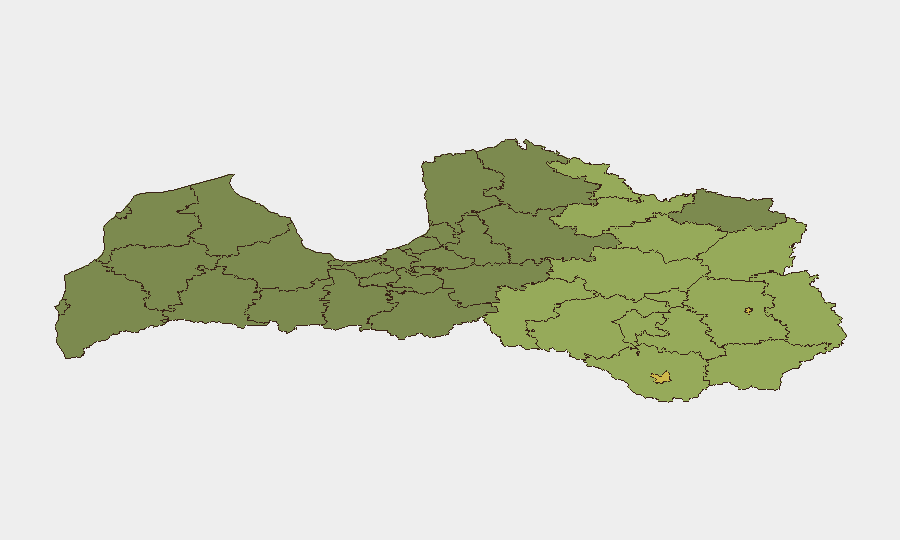
Rēzekne (risk 68) and Daugavpils (risk 65) dominate the sub-national ranking, reflecting their proximity to the Belarus border and historical vulnerability to hybrid threats, irregular migration, and cross-border crime. The top five municipalities (Rēzekne, Daugavpils, Rēzeknes novads, Ludzas novads, Balvu novads) are all concentrated in eastern and southeastern Latvia, where Belarus border exposure, infrastructure criticality, and limited emergency-response redundancy amplify institutional and personnel risk. Westward risk drops sharply, with Aizkraukles novads (rank 10, risk 45) marking the edge of elevated concern.
How GeoBit Would Assist
Security teams protecting assets and personnel in Latvia should deploy AOI Monitoring & Early Warning on the Belarus border corridor and energy-infrastructure nodes (Incukalns, hydroelectric facilities) to detect anomalies in activity patterns, vehicle/personnel movement, or intelligence signals in real time. OSINT Fusion & Corroboration across social media, official statements, and signals intelligence would provide continuous tracking of migration pressure, corruption investigations affecting supply chains or vendors, and hybrid-threat indicators. Routing & Network Analysis enables dynamic alternative-route planning for staff and logistics movements in the event of border incidents or infrastructure disruption, while Satellite & Imagery Analysis supports damage assessment and infrastructure resilience planning in storm-affected regions.
7-Day Outlook
No major escalation is anticipated; border-crossing attempts and corruption investigations are likely to continue at present levels. Residual storm damage repairs should largely clear by early week, reducing minor travel risk. Heightened energy-infrastructure security posture will persist as long as hybrid-threat intelligence remains current.
Highest-Risk Areas — Ranked
| # | State / Region | Risk |
|---|---|---|
| 1 | Rēzekne | 68 |
| 2 | Daugavpils | 65 |
| 3 | Rēzeknes novads | 58 |
| 4 | Ludzas novads | 55 |
| 5 | Balvu novads | 52 |
| 6 | Preiļu novads | 50 |
| 7 | Krāslavas novads | 48 |
| 8 | Jēkabpils novads | 47 |
| 9 | Augšdaugavas novads | 46 |
| 10 | Aizkraukles novads | 45 |
| 11 | Varakļānu novads | 44 |
| 12 | Līvānu novads | 43 |
Sources
Previous Daily Briefs
A new Latvia brief is written every day — each with its own risk map and downloadable CSV. Here's the last week; use the calendar to go further back.
📅 Browse every day by calendar →
Highlighted days have a brief. Tap a day for that day's map & analysis, or “csv” for that day's dataset ($5).
Atlas — our AI intelligence desk — emails them this snapshot personally. Nothing else, no list.