Situation Summary
Lesotho remains in a period of relative calm with no significant security incidents reported in the last 24–48 hours. Routine political and commercial activities are proceeding normally, including corporate events in Maseru and preparations for regional diplomatic engagement at the upcoming SADC Summit. The country's composite threat score of 8 reflects persistent baseline risks—primarily urban crime, informal-sector instability, and border management challenges—rather than acute escalation or imminent state-level breakdown.
Key Developments
No discrete security or civil-unrest incidents meeting corroboration standards were identified in Lesotho during the 24–48 hour window ending 24 June 2026. Open-source reporting (news, government channels, and public social media) indicates continued normal business operations in Maseru, including a corporate innovation event on 23 June. Political activity is focused on forward-looking reform discussions rather than crisis management. Absence of reported unrest does not indicate zero risk; rather, no acute triggering event has surfaced in monitored channels.
Highest-Risk Areas
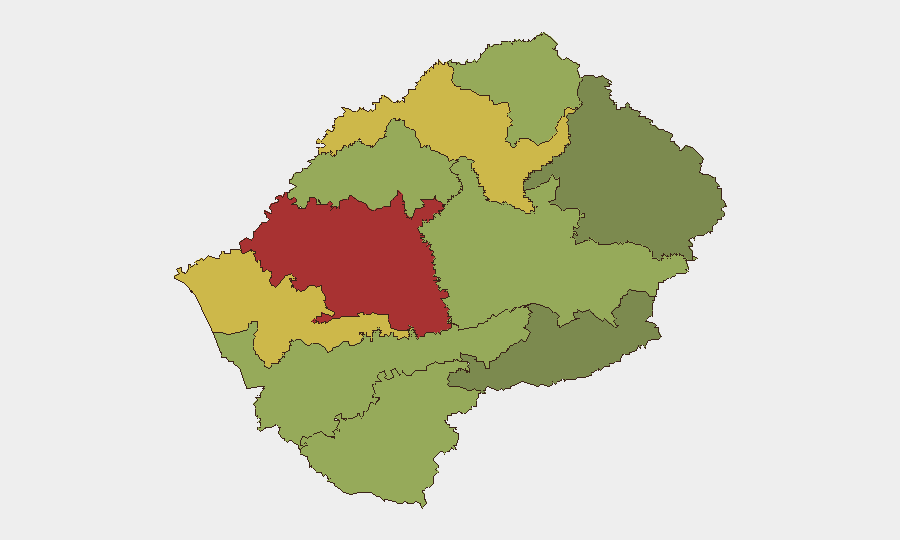
Maseru District (risk 78) and Mafeteng District (risk 65) drive the country's overall threat ranking, reflecting concentrated urban crime, informal settlement vulnerabilities, and economic precarity in and around the capital and its secondary urban zones. Leribe, Berea, and Mohale's Hoek districts round out the top five, where similar pressures—unemployment, gang activity, and limited state presence—compound baseline instability. The southern and eastern districts (Qacha's Nek, Mokhotlong) register lower composite scores, likely due to smaller populations, geographic remoteness, and reduced reporting density. Risk in all zones remains endemic rather than crisis-level; escalation typically stems from political factional violence, labor unrest, or localized criminal turf conflict rather than organized insurgency.
How GeoBit Would Assist
Security teams with personnel or assets in Lesotho should deploy AOI Monitoring & Early Warning on Maseru and Mafeteng districts to detect emerging unrest, labor actions, or criminal activity spikes in real time. Multi-language OSINT (web, social media, and radio SIGINT) combined with sentiment and temporal analysis will flag rhetoric shifts, protest announcements, and community grievance escalation before physical incidents occur. Routing & Network Analysis enables rapid alternative-route planning if primary corridors or border crossings become congested or unsafe. Regular Intel Sweeps and fusion of open event feeds will maintain near-term early warning of political or labor-related disruptions.
7-Day Outlook
No imminent security trigger is evident in the current reporting window. The SADC Summit discussions and domestic reform roadmap discussions are unlikely to produce acute instability in the next week, though factional or labor tensions occasionally surface with limited notice. Routine crime and informal-sector volatility in Maseru and Mafeteng districts will remain the primary exposure for corporate personnel; contingency planning for short-notice mobility restrictions is prudent.
Highest-Risk Areas — Ranked
| # | State / Region | Risk |
|---|---|---|
| 1 | Maseru District | 78 |
| 2 | Mafeteng District | 65 |
| 3 | Leribe District | 62 |
| 4 | Berea District | 58 |
| 5 | Mohale's Hoek District | 52 |
| 6 | Butha-Buthe District | 48 |
| 7 | Thaba-Tseka District | 45 |
| 8 | Quthing District | 42 |
| 9 | Mokhotlong District | 38 |
| 10 | Qacha's Nek District | 28 |
Previous Daily Briefs
A new Lesotho brief is written every day — each with its own risk map and downloadable CSV. Here's the last week; use the calendar to go further back.
📅 Browse every day by calendar →
Highlighted days have a brief. Tap a day for that day's map & analysis, or “csv” for that day's dataset ($5).