Situation Summary
Malta remains a low-threat jurisdiction (global rank #177, composite score 4), with no tracked discrete security events in the current window. However, the last 24–48 hours have revealed heightened law-enforcement activity concentrated in high-risk urban zones—particularly St Julian's and Valletta—spanning diplomatic investigation, targeted police operations, and enhanced public-order enforcement. The trajectory indicates tightening internal security measures rather than emerging civil instability or travel-critical incidents.
Key Developments
- Valletta – Police investigation of ambassador (10–11 July 2026). Malta Police and Ministry of Foreign Affairs are investigating Ambassador Frank Aquilina over alleged harassment of a Libyan embassy employee; reports indicate 48-hour detention on arrival in Malta, release on bail, and daily reporting conditions, with no formal charges filed. Reflects diplomatic and internal government tension but carries no direct public safety implication for expatriate or corporate presence.
- Paceville, St Julian's – Government security initiative (10–11 July 2026). Prime Minister Robert Abela, Home Affairs Minister Glenn Bedingfield, and Police Commissioner Angelo Gafà visited a newly established dedicated police squad for the nightlife district, signaling heightened enforcement in a historically high-risk entertainment zone. No specific incident triggered the visit; positioning is preventative.
- Nationwide – First on-the-spot fines issued (11 July, 04:00). Home Affairs Minister announced the first enforcement action under new on-the-spot fine rules for public-order and minor offences, indicating tightened administrative enforcement capacity. Travelers should expect more rigorous compliance checks on alcohol, traffic, and disorder violations.
- Triq Luigi Apap, St Julian's – Targeted police search operation (within 24–48 hours). Residents reported police presence and search in an apartment block, apparently targeting a specific individual; operation concluded quickly, suggesting a localized or mistaken-address case rather than broad area sweep. No charges or formal incident report publicly disclosed.
- St Julian's residential block – Resident reports of violent/disruptive incident (within 24–48 hours). Residents described fear during a recent incident involving Maltese nationals and an Italian victim, with commentary noting broken Italian spoken during the event. Details remain sparse in official reporting; signals localized interpersonal or organized-crime-related activity rather than random tourist violence.
Highest-Risk Areas
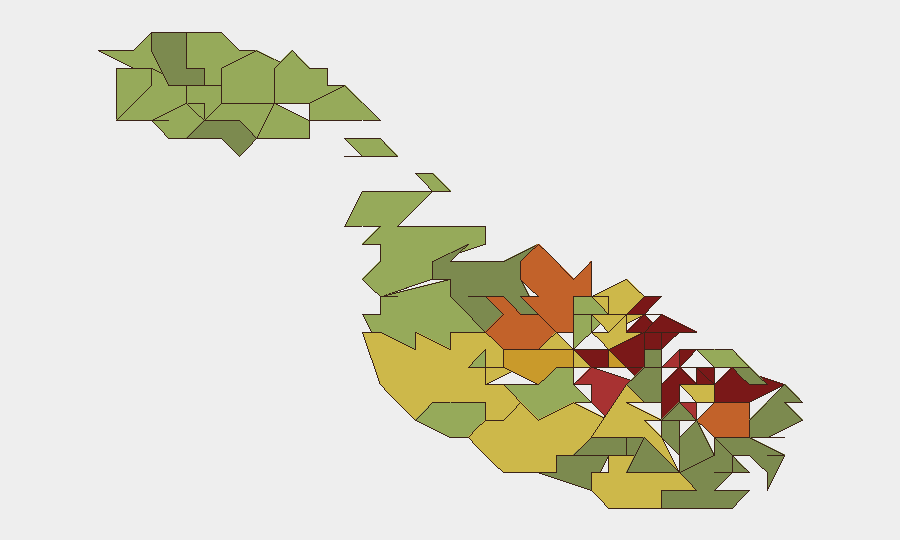
Valletta (95), Sliema (92), and St Julian's (90) dominate the sub-national ranking, reflecting concentration of commercial, diplomatic, nightlife, and residential activity in a compact urban corridor. St Julian's and Paceville carry elevated risk tied to alcohol-fueled disorder, petty crime, and recent targeted law-enforcement operations; Valletta risk is amplified by diplomatic presence and ongoing investigation activity. These three zones account for the majority of security footprint for corporate and expatriate operations in Malta and warrant proportionate duty-of-care monitoring.
How GeoBit Would Assist
Intel Sweep and OSINT fusion would provide continuous multi-language monitoring of Maltese social media, police announcements, and local news to detect early indicators of emerging unrest, enforcement escalation, or diplomatic friction before they reach international press. AOI Monitoring & Early Warning on Valletta (diplomatic quarter), St Julian's (business/nightlife), and Sliema (residential/commercial) would enable persistent watch for crowd activity, police deployments, or public gatherings with automated alerting on threshold changes. Network & Actor Analysis applied to recent policing and investigation narratives would clarify operational intent and scope, reducing uncertainty around ambassador case and localized incidents.
7-Day Outlook
Enforcement intensity is likely to remain elevated across urban zones, particularly Paceville and Valletta, as government consolidates new on-the-spot-fine and police-squad initiatives. The ambassador investigation will continue administratively with minimal public disruption. No indicators of mass protest, political unrest, or travel-critical infrastructure disruption are evident in current signal; risk profile remains consistent with historical baseline for Malta.
Highest-Risk Areas — Ranked
| # | State / Region | Risk |
|---|---|---|
| 1 | Valletta | 95 |
| 2 | Sliema | 92 |
| 3 | Saint Julian's | 90 |
| 4 | Gżira | 88 |
| 5 | Hamrun | 87 |
| 6 | Paola | 86 |
| 7 | Msida | 85 |
| 8 | Birkirkara | 84 |
| 9 | Birgu | 83 |
| 10 | Senglea | 82 |
| 11 | Cospicua | 81 |
| 12 | Żabbar | 80 |
Sources
Previous Daily Briefs
A new Malta brief is written every day — each with its own risk map and downloadable CSV. Here's the last week; use the calendar to go further back.
📅 Browse every day by calendar →
Highlighted days have a brief. Tap a day for that day's map & analysis, or “csv” for that day's dataset ($5).
Atlas — our AI intelligence desk — emails them this snapshot personally. Nothing else, no list.