Situation Summary
Mexico remains the 15th highest-threat country globally, driven primarily by sustained criminal conflict across organized crime networks competing for territory and trafficking routes. The composite threat score of 80.6 reflects 973 tracked events, with volatility concentrated in northern and central states. Political friction—evidenced by June 7 signals involving presidential rejection, legislative–media tension, and judicial targeting—compounds criminal-sector instability. The operational security environment is characterized by fragmented cartel control, inconsistent state capacity, and periodic episodes of institutional strain.
Key Developments
Judicial Targeting (Tijuana, 2026-06-07): An assassination event targeting a judge in Tijuana underscores continued cartel pressure on the judicial system in Baja California, a state ranked #3 in sub-national risk. Judicial killings typically signal either territorial consolidation by criminal groups or retaliation against prosecution efforts.
Presidential and Legislative Friction (National, 2026-06-07): Multiple concurrent signals—presidential rejection, chamber–media disputes, and government–lawyer tensions—suggest elevated institutional friction. These political signals, while not directly criminal, can delay or fragment security responses and create windows of organizational confusion exploitable by criminal actors.
Airline Operational Response (2026-06-07): A commercial airline's relation reduction signals either route suspension, capacity cut, or insurance/operational response to a security incident. This typically follows a specific threat event (criminal activity at an airport or on a route) and warrants monitoring of which routes/airports are affected.
Media Repression Report (2026-06-07): A violent repression event involving a governor and journalist indicates either a protest or investigative reporting episode. Given Mexico's history of cartel–government collusion affecting media, this merits tracking for potential judicial corruption or organized crime interference in information flows.
Activist–Tourist Interaction (2026-06-07): A public statement incident between activist and tourist networks suggests either a tourism-sector disruption (common in high-crime areas) or protest activity affecting visitor safety. Tourism-linked incidents are early indicators of localized territorial instability.
Criminal–State Relations Shift (National, 2026-06-07): A "reduce relations" signal between Mexico (presumably state authorities) and criminal actors may reflect either a crackdown announcement, extradition, or public denunciation. Such signals often precede enforcement escalation and corresponding cartel retaliation.
Highest-Risk Areas
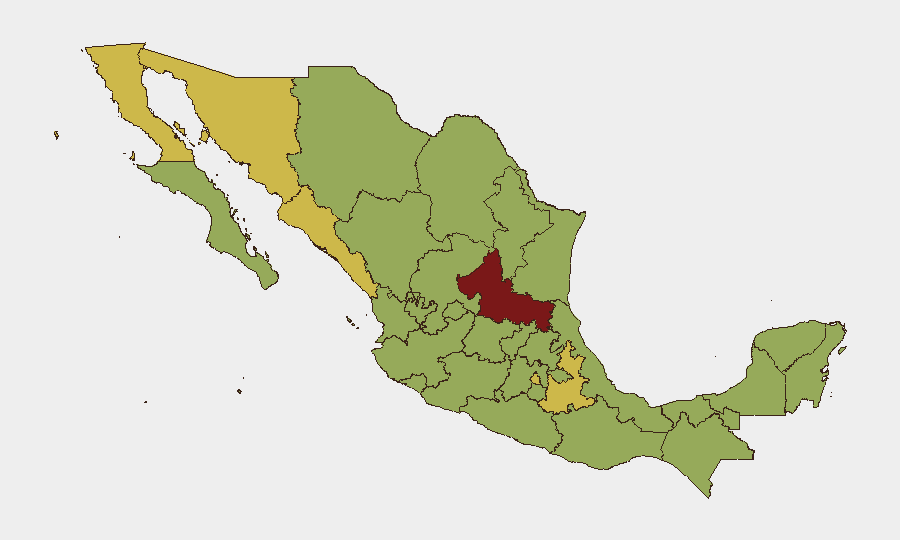
San Luis Potosí (86.4), Mexico City (67), and Baja California (66.6) form the tier-one risk zone. San Luis Potosí's ranking reflects sustained turf battles among trafficking organizations; Mexico City's score reflects both cartel presence and political volatility in the capital; Baja California combines cartel violence, judicial targeting, and cross-border trafficking pressure. Sinaloa, Puebla, and Sonora (65.1–61.8) represent a secondary cluster of high criminal conflict. The northern corridor (Chihuahua, Nuevo León, Sonora) and central axis (Hidalgo, Puebla, Mexico City) remain the primary geographic drivers of national threat score elevation.
How GeoBit Would Assist
Security teams operating in Mexico should deploy AOI (Area-of-Interest) Monitoring & Early Warning on their facility locations and travel corridors, with alerting configured for criminal events, judicial incidents, and road closures. Intel Sweep and OSINT fusion (X/Telegram feeds, local media blotters, regional security accounts) would provide 24–48-hour incident detection in highest-risk states. Routing & Network Analysis and satellite/imagery monitoring of key infrastructure (airports, highways, borders) enable duty-of-care teams to adapt travel and supply-chain decisions in real time.
7-Day Outlook
Criminal conflict intensity is expected to persist or modestly increase, particularly in San Luis Potosí and Baja California, as cartel territorial adjustments typically follow judicial interventions or enforcement announcements. Political friction signals warrant monitoring for coordination failures between state and federal security agencies. No significant de-escalation is anticipated in the near term.
Highest-Risk Areas — Ranked
| # | State / Region | Risk |
|---|---|---|
| 1 | San Luis Potosí | 86.4 |
| 2 | Mexico City | 67 |
| 3 | Baja California | 66.6 |
| 4 | Sinaloa | 65.1 |
| 5 | Puebla | 64.7 |
| 6 | Sonora | 61.8 |
| 7 | Nuevo León | 59.7 |
| 8 | Tabasco | 59.7 |
| 9 | Veracruz | 59.3 |
| 10 | Chihuahua | 59.1 |
| 11 | Hidalgo | 59.1 |
| 12 | Chiapas | 58.9 |
Previous Daily Briefs
A new Mexico brief is written every day — each with its own risk map and downloadable CSV. Here's the last week; use the calendar to go further back.
📅 Browse every day by calendar →
Highlighted days have a brief. Tap a day for that day's map & analysis, or “csv” for that day's dataset ($5).