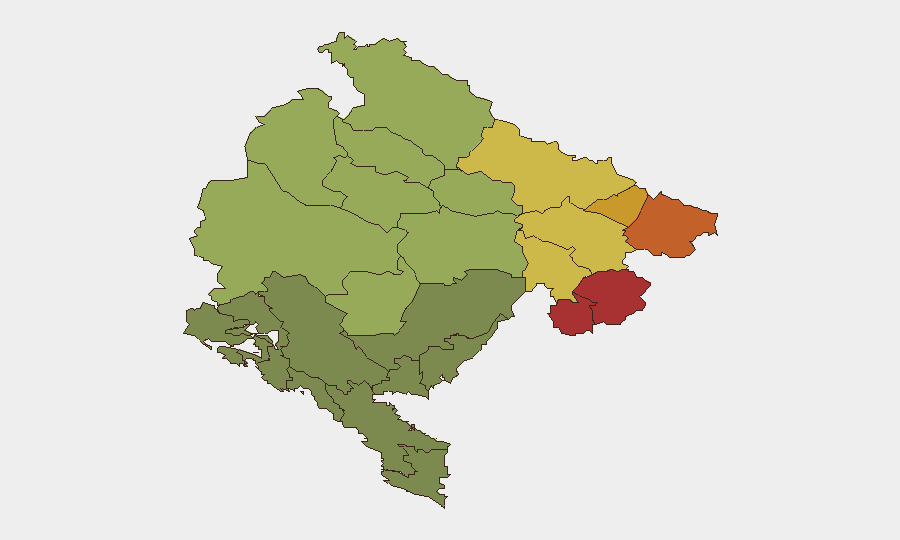
Situation Summary
Montenegro remains a low-threat environment globally (rank #119, composite score 2) with no confirmed security incidents or civil unrest reported in the last 24–48 hours. The country's security posture is stable, though significant sub-national risk concentration persists in the northeastern municipalities bordering Serbia and Kosovo. No developments suggest imminent escalation or changes to the overall risk trajectory.
Key Developments
No discrete security, conflict, civil-unrest, crime, or infrastructure incidents were confirmed in Montenegro during the last 24–48 hours. Web research and event feeds returned no current reportage of attacks, protests, accidents, or policy changes affecting duty-of-care risk. Routine labor and industry updates unrelated to security were noted but do not constitute operational developments for corporate teams.
Highest-Risk Areas
Risk is heavily concentrated in Montenegro's northeastern municipalities, with Plav, Gusinje, Rožaje, Petnjica, and Andrijevica forming a high-risk arc (composite scores 68–78). These areas share proximity to Serbia and Kosovo, historical trafficking corridors, and documented organized-crime and smuggling networks. Bijelo Polje, Berane, and Plužine extend this risk footprint into central-northern regions. By contrast, southern and coastal municipalities (Kolašin, Žabljak, Šavnik) show markedly lower risk profiles, as do major urban centers. Corporate operations in the northeast should apply heightened due diligence; southern and central areas support routine security posture.
How GeoBit Would Assist
Intel Sweep & OSINT Fusion would monitor cross-border activity, trafficking networks, and organized-crime signals across the Serbian and Kosovo borderlands in real time, corroborating multiple feeds to detect emerging incidents before broader reporting. AOI Monitoring & Early Warning with persistent watch on high-risk municipalities (Plav, Gusinje, Rožaje) would generate automated alerts for violence, protests, or infrastructure disruption affecting asset security and personnel safety. Routing & Network Analysis would identify safer transit corridors and alternative supply-chain pathways around northeastern hotspots, supporting travel risk mitigation and logistics continuity for teams on the ground.
7-Day Outlook
No imminent threat escalation is indicated; Montenegro's near-term security trajectory remains stable. Northeastern municipalities will continue to warrant elevated monitoring due to endemic organized-crime and cross-border smuggling activity, but no acute trigger for policy change, conflict, or major incident is present. Routine monitoring protocols should remain in place.
Next Steps:
For teams with operations in Plav, Gusinje, or Rožaje municipalities, consider requesting a targeted 72-hour Balkan regional risk scan or persistent AOI monitoring on key facilities. GeoBit's Intel Sweep can establish baseline cross-border threat intelligence specific to your asset footprint.
Highest-Risk Areas — Ranked
| # | State / Region | Risk |
|---|---|---|
| 1 | Plav Municipality | 78 |
| 2 | Gusinje Municipality | 76 |
| 3 | Rožaje Municipality | 74 |
| 4 | Petnjica Municipality | 72 |
| 5 | Andrijevica Municipality | 68 |
| 6 | Bijelo Polje Municipality | 65 |
| 7 | Berane Municipality | 62 |
| 8 | Plužine Municipality | 58 |
| 9 | Pljevlja Municipality | 55 |
| 10 | Šavnik Municipality | 52 |
| 11 | Žabljak Municipality | 50 |
| 12 | Kolašin Municipality | 48 |
Previous Daily Briefs
A new Montenegro brief is written every day — each with its own risk map and downloadable CSV. Here's the last week; use the calendar to go further back.
📅 Browse every day by calendar →
Highlighted days have a brief. Tap a day for that day's map & analysis, or “csv” for that day's dataset ($5).