Situation Summary
Montenegro remains a stable, low-threat environment (global rank #105) with no tracked security incidents in the reporting week. The country's composite threat score of 18 reflects primarily localized organized-crime and cross-border smuggling activity concentrated in the northern municipalities, coupled with ongoing political friction with Croatia over EU accession and unresolved historical disputes. The detention of Russian pro-war Telegram operator Mikhail Zvinchuk on 9 October and parallel arrests of two security-sector trade union leaders (10 October) signal active law-enforcement responses to foreign influence and internal security-sector corruption, but do not materially elevate the national risk profile.
Key Developments
- Podgorica, 20 October: Opposition Democratic People's Party leader Milan Knežević called for an "uprising" in parliament, accusing the government of surrendering sovereignty to Croatia in EU negotiations; Croatian Prime Minister Andrej Plenković responded publicly, escalating political rhetoric but not indicating imminent institutional instability.
- Montenegro–Croatia border / EU accession track, 14–20 October: Croatia circulated an eight-point demands document to EU member states, pressuring Montenegro on war-crimes prosecution, fundamental rights, foreign policy alignment, and security commitments; unresolved border and wartime detention-camp accountability issues remain formal obstacles to accession.
- Kotor, 14–20 October: Parliament reportedly approved renaming a municipal swimming pool amid Croatian–Montenegrin cultural and political disputes tied to EU accession; claims remain partially unconfirmed and reflect low-level political symbolism rather than security risk.
- Northern Montenegro, 18–19 October (night): Police executed intensified "Raiding," "Mini Blockade," and "Tracker" operations across 382 person-checks and 288 vehicle inspections, resulting in two arrests and seizure of a Mercedes, Renault, knife, pepper spray, and metal baton; operations target ongoing organized-crime and smuggling networks.
- Budva, 20 October: Fires damaged an ATM and supermarket warehouse; municipal firefighters contained both incidents; initial reporting attributed damage to faulty electrical installations with no security implications.
- Montenegro-wide roads, 14–16 October: Traffic police deployed enhanced automated radar enforcement, fining over 200 drivers for speeding across two days; routine enforcement activity.
Highest-Risk Areas
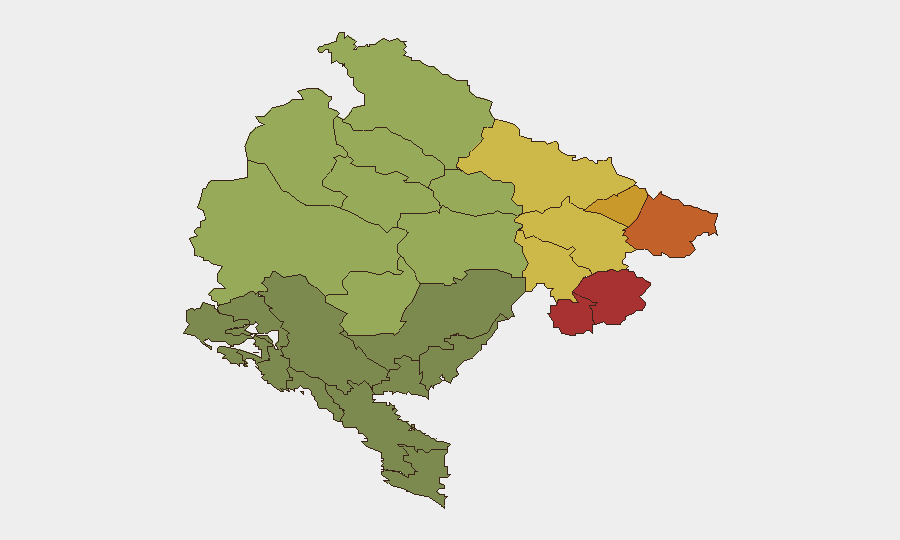
The top five municipalities—Plav (78), Gusinje (76), Rožaje (74), Petnjica (72), and Andrijevica (68)—all lie in northern Montenegro along the Kosovo and Serbia borders and account for the majority of the country's residual threat. These areas are endemic to cross-border smuggling (narcotics, weapons, contraband), organized-crime activity, and historical clan-based feuding. Risk scores decline progressively southward and westward; the Adriatic coastal municipalities (Budva, Kotor, Tivat) and central regions carry minimal threat. Organizations operating in or transiting the north should maintain heightened awareness of smuggling checkpoints, police operations, and informal dispute-resolution dynamics.
How GeoBit Would Assist
Security teams should deploy AOI Monitoring & Early Warning on the five highest-risk northern municipalities to track intensified police operations, border-crossing activity, and violence indicators. Network & Actor Analysis paired with OSINT fusion (X, Telegram, local reporting) can identify organized-crime and foreign-influence actors operating within Montenegro's security sector—particularly relevant given recent trade-union arrests. Routing & Network Analysis enables duty-of-care teams to plan alternative routes for personnel transiting northern regions during police crackdowns or cross-border tensions.
7-Day Outlook
Political rhetoric around EU accession will likely remain elevated as Croatia's demands remain unresolved and domestic opposition voices complaints of concessions. Northern police operations are expected to continue at current intensity. No imminent escalation to national-level instability is indicated; risk remains regionally concentrated in the north and politically contained in Podgorica.
Highest-Risk Areas — Ranked
| # | State / Region | Risk |
|---|---|---|
| 1 | Plav Municipality | 78 |
| 2 | Gusinje Municipality | 76 |
| 3 | Rožaje Municipality | 74 |
| 4 | Petnjica Municipality | 72 |
| 5 | Andrijevica Municipality | 68 |
| 6 | Bijelo Polje Municipality | 65 |
| 7 | Berane Municipality | 62 |
| 8 | Plužine Municipality | 58 |
| 9 | Pljevlja Municipality | 55 |
| 10 | Šavnik Municipality | 52 |
| 11 | Žabljak Municipality | 50 |
| 12 | Kolašin Municipality | 48 |
Sources
Previous Weekly Briefs
A new Montenegro brief is written every Monday, covering the week — each with its own risk map and downloadable CSV. Use the calendar to go further back.
- October 13, 2026
- October 6, 2026
- September 29, 2026
- September 22, 2026
- September 15, 2026
- September 8, 2026
- September 3, 2026
📅 Browse past briefs by calendar →
Highlighted days have a brief. Tap a day for that day's map & analysis, or “csv” for that day's dataset ($5).
Atlas — our AI intelligence desk — emails them this snapshot personally. Nothing else, no list.