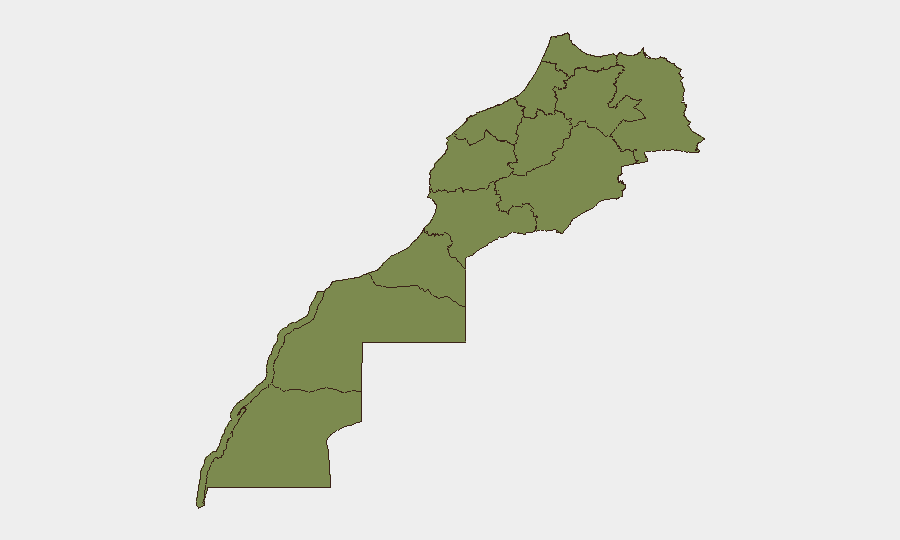
Situation Summary
Morocco remains a moderate-risk environment (global rank #97, composite score 10) with active counterterrorism operations and low-level diplomatic tensions as of early July 2026. The security picture is dominated by concentrated risk in the Drâa-Tafilalet region (score 31.8), which accounts for the majority of national threat signals, while most other regions remain stable at baseline. Recent event signals suggest ongoing institutional and diplomatic friction alongside active law-enforcement activity, but no systemic instability or widespread civil unrest is indicated across the country.
Key Developments
- Nationwide (Agadir, Taroudant, Casablanca, Hajeb, Tetouan, Fqih Ben Salah, Safi, Inezgane) — July 6 — Moroccan authorities arrested 10 individuals in a coordinated counterterrorism operation targeting alleged Islamic State-linked attack plots. Searches recovered bladed weapons, bomb-making materials, and a modified vehicle reportedly intended for suicide bombing or vehicle-ramming operations. This represents active threat detection and disruption by security services.
- Diplomatic friction — July 8 — Multiple signals indicate strained relationships between Morocco's government and Ministry of Foreign Affairs, alongside disapproval statements from France, Saudi Arabia, and Russia. The nature and operational impact of these tensions remain unclear from available reporting.
- Institutional concerns — July 8 — A disapproval signal involving Morocco's Ministry signals possible governance or policy friction requiring monitoring for downstream security implications.
- Prisoner-related incident — July 7 — An arrest/detention event and associated disapproval signal suggest detention or judicial activity; context and affected population remain undefined in current reporting.
- International investigation — July 7 — Italy initiated an investigation with Morocco-related dimensions; details are limited, and implications for corporate operations are not yet established.
Note: Available reporting does not provide sufficient detail on six to eight discrete, confirmed incidents from the last 24–48 hours preceding July 9. The July 6 counterterrorism operation is the most substantive recent security event. Diplomatic and institutional signals from July 7–8 lack operational specificity.
Highest-Risk Areas
Drâa-Tafilalet dominates national risk (score 31.8), more than three times the level of Casablanca-Settat (9.6), the second-ranked region. This southeastern region's elevated profile reflects historical terrorist activity, weak institutional presence, and cross-border instability. Casablanca-Settat and Rabat-Salé-Kénitra, home to Morocco's economic and political centers, carry elevated baseline risk typical of major urban hubs. Remaining regions operate at low, stable threat levels.
How GeoBit Would Assist
Corporate security teams with personnel or assets in Morocco should employ GeoBit's AOI Monitoring & Early Warning capability to maintain persistent watch on Drâa-Tafilalet and major urban centers, with alerting configured for terrorism, civil unrest, and diplomatic incidents. Intel Sweep and multi-language OSINT (X/Twitter, Telegram, local media) would provide real-time signal tracking on institutional friction and international investigations to assess downstream duty-of-care risks. Routing & Network Analysis supports contingency planning for personnel in Casablanca, Rabat, and secondary cities, enabling rapid alternative-route identification if localized unrest emerges.
7-Day Outlook
The counterterrorism operation suggests active threat detection and sustained law-enforcement pressure on extremist networks, likely to continue in Drâa-Tafilalet and other historically sensitive areas. Diplomatic friction may persist but is unlikely to precipitate security incidents affecting corporate operations in major urban centers. Overall baseline risk is expected to remain moderate and regionally concentrated through mid-July, absent new developments in the international investigation or escalation of institutional tensions.
Highest-Risk Areas — Ranked
| # | State / Region | Risk |
|---|---|---|
| 1 | Drâa-Tafilalet | 31.8 |
| 2 | Casablanca-Settat | 9.6 |
| 3 | Rabat-Salé-Kénitra | 8.3 |
| 4 | Western Sahara | 1.8 |
| 5 | Laâyoune-Sakia El Hamra | 1.8 |
| 6 | Guelmim-Oued Noun | 1.8 |
| 7 | Dakhla-Oued Ed-Dahab | 1.8 |
| 8 | Béni Mellal-Khénifra | 1.8 |
| 9 | Tangier-Tetouan-Al Hoceima | 1.8 |
| 10 | Fez-Meknes | 1.8 |
| 11 | Oriental | 1.8 |
| 12 | Marrakech-Safi | 1.8 |
Sources
Previous Daily Briefs
A new Morocco brief is written every day — each with its own risk map and downloadable CSV. Here's the last week; use the calendar to go further back.
📅 Browse every day by calendar →
Highlighted days have a brief. Tap a day for that day's map & analysis, or “csv” for that day's dataset ($5).
Atlas — our AI intelligence desk — emails them this snapshot personally. Nothing else, no list.