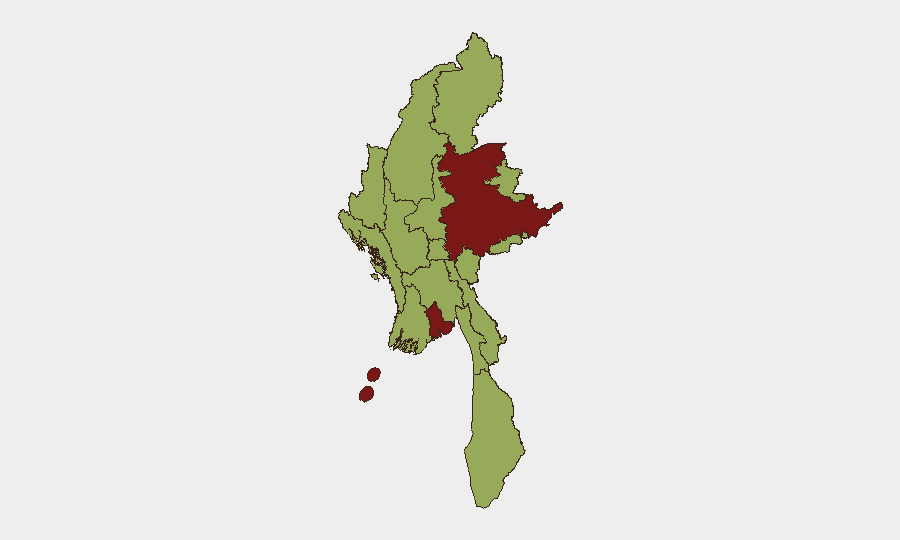
Situation Summary
Myanmar remains in active civil conflict with composite threat score 79.9 (#16 globally), driven primarily by military strikes across multiple fronts. The junta's control is eroding due to coordinated ethnic-armed and People's Defense Force offensives, compounded by international sanctions and dependency on Chinese and Russian support. Armed clashes, arbitrary violence, and cyber-crime operations continue to destabilize border regions and major urban centers. Overall trajectory is deteriorating, with no near-term political settlement apparent.
Key Developments
- Myawaddy, Kayin State (Thai border) – Myanmar military announced recapture of the strategic border town, reversing recent resistance gains and extending junta control over key Thailand trade crossings.
- Namhkam Township, northern Shan State – Mining-explosive storage facility explosion killed 38–45 people under Ta'ang National Liberation Army (TNLA) control; indicates severe safety and regulatory breakdown in contested areas.
- KK Park, Myawaddy area (Kayin State) – Military raided and closed major cyber-scam compound, detaining 2,198 people and seizing ~30 Starlink terminals; operation reportedly targeting online fraud and cross-border cybercrime near Thai frontier.
- Northern Shan State – Resistance forces continue multi-front offensives ("Operations 1027" and "1107") with indications of tacit Chinese backing targeting Chinese-facing cyber-scam networks.
- Shan and border areas – Chinese security forces reportedly deployed into northern Myanmar in direct cooperation with junta security organs to counter transnational cybercrime syndicates; signals Beijing's frustration with junta enforcement capacity and adds external military actor to conflict zone.
- Nationwide security environment – Widespread armed conflict, arbitrary violence, and human-rights abuses documented across regions; highly volatile operating conditions for civilians and foreign personnel persist.
- Political-military strain (Naypyitaw) – Analytical reporting indicates junta grip on power deteriorating under sanctions, battlefield losses, and coordinated resistance, while regime remains heavily dependent on China and Russia for political, military, and economic survival.
Highest-Risk Areas
Shan State (85.9) and Yangon (84.1) are the primary risk drivers, reflecting active multi-faction conflict and Chinese cross-border involvement in the north, and urban instability and potential secondary effects in the capital. The remaining nine regions cluster at 55.9, indicating widespread secondary conflict and administrative instability across the country. Border regions—particularly Kayin, Tanintharyi, Kachin, and Wa—face both junta-resistance clashes and transnational criminal networks (cyber-scams, trafficking). Urban centers (Yangon, Mandalay, Naypyitaw) face arbitrary enforcement, potential unrest, and secondary supply-chain disruption.
How GeoBit Would Assist
Security teams should employ AOI Monitoring & Early Warning to track volatile sub-national zones (Shan, Yangon, Kayin) with persistent alerting on military movements and cross-border activity. Conflict & Military capabilities—including battle mapping and force-structure analysis—enable real-time tracking of resistance and junta positions to assess safe corridors and operational windows. OSINT fusion (X/Telegram/YouTube intelligence, multi-language search, entity extraction) combined with Network & Actor Analysis provide early warning of cyber-scam syndicate disruptions and cross-border enforcement actions affecting supply chains and expatriate security.
7-Day Outlook
Expect continued junta counter-offensives along Thai and Chinese borders as the regime attempts to stabilize territorial control and demonstrate momentum to Beijing and Moscow. Resistance operations will likely intensify in northern Shan and adjoining zones. Cross-border incursions by Chinese security forces may increase if cyber-scam operations ramp up, creating localized volatility and complicating safe passage near Shan-China frontier areas. No major political shifts anticipated in the near term.
Highest-Risk Areas — Ranked
| # | State / Region | Risk |
|---|---|---|
| 1 | Shan State | 85.9 |
| 2 | Yangon | 84.1 |
| 3 | Ayeyarwady | 59.7 |
| 4 | Tanintharyi Region | 55.9 |
| 5 | Chin | 55.9 |
| 6 | Sagaing Region | 55.9 |
| 7 | Kachin State | 55.9 |
| 8 | Wa State (Northern Region) | 55.9 |
| 9 | Magway | 55.9 |
| 10 | Mandalay | 55.9 |
| 11 | Rakhine | 55.9 |
| 12 | Naypyitaw Union Territory | 55.9 |
Previous Daily Briefs
A new Myanmar brief is written every day — each with its own risk map and downloadable CSV. Here's the last week; use the calendar to go further back.
📅 Browse every day by calendar →
Highlighted days have a brief. Tap a day for that day's map & analysis, or “csv” for that day's dataset ($5).