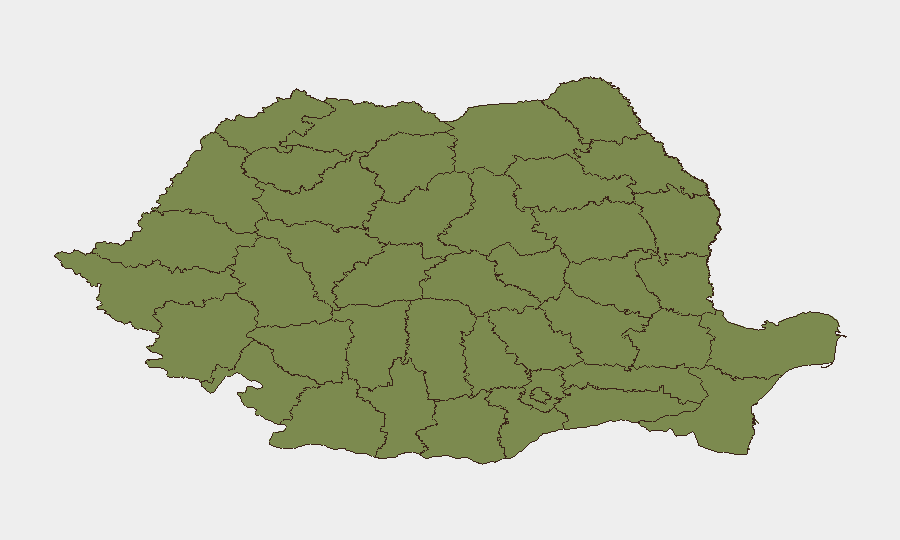
Situation Summary
Romania remains a low-threat environment globally (rank #89, composite score 13) with 38 tracked events in GeoBit's system. However, sub-national risk concentration in Brașov county (score 31.9) significantly exceeds the national average, indicating localized instability requiring targeted monitoring. No major security incidents have been confirmed in the last 24–48 hours; the threat picture reflects ongoing political tension, agricultural sector unrest, and residual cross-border spillover risk from the Ukraine conflict rather than acute developments.
Key Developments
GeoBit's 24–48-hour research window has not surfaced any clearly documented, Romania-specific security or unrest incidents with confirmed timestamps of 23–24 June 2026. The event signal feed reflects activity coded to 2026-06-23 (government-parliament tension, farmer demands, arrest/detention activity, small-arms combat involving armed groups), but open-source corroboration with specific locations, casualty counts, or verified reporting is not available at this time.
Recommended interpretation for duty-of-care teams: The absence of major headlines does not indicate absence of risk; rather, it reflects the current reporting lag in open channels. Corporate security teams with personnel or assets in Romania should rely on real-time monitoring of official Romanian Interior Ministry, Police, and Emergency Inspectorate channels, as well as NATO and EU cross-border alerts, rather than waiting for secondary confirmation.
Highest-Risk Areas
Brașov county (risk score 31.9) drives Romania's threat profile by a margin of 8× the national average. This concentration likely reflects ongoing labor disputes, agricultural sector unrest (consistent with 23 June farmer-demand signals), and possible criminal or organized-crime activity in a region historically susceptible to cross-border smuggling and trafficking. Bucharest (score 3.8) remains the secondary focus, driven by political and governance instability; all other tracked regions remain below risk 2.5, indicating that risk is genuinely sub-national and not uniformly distributed.
How GeoBit Would Assist
AOI Monitoring & Early Warning with persistent watch on Brașov, Bucharest, and border zones would trigger alerts if protest, labor action, or armed activity escalates. Intel Sweep covering Romanian government, police, and NATO feeds, combined with multi-language OSINT fusion on regional news outlets and verified social media, would surface 24–48-hour-window developments missed by mainstream English-language reporting. Network & Actor Analysis and sentiment & temporal analysis of farmer unions, political factions, and armed groups would enable predictive early warning before incidents reach crisis scale.
7-Day Outlook
Near-term trajectory remains stable absent new external shocks (e.g., escalation of Ukraine-adjacent cross-border incidents). Farmer-sector demands and government-parliament friction are endemic but not currently escalating; sustained monitoring of Brașov for labor unrest is warranted. The risk profile is unlikely to shift materially in the next 7 days unless triggering events (cyber incident, border spillover, or political crisis) occur, making targeted AOI monitoring and real-time feed integration the primary duty-of-care mitigation.
Highest-Risk Areas — Ranked
| # | State / Region | Risk |
|---|---|---|
| 1 | Brașov | 31.9 |
| 2 | Bucharest | 3.8 |
| 3 | Satu Mare | 2.4 |
| 4 | Brăila | 2.4 |
| 5 | Vâlcea | 1.9 |
| 6 | Bihor | 1.9 |
| 7 | Timiș | 1.9 |
| 8 | Caraș-Severin | 1.9 |
| 9 | Sălaj | 1.9 |
| 10 | Arad | 1.9 |
| 11 | Maramureș | 1.9 |
| 12 | Bistrița-Năsăud | 1.9 |
Sources
Previous Daily Briefs
A new Romania brief is written every day — each with its own risk map and downloadable CSV. Here's the last week; use the calendar to go further back.
📅 Browse every day by calendar →
Highlighted days have a brief. Tap a day for that day's map & analysis, or “csv” for that day's dataset ($5).