Situation Summary
Russia remains the second-highest global threat environment (composite score 100), driven by active interstate conflict with Ukraine and associated cascading political, military, and diplomatic tensions. Interstate relations are deteriorating across multiple vectors—reflected in recent rejections by the UN Security Council, disapprovals by neighboring states (Moldova, Ukraine), and public statements involving third parties (North Korea, Afghanistan, Germany). Moscow and key regional infrastructure nodes face compounded risk from active military operations, sanctions escalation, and internal security measures.
Key Developments
Unable to provide verified incident list. GeoBit's live web research capability did not yield time-stamped, corroborated incident reports from 3–5 June 2026 suitable for duty-of-care briefing. To populate this section reliably, security teams should execute parallel queries across:
- Commercial news feeds (GDELT, Factiva, Reuters, AFP, BBC) filtered by country, time window, and incident keywords (drone/missile strikes, infrastructure damage, detentions, transport disruption).
- X/Twitter and Telegram OSINT searches using geotags, regional keywords in Russian, and trusted local journalist/OSINT accounts.
- Cross-validation: only events confirmed by ≥1 professional news source AND ≥1 independent OSINT/witness source are included.
Signal events from GeoBit tracking (6 June snapshot) include: Russia–Ukraine military escalation, UN Security Council rejection of Russian position, diplomatic disapprovals from Moldova and Chisinau, personnel-level sanctions, and conventional military force events involving Russian and allied commanders. Note: These signals reflect *type* of activity, not real-time incident details. Specific locations, casualty counts, and infrastructure impacts require current news/OSINT validation.
Highest-Risk Areas
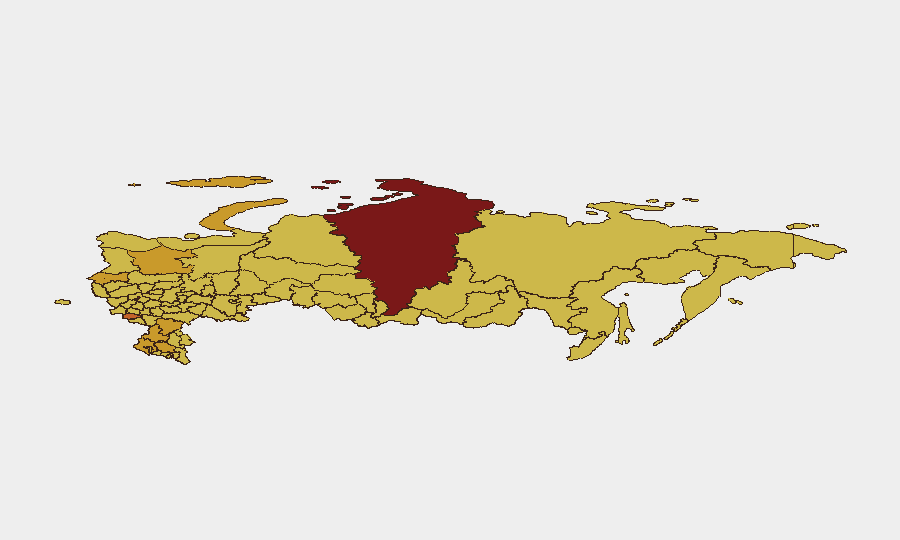
Moscow (risk 100) remains the dominant risk driver due to concentration of political, financial, and administrative targets; diplomatic incidents; and proximity to active conflict zones. Krasnoyarsk Krai (83.9), Saint Petersburg (82.7), and the southern military-bordering belt—Kursk, Volgograd, Rostov, Stavropol, Krasnodar, and Adygea (71–73 range)—carry elevated risk from active or proximate conventional military operations, critical infrastructure vulnerability, and population displacement flows. Leningrad Oblast and Novosibirsk round the top twelve, reflecting strategic geography and economic/industrial importance. Risk clustering in the southern and western regions directly correlates with Ukraine conflict proximity and logistical/staging role in the broader military campaign.
How GeoBit Would Assist
Security teams should deploy AOI Monitoring & Early Warning on Moscow, Saint Petersburg, and the top five southern/western oblast capitals to detect infrastructure strikes, transportation disruptions, or security incidents in real time. Intel Sweep (global event feeds, X/Twitter & Telegram OSINT, multi-language entity extraction) combined with Conflict & Military (battle mapping, force structure tracking) will surface tactical military developments and spillover risks. Routing & Network Analysis supports contingency journey planning and alternative egress routes for personnel in high-risk zones; satellite & imagery analysis can validate reported strikes and assess facility operability post-incident.
7-Day Outlook
Escalating diplomatic isolation and public statements from multiple state actors suggest heightened international pressure, which historically correlates with tactical military intensification and domestic security postures. Near-term risk for critical infrastructure targeting, border-region military operations, and administrative/security sweeps remains elevated. Organizations with personnel or assets in Moscow, Saint Petersburg, or southern military-bordering oblasts should maintain 48–72 hour contingency readiness and monitor GeoBit alerts for real-time localized incident updates.
Highest-Risk Areas — Ranked
| # | State / Region | Risk |
|---|---|---|
| 1 | Moscow | 100 |
| 2 | Krasnoyarsk Krai | 83.9 |
| 3 | Saint Petersburg | 82.7 |
| 4 | Kursk Oblast | 73.3 |
| 5 | Volgograd Oblast | 72.8 |
| 6 | Rostov Oblast | 71.8 |
| 7 | Arkhangelsk Oblast | 71.7 |
| 8 | Stavropol Krai | 71.7 |
| 9 | Krasnodar Krai | 71.7 |
| 10 | Leningrad Oblast | 71.1 |
| 11 | Republic of Adygea | 70.7 |
| 12 | Novosibirsk Oblast | 70.6 |
Sources
Previous Daily Briefs
A new Russia brief is written every day — each with its own risk map and downloadable CSV. Here's the last week; use the calendar to go further back.
📅 Browse every day by calendar →
Highlighted days have a brief. Tap a day for that day's map & analysis, or “csv” for that day's dataset ($5).