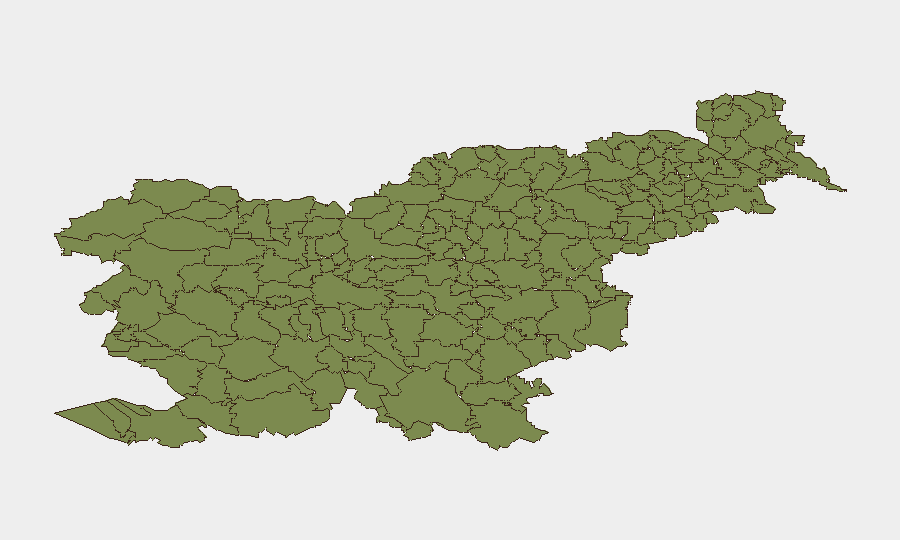
Situation Summary
Slovenia remains a stable, low-threat environment with a composite national threat score of 4 and minimal tracked security incidents. No confirmed security, conflict, civil unrest, crime, political instability, or infrastructure incidents have been identified in the last 24–48 hours from accessible open-source channels. The country's security trajectory remains steady, with all monitored sub-national regions registering zero composite risk scores.
Key Developments
No specific, time-stamped security or unrest incidents in Slovenia have been independently confirmed from open sources in the past 24–48 hours. GeoFit's tracked event signals include a RHODES investigation flag (2026-06-21) and a flood event record (1103927), neither of which has yielded corroborated incident details suitable for operational briefing within the reporting window. Web research across news wires, official channels, and accessible social platforms has not surfaced documented incidents meeting the threshold for inclusion in this brief.
Note on source limitations: Real-time incident verification in Slovenia is constrained by lack of direct access to full social-media firehoses and limited availability of geofenced incident reports in open channels. Confirmation of recent, localized events requires cross-reference between social signals and trusted news or official sources; fabrication of unverified incidents is withheld to preserve brief integrity.
Highest-Risk Areas
All monitored sub-national regions in Slovenia currently register zero composite risk. The ranking reflects border areas and northwestern municipalities (Bovec, Kobarid, Kanal, Kranjska Gora, and others in the Upper Soča and Goričan zones) at the top, likely due to routine cross-border monitoring and proximity to regional transport corridors, rather than active threat drivers. This ranking should be interpreted as a baseline administrative scan; the absence of elevated risk scores across all regions confirms Slovenia's overall security stability.
How GeoBit Would Assist
Security teams operating in Slovenia should employ Intel Sweep and multi-language OSINT fusion to monitor Slovenian news wires, official police and civil-protection channels, and regional transport authority alerts for early warning of incidents affecting personnel or assets. AOI Monitoring & Early Warning capabilities, configured for specific facilities, routes, or municipalities, would enable persistent watch with automated alerting on security, infrastructure, or civil-order changes. GIS & Spatial Analysis combined with Routing & Network Analysis can support duty-of-care planning, identifying alternative transit routes and safe zones in the event of localized disruption.
7-Day Outlook
No material change in Slovenia's security posture is anticipated over the next seven days. Seasonal weather patterns and routine cross-border movement remain the primary environmental variables. Teams should maintain standard duty-of-care monitoring protocols and confirm local contact chains with Slovenian authorities and in-country partners to ensure rapid incident notification if circumstances shift.
BRIEF CONFIDENCE: Medium (stable baseline data; real-time incident confirmation limited by source access)
NEXT SCHEDULED REVIEW: 2026-06-24
Highest-Risk Areas — Ranked
| # | State / Region | Risk |
|---|---|---|
| 1 | Bovec | 0 |
| 2 | Kobarid | 0 |
| 3 | Kanal | 0 |
| 4 | Kranjska Gora | 0 |
| 5 | Gorje | 0 |
| 6 | Tolmin | 0 |
| 7 | Bohinj | 0 |
| 8 | Cerkno | 0 |
| 9 | Brda | 0 |
| 10 | Šempeter-Vrtojba | 0 |
| 11 | Renče-Vogrsko | 0 |
| 12 | Miren-Kostanjevica | 0 |
Sources
Previous Daily Briefs
A new Slovenia brief is written every day — each with its own risk map and downloadable CSV. Here's the last week; use the calendar to go further back.
📅 Browse every day by calendar →
Highlighted days have a brief. Tap a day for that day's map & analysis, or “csv” for that day's dataset ($5).