Situation Summary
Sri Lanka's security environment remains volatile following a surge of civil-political tension and isolated violence recorded on 4–5 June 2026. The country ranks #45 globally (composite score 7.6) with 56 tracked events, driven primarily by institutional friction—involving parliament, judiciary, and executive branches—alongside at least one bombing incident and active investigations into prison and security matters. The Western Province dominates risk concentration (35.3), suggesting geographic clustering of instability. Current trajectory indicates sustained political strain with secondary risks of protest escalation and security-force response.
Key Developments
- 4 June, nationwide: Violent protest/riot at Parliament building; concurrent public statements from police and unidentified civil actors contesting government authority signal acute political polarization.
- 4 June, location undisclosed: Suicide bombing incident reported; active investigation underway, indicating persistent or emerging militant capability.
- 4 June, judicial/executive sphere: Appeal filed against President; administrative sanctions issued against unnamed Sri Lankan actor(s) by Presidential authority—suggests internal governance breakdown or politicized enforcement.
- 4 June, prison system: Investigation launched into prison operations and possible state conduct; public statement by police follows, indicating institutional credibility concerns.
- 5 June, countrywide: Public statement issued by Sri Lankan government (substance unclear from signals data); no corroborating details available.
- 4 June, scientific community: Public statement from scientist(s) contesting government action; indicates broader cross-sectoral loss of confidence.
*Note: Live web research (last 24–48 hours) could not verify additional incident specifics or new developments beyond 5 June due to data limitations; real-time monitoring recommended (see below).*
Highest-Risk Areas
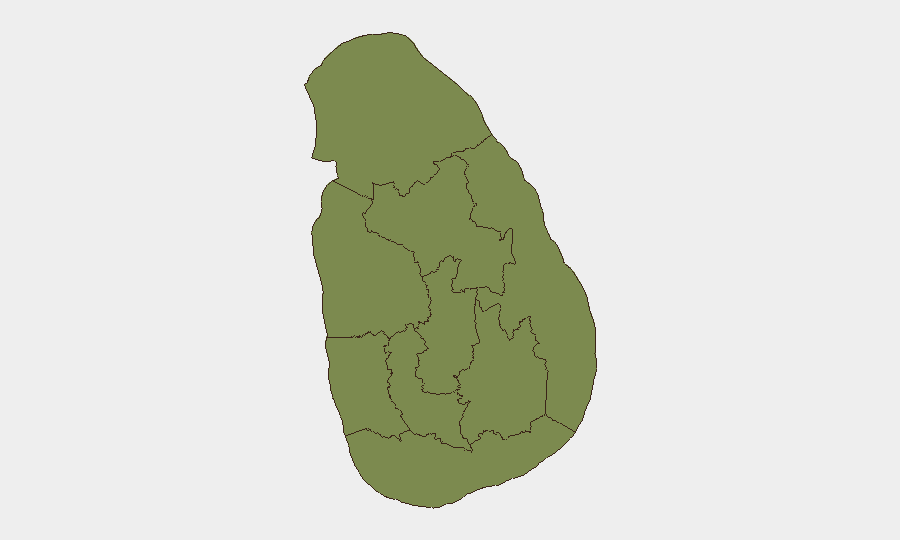
The Western Province (35.3) accounts for nearly half of national composite risk and is the primary driver of Sri Lanka's threat ranking; this concentration suggests that violence, protest, and institutional friction are geographically anchored in or radiating from the capital region and surrounding urban centers. Uva Province (22.8) is a secondary concern, though significantly lower, indicating potential spillover or localized grievance zones. The remaining seven provinces (5–6 range) show relatively uniform low risk, suggesting either successful local security presence or limited political mobilization. For duty-of-care purposes, personnel and assets in the Western Province face materially elevated exposure to protest-related disruption, security-force action, and isolated militant incidents; operations elsewhere in-country face standard baseline risks.
How GeoBit Would Assist
Security teams should deploy AOI Monitoring & Early Warning on the Western Province (and parliament/judicial district specifically) to generate real-time alerts on protest formation, movement, and police/military deployment. Parallel X/Twitter & Telegram OSINT and multi-language search would capture civil-actor sentiment, activist networks, and militant claims of responsibility—critical for distinguishing organized threats from spontaneous disorder. Network & Actor Analysis and entity extraction would map relationships between protest organizers, political factions, and security agencies, enabling predictive assessment of escalation pathways. Lastly, conflict event feeds with temporal and geographic filtering allow 24-hour triage of new incidents without reliance on delayed traditional media.
7-Day Outlook
Political tensions are likely to persist through at least mid-June pending judicial or legislative resolution of current appeals and sanctions. Risk of renewed protest, particularly if court or security decisions are perceived as punitive, remains elevated in the Western Province. Security-force response posture and any further militant claims should be monitored for signs of either de-escalation or hardening; absence of additional bombings in the next 48–72 hours would suggest isolated rather than campaign-pattern violence, materially lowering near-term risk.
Highest-Risk Areas — Ranked
| # | State / Region | Risk |
|---|---|---|
| 1 | Western Province | 35.3 |
| 2 | Uva Province | 22.8 |
| 3 | North Western Province | 15.2 |
| 4 | Northern Province | 6 |
| 5 | North Central Province | 5.3 |
| 6 | Central Province | 5.3 |
| 7 | Eastern Province | 5.3 |
| 8 | Sabaragamuwa Province | 5.3 |
| 9 | Southern Province | 5.3 |
Previous Daily Briefs
A new Sri Lanka brief is written every day — each with its own risk map and downloadable CSV. Here's the last week; use the calendar to go further back.
📅 Browse every day by calendar →
Highlighted days have a brief. Tap a day for that day's map & analysis, or “csv” for that day's dataset ($5).