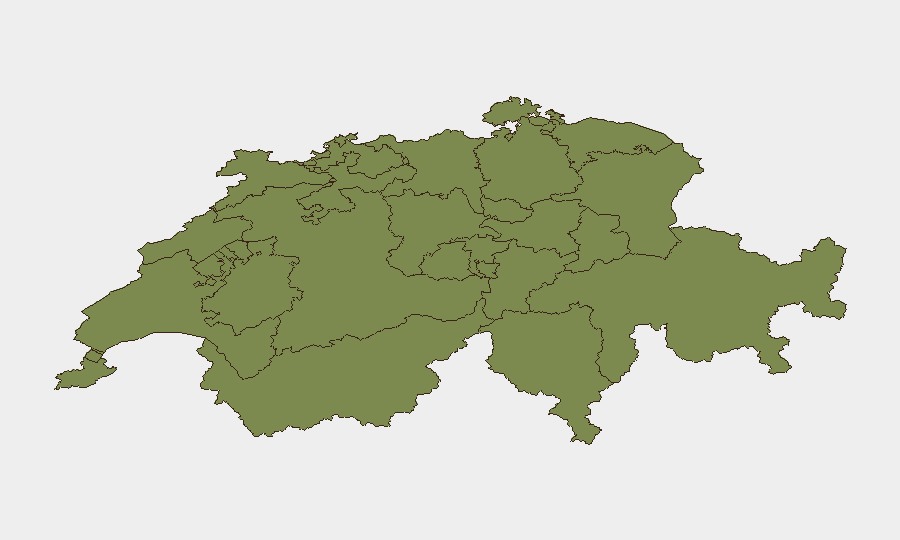
Situation Summary
Switzerland maintains a composite threat score of 3 (rank #163 globally), reflecting its stable security environment and low incidence of major incidents. Recent event signals indicate political statements and demonstrations related to China policy and domestic referenda, with no confirmed large-scale security incidents or civil unrest in the past 24–48 hours. The country's sub-national risk distribution is heavily skewed toward Geneva and Lucerne, where composite scores substantially exceed the national average, while most cantons remain in the low-risk range.
Key Developments
- No confirmed security incidents within 24–48 hours: Open-source reporting does not contain specific, time-stamped security, unrest, crime, or infrastructure disruption events in Switzerland dated 15–17 June 2026. Routine political activity and the 15 June referendum on population caps constitute normal democratic process, not discrete security events.
- Geneva and Lucerne remain elevated: Both cantons show composite risk scores significantly above the national average (31.7 and 26.1 respectively), suggesting concentration of political activity, international presence, or demonstration activity; however, current incident specifics are not available in open sources.
- Political statements on China policy: Multiple actors (President, academics, economists) issued disapprovals and public statements related to China on 16–17 June; these reflect policy discourse and do not indicate imminent domestic security threats.
- Demonstration activity signaled: Event data reference a 17 June demonstration/rally by a professor and related activity; specific location and scale are not confirmed in accessible reporting.
Highest-Risk Areas
Geneva dominates the sub-national risk profile with a score of 31.7—more than seven times the national average—reflecting its role as a hub for international organizations, diplomatic missions, NGO headquarters, and political activity. Lucerne follows at 26.1, suggesting periodic protest or demonstration activity. Zurich and Bern, despite their size and economic importance, register substantially lower scores (4.2 and 3.9), indicating either lower event frequency or lower intensity. All other cantons remain below 2.0, suggesting minimal reported risk concentration outside the top two.
How GeoBit Would Assist
Corporate security and duty-of-care teams should deploy GeoBit's AOI (Area-of-Interest) Monitoring & Early Warning for Geneva and Lucerne to receive real-time alerts on demonstrations, gatherings, and political activity. Intel Sweep and multi-language OSINT (X/Twitter, Telegram, local media) will provide earlier warning of emerging protests or statements than English-language news cycles. Network & Actor Analysis can map organizers and key figures behind political movements, while Sentiment & Temporal Analysis will flag escalating rhetoric or coordination signals before events materialize.
7-Day Outlook
No significant escalation in security incidents is forecast for the next seven days. Political activity and public statements will likely continue at current levels; however, the June referendum outcome and subsequent policy discussion may generate localized demonstrations in Geneva or Lucerne within the coming week. Routine commercial, travel, and operational security protocols remain appropriate for most of Switzerland.
Highest-Risk Areas — Ranked
| # | State / Region | Risk |
|---|---|---|
| 1 | Geneva | 31.7 |
| 2 | Lucerne | 26.1 |
| 3 | Zurich | 4.2 |
| 4 | Bern | 3.9 |
| 5 | Nidwalden | 2 |
| 6 | Ticino | 2 |
| 7 | Basel-City | 1.7 |
| 8 | Jura | 1.7 |
| 9 | Basel-Landschaft | 1.7 |
| 10 | Solothurn | 1.7 |
| 11 | Aargau | 1.7 |
| 12 | Vaud | 1.7 |
Sources
Previous Daily Briefs
A new Switzerland brief is written every day — each with its own risk map and downloadable CSV. Here's the last week; use the calendar to go further back.
📅 Browse every day by calendar →
Highlighted days have a brief. Tap a day for that day's map & analysis, or “csv” for that day's dataset ($5).