Situation Summary
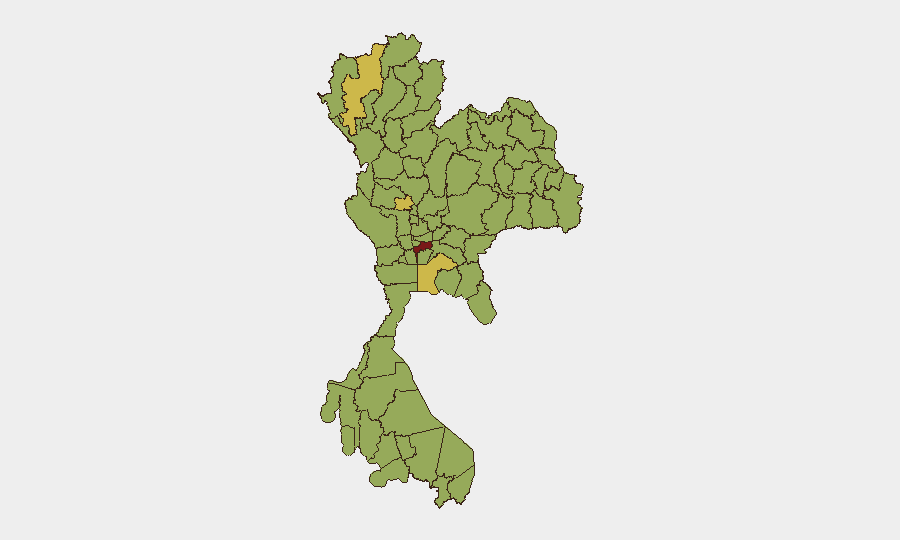
Thailand remains a moderately elevated risk environment (rank #19 globally, composite score 71.5) driven by converging governance instability, border militarization, active separatist violence in the south, and recent cyber targeting of state infrastructure. The past 72 hours have surfaced multiple arrest/detention events, military force deployments, public demonstrations against governance, and diplomatic friction with neighboring states—signals consistent with political tension and enforcement action rather than acute crisis, but warrant close tracking. Bangkok's risk score (80) reflects concentration of political activity and governance tension; sub-national variation is sharp, with southern provinces (Pattani, Yala, Narathiwat) and the Cambodia frontier zones carrying sustained high risk from insurgent and cross-border violence.
Key Developments
- 2026-06-02 · Conventional Military Force deployment — Thai armed forces activated in an unspecified operational context; precise location and scale not yet confirmed in available reporting. Correlates with diplomatic tension signals on the same date.
- 2026-06-01 · Public Demonstration vs. Governance — Rally or protest activity recorded in Thailand, indicating continued political mobilization and grievance expression against state authority.
- 2026-06-02 · Multiple arrests/detention events — Thai authorities conducted arrest/detention operations involving Canadian nationals and unspecified populations; suggests law-enforcement escalation or security enforcement campaign.
- 2026-06-02 · Bilateral friction (Thailand–Vietnam) — Public statement issued by Thai government in dispute with Vietnam; context unclear but consistent with border or diplomatic tension.
- 2026-06-02 · Arrest/detention reciprocal event — Ecuadorian (Guayaquil) entity arrested Thai national or vice versa, suggesting possible consular or transnational security incident.
- Cambodia–Thailand border escalation (July 2025 baseline) — Prior reporting indicates most severe cross-border clashes in >10 years, with airstrikes, artillery, and 130,000+ evacuations; ceasefire status as of June 2026 unclear.
- Southern Thailand insurgent activity (ongoing) — UK and Canadian travel advisories maintain warnings of regular terrorist/separatist attacks in Pattani, Yala, and Narathiwat; no end-state change indicated.
- Thai government cyber targeting (March–June 2026) — 70+ coordinated cyberattacks reported against Thai government, military, financial, and industrial systems; attribution and operational impact unconfirmed in primary sources.
Highest-Risk Areas
Bangkok dominates with a risk score of 80, reflecting its role as the political epicenter and highest concentration of state, business, and foreign-national assets. Chai Nat Province (68.6) and Chon Buri Province (60.5) show elevated scores, likely tied to proximity to Bangkok's administrative orbit or localized labor/protest activity. The southern insurgency provinces (Pattani, Yala, Narathiwat) and the Cambodia frontier (Bueng Kan, Nong Khai) carry sustained violence risk from separatist/militant groups and cross-border military activity, respectively; these areas remain distinctly higher-risk for expatriates and supply-chain infrastructure than the central region.
How GeoBit Would Assist
Security teams should deploy AOI Monitoring & Early Warning on Bangkok, key southern provinces, and the Cambodia frontier to detect military mobilization, protest escalation, or attack patterns in real time. OSINT fusion (X/Telegram, multi-language search, entity extraction) provides rapid corroboration of arrest campaigns and governance actions; sentiment & temporal analysis flags protest momentum and policy shifts before they trigger broader instability. Conflict & Military battle mapping and force-structure tracking would clarify the June 2 military deployment and assess Cambodia border risk trajectory.
7-Day Outlook
Governance friction and military activation signals suggest elevated risk of further detention operations, protest cycles, or border skirmishes over the next week. The Cambodia border remains the highest-volatility wildcard; absence of clear ceasefire status or de-escalation statement raises risk of renewed clashes. Corporate security teams should maintain heightened vigilance in Bangkok and southern provinces and prepare contingency communication protocols.
Highest-Risk Areas — Ranked
| # | State / Region | Risk |
|---|---|---|
| 1 | Bangkok | 80 |
| 2 | Chai Nat Province | 68.6 |
| 3 | Chon Buri Province | 60.5 |
| 4 | Chiang Mai Province | 60 |
| 5 | Si Sa Ket Province | 55 |
| 6 | Prachuap Khiri Khan Province | 54.6 |
| 7 | Surat Thani Province | 51.3 |
| 8 | Phuket Province | 50.5 |
| 9 | Chiang Rai Province | 50.5 |
| 10 | Bueng Kan Province | 50 |
| 11 | Nong Khai Province | 50 |
| 12 | Udon Thani Province | 50 |
Sources
Previous Daily Briefs
A new Thailand brief is written every day — each with its own risk map and downloadable CSV. Here's the last week; use the calendar to go further back.
📅 Browse every day by calendar →
Highlighted days have a brief. Tap a day for that day's map & analysis, or “csv” for that day's dataset ($5).