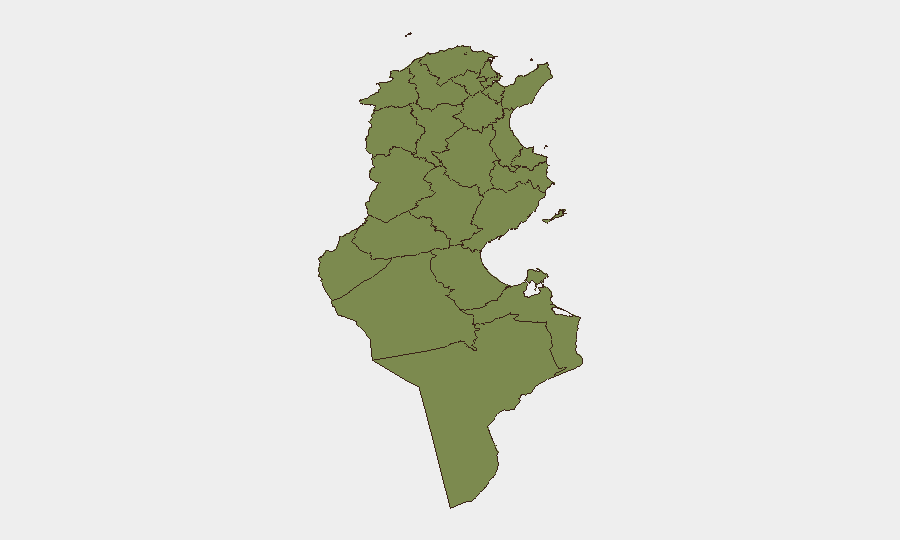
Situation Summary
Tunisia's composite threat score places it at mid-tier global risk (#57), with 52 tracked events reflecting a diverse threat landscape spanning civil unrest, criminal activity, and border tensions. The most acute concentration of risk is geographically isolated to Kébili governorate (risk 31.8), which substantially exceeds all other regions; the capital Tunis and surrounding Ariana show elevated but manageable threat signatures. Recent signal activity indicates upticks in arrest operations, investigative actions by executive leadership, and international military posturing that warrant close monitoring.
Key Developments
- Tunis (Bab Menara district), 2026-07-18 — Police arrested a suspect wanted on nine search warrants for assault and attempted murder offences; detainee placed in judicial custody. This reflects continued law enforcement operations against serious violent crime in the capital.
- Tunisia nationwide, 2026-07-18–2026-07-19 — Civil protection reported 683 interventions in 24 hours, including 188 fire responses and 152 road-rescue operations, indicating sustained incident demand across the country and potential underlying instability drivers.
- International military activity, 2026-07-19 — GeooBit event signals registered conventional military force activity involving Italy and Tunisia, and separately Burkina Faso and Tunisia, suggesting external regional engagement or border tensions. Specific operational details require additional source corroboration.
- Executive investigative activity, 2026-07-19 — Multiple signals indicate presidential and head-of-state investigative actions commenced, suggesting internal governance review or accountability processes. Scope and target remain unconfirmed by independent sources.
- Small arms combat (residents), 2026-07-19 — Resident-level armed engagement logged; geographic specificity and casualty count not yet available from open sources.
- Migrant detention statement, 2026-07-19 — Public statement activity linked to migrant populations and prison facilities suggests possible detention or policy friction; detail pending corroboration.
Highest-Risk Areas
Kébili governorate is the dominant driver of Tunisia's composite threat score, with a risk coefficient (31.8) more than five times higher than any other region. This southern interior zone warrants asset and personnel concentration review for security teams; Kébili's elevation may reflect border proximity, migration flows, or militant activity density. Tunis (risk 6.1) and surrounding Ariana (3.2) show secondary risk concentration tied to capital-city crime, administrative friction, and population density; these remain operationally relevant for corporate presence but are substantially below the Kébili threshold. All other governorates score at baseline (1.8), indicating broadly stable peripheral regions.
How GeoBit Would Assist
Security teams with Tunisian operations should activate Area-of-Interest (AOI) monitoring focused on Kébili, Tunis, and border zones to detect escalation signals in real time. Intel Sweep and OSINT fusion (social media, Arabic-language sources, event feed correlation) will clarify the international military posturing and executive investigations now flagged only at signal level. Conflict & Military tracking and satellite imagery analysis will distinguish genuine border activity from routine cross-border movement, supporting risk-adjusted duty-of-care decisions for field teams and supply lines.
7-Day Outlook
Short-term escalation risk is moderate to elevated, driven by unresolved international military engagement signals and apparent domestic governance investigations. Personnel and asset security postures should remain heightened in Kébili and Tunis; communication protocols and evacuation contingencies warrant review. Clarification of the Italy–Burkina Faso military engagements within 48–72 hours will be essential to forecast the next 7-day trajectory.
Highest-Risk Areas — Ranked
| # | State / Region | Risk |
|---|---|---|
| 1 | Kébili | 31.8 |
| 2 | Tunis | 6.1 |
| 3 | Ariana | 3.2 |
| 4 | Tataouine | 1.8 |
| 5 | Nabeul | 1.8 |
| 6 | Monastir | 1.8 |
| 7 | Sfax | 1.8 |
| 8 | Mahdia | 1.8 |
| 9 | Médenine | 1.8 |
| 10 | Jendouba | 1.8 |
| 11 | Béja | 1.8 |
| 12 | Bizerte | 1.8 |
Sources
Previous Daily Briefs
A new Tunisia brief is written every day — each with its own risk map and downloadable CSV. Here's the last week; use the calendar to go further back.
📅 Browse every day by calendar →
Highlighted days have a brief. Tap a day for that day's map & analysis, or “csv” for that day's dataset ($5).
Atlas — our AI intelligence desk — emails them this snapshot personally. Nothing else, no list.