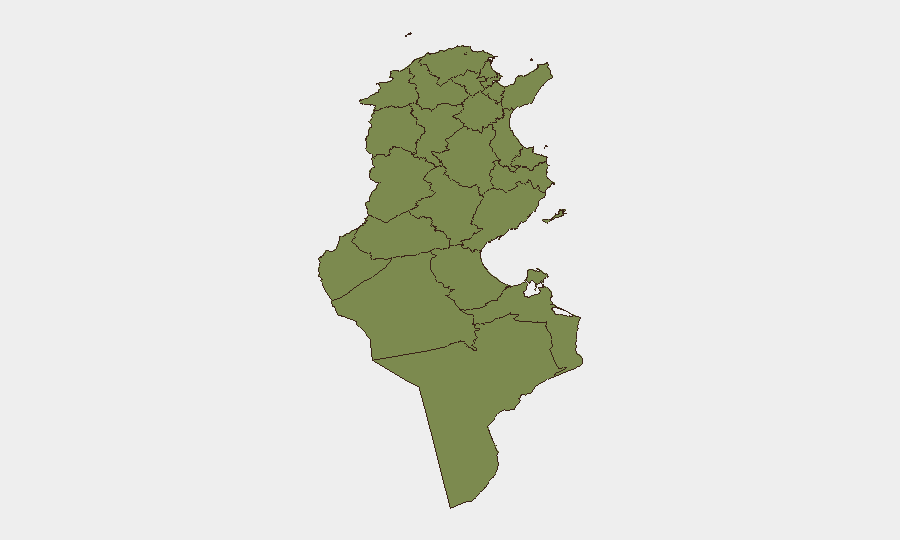
Situation Summary
Tunisia's security environment remains characterized by civil unrest driven by service-delivery failures and political repression, with no major security incidents reported this week but sustained protest activity and targeted arrests of opposition figures and media professionals. Unemployment, electricity and water shortages, and perceived restrictions on freedoms are fueling street demonstrations, primarily concentrated in the capital. The judicial system is being used to enforce convictions against political opponents, lawyers, and civil-society actors, creating a climate of legal and political risk. The trajectory is one of mounting social pressure co-existing with state crackdown, with no imminent de-escalation signals.
Key Developments
- Tunis (Kasbah government headquarters) – 2 September 2026
Hundreds of unemployed university graduates protested non-implementation of public-sector recruitment law, clashing with police before marching toward Habib Bourguiba Avenue and chanting against perceived police-state governance and employment exclusion.
- Tunis (political/social-organization calls) – 1 September 2026
Multiple political parties and civil-society organizations publicly demanded President Kais Saied's resignation, citing the government's failure to address electricity and water shortages—framing the crisis as grave and systemic.
- Tunis (Court of Cassation) – 3–4 September 2026
The Court of Cassation upheld sentences of 5 to 45 years against dozens of opposition figures, lawyers, and human-rights defenders in a high-profile "conspiracy against state security" case, rejecting final appeals and making verdicts enforceable.
- Tunis (Express FM radio station) – 4 September 2026
Police arrested journalist Mohamed Yousfi, editor-in-chief of investigative outlet Al-Qatiba, as he arrived to discuss Tunisia's water crisis; he was held in police custody under financial-crimes investigation without formal charges.
- Tunis – 5 September 2026
Mohamed Yousfi remained detained overnight following his 4 September arrest. On the same day, authorities arrested lawyer Ghazi Mrabet, known for politically sensitive and civil-liberties cases, signaling escalating targeting of legal and media professionals.
- Tunis (Al-Manzah stadium area) – 5–6 September 2026
Hundreds of demonstrators gathered at a rally organized by the opposition "Nefes" (Breath) movement, chanting "No electricity, no water, prison and high prices" and "Game over, resign," linking infrastructure failure and perceived repression to calls for presidential departure.
- Tunis (civil-rights march) – 6 September 2026
Political activists and civil-society figures marched demanding the release of all political detainees and defending rights and freedoms, emphasizing public-service failures and politicized detention as core grievances.
- Tunisia (nationwide cybersecurity report) – 7 September 2026
Tunisia's cybersecurity agency announced detection of 657,540 cybersecurity incidents in the first half of 2026, including 35,000 DDoS attacks (38% increase over 2025), and announced measures to address routine government-system vulnerabilities.
Highest-Risk Areas
Kasserine, Jendouba, and Tataouine dominate the sub-national risk profile (scores 92, 88, 85 respectively), with southwestern and west-central border regions (Médenine, Gafsa, Béja, Sidi Bouzid) also elevated. These areas are historically linked to informal-economy activity, marginalization, and proximity to porous borders; current unrest is amplifying baseline fragility. Kairouan, Siliana, and Tozeur show moderate but sustained risk, driven by economic grievance and limited state capacity. The capital Tunis itself, while not ranked in the top 12, is the epicenter of organized political protest and state enforcement this week—representing acute, *episodic* risk distinct from the *chronic* instability of border and interior zones.
How GeoBit Would Assist
Security teams should deploy AOI Monitoring & Early Warning on high-risk governorates (especially Kasserine and Jendouba) and key Tunis neighborhoods (Kasbah, Habib Bourguiba Avenue, Al-Manzah) to track protest nodes and security-force deployments in near real-time. Intel Sweep and multi-language OSINT (including social-media and Telegram monitoring) would provide early signals of planned demonstrations, arrest campaigns, or escalation before they occur. Regime-stability search and sentiment analysis capabilities would help assess the durability of current political tensions and forecast flashpoints.
7-Day Outlook
Protest activity will likely persist through September as infrastructure crises remain unresolved and conviction verdicts strengthen opposition grievance narratives. Arrest campaigns targeting journalists and lawyers may continue, raising reputational and legal risk for international organizations. No major security event is forecast, but sustained street mobilization combined with state enforcement creates persistent risk of confrontation, particularly in Tunis.
Highest-Risk Areas — Ranked
| # | State / Region | Risk |
|---|---|---|
| 1 | Kasserine | 92 |
| 2 | Jendouba | 88 |
| 3 | Tataouine | 85 |
| 4 | Médenine | 83 |
| 5 | Gafsa | 78 |
| 6 | Béja | 75 |
| 7 | Sidi Bouzid | 72 |
| 8 | Al Kaf | 70 |
| 9 | Kébili | 68 |
| 10 | Kairouan | 65 |
| 11 | Siliana | 62 |
| 12 | Tozeur | 58 |
Sources
Previous Weekly Briefs
A new Tunisia brief is written every Monday, covering the week — each with its own risk map and downloadable CSV. Use the calendar to go further back.
- September 2, 2026
- August 31, 2026
- August 29, 2026
- August 27, 2026
- August 25, 2026
- August 23, 2026
- August 21, 2026
📅 Browse past briefs by calendar →
Highlighted days have a brief. Tap a day for that day's map & analysis, or “csv” for that day's dataset ($5).
Atlas — our AI intelligence desk — emails them this snapshot personally. Nothing else, no list.