Situation Summary
Tunisia faces a composite threat score of 28, placing it in the lower-middle range of global risk, but significant near-term operational pressures are evident. A severe heatwave affecting 12 governorates has triggered rolling power cuts nationwide and sparked 196 fires in 24 hours, with forestry incidents concentrated around Jendouba. Concurrent signals point to investigative activity involving the head of state, cross-border military posturing (Italy and Burkina Faso), and internal security scrutiny, though the causal linkages remain unclear from available reporting.
Key Developments
- Nationwide (Tunis, Greater Tunis region) — 20–21 Jul 2026: State electricity company STEG issued formal notice of scheduled rolling power cuts on 21 July, triggered by extreme heat stress on the grid. This affects critical infrastructure operations across the capital and surrounding governorates.
- 12 Governorates, Tunisia — 20–21 Jul 2026: An extreme heatwave placed the majority of Tunisia on high alert; civil protection agencies reported 196 fires in a single 24-hour period. Jendouba governorate experienced significant forestry fires, with secondary impacts on transportation and emergency services.
- Kébili Governorate — 19 Jul 2026: Small arms combat involving residents was recorded, marking the highest-risk incident signal in the current dataset. Context and parties to the engagement remain unconfirmed.
- Capital region — 19 Jul 2026: Investigative actions targeting the president and head of state were formally initiated; a public statement by the president directed at Tunisian audiences was issued on 21 Jul. The substance and political trajectory remain unclear from public sources.
- National level — 19 Jul 2026: Two separate investigative signals involving conventional military forces (Italy vs. Tunisia and Burkina Faso vs. Tunisia) and one internal state-to-state investigation signal (Tunisia vs. Tunisia) were recorded. These suggest border or diplomatic friction, though operational scale is not yet confirmed.
- Prison / Migration nexus — 19 Jul 2026: A public statement from migrant groups regarding prison conditions was documented, indicating potential civil tension or humanitarian concern in detention facilities.
- National — 19 Jul 2026: Police disapproval signal recorded; context unclear.
Highest-Risk Areas
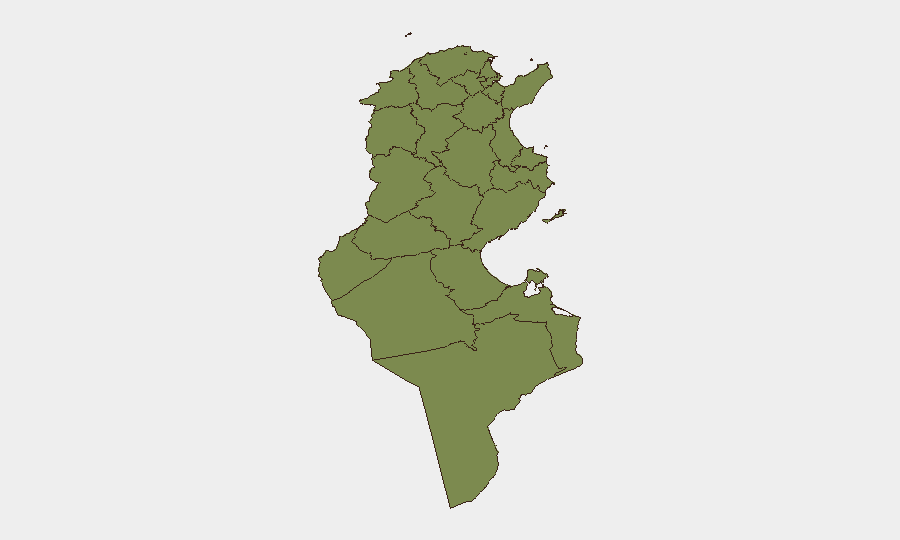
Kébili governorate stands sharply apart with a composite risk score of 31.3—more than six times higher than Tunis (4.5). The small-arms combat signal from 19 July and Kébili's border proximity (Algeria, Libya) suggest either localized conflict, smuggling activity, or cross-border spillover. Tunis itself carries elevated but manageable risk (4.5), driven by the concurrent investigative and political signals affecting the capital. All remaining governorates cluster at 1.3–2.9, indicating baseline stability; however, the heatwave impact on Jendouba's forestry and the nationwide electricity crisis create secondary operational risks for any organization dependent on stable power or emergency access.
How GeoBit Would Assist
Security teams should deploy AOI Monitoring & Early Warning on Kébili and southern border regions to flag further combat or irregular activity. Intel Sweep and multi-language OSINT across Arabic and French sources would clarify the political investigation trajectory and any cascading institutional risk. Satellite & Imagery analysis of fire perimeters in Jendouba and Economic & Trade monitoring would help assess infrastructure resilience and supply-chain continuity during the heatwave and power-rationing phase.
7-Day Outlook
The heatwave and rolling blackouts are expected to persist through mid-week; organizations should assume intermittent utilities and activate contingency operations. Political investigative signals and the Kébili combat incident require close monitoring over the next 48–72 hours to assess whether these represent isolated events or early indicators of broader state instability. Border activity involving Italy and Burkina Faso warrants continued watch.
Highest-Risk Areas — Ranked
| # | State / Region | Risk |
|---|---|---|
| 1 | Kébili | 31.3 |
| 2 | Tunis | 4.5 |
| 3 | Ariana | 2.9 |
| 4 | Tataouine | 1.3 |
| 5 | Nabeul | 1.3 |
| 6 | Monastir | 1.3 |
| 7 | Sfax | 1.3 |
| 8 | Mahdia | 1.3 |
| 9 | Médenine | 1.3 |
| 10 | Jendouba | 1.3 |
| 11 | Béja | 1.3 |
| 12 | Bizerte | 1.3 |
Sources
Previous Daily Briefs
A new Tunisia brief is written every day — each with its own risk map and downloadable CSV. Here's the last week; use the calendar to go further back.
📅 Browse every day by calendar →
Highlighted days have a brief. Tap a day for that day's map & analysis, or “csv” for that day's dataset ($5).
Atlas — our AI intelligence desk — emails them this snapshot personally. Nothing else, no list.