Situation Summary
Turkmenistan remains a low-incident environment with no acute security, civil-unrest, or infrastructure threats reported in the last 24–48 hours. Ashgabat City carries substantially elevated risk (31.3) relative to all other regions (1.3 each), though the drivers of that differential are not acute events but rather structural factors typical of capital-city concentration. The country's security posture is stable; near-term escalation risk is minimal.
Key Developments
- 10 June 2026 · New York, UN Security Council: Turkmenistan's delegation advocated for expanded international economic support for Afghanistan and acceleration of regional connectivity projects (TAPI gas pipeline, TAP power transmission, rail corridors) as mechanisms for regional stability. This signals Turkmenistan's continued strategic focus on cross-border economic integration as a stabilization tool, with no domestic security implications reported.
No verifiable on-the-ground security, crime, protest, infrastructure disruption, or travel-risk incidents were identified in Turkmenistan during the 24–48 hour reporting window.
Highest-Risk Areas
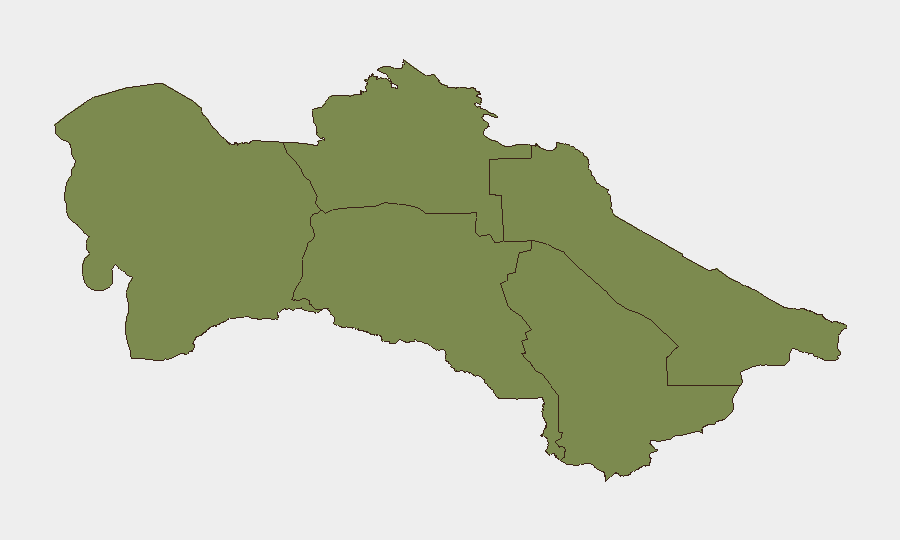
Ashgabat City dominates the sub-national risk profile, with a composite score of 31.3 compared to 1.3 across all other regions (Dashoguz, Balkan, Lebap, Ahal, Mary). This 24-fold differential reflects capital-city concentration of population, economic activity, government presence, and monitoring density rather than acute threat indicators. All five provincial regions exhibit uniform, low baseline risk. For corporate operations, Ashgabat presents the highest exposure surface due to density and visibility; provincial locations face minimal localized threats but reduced emergency response and medical infrastructure.
How GeoBit Would Assist
Security teams with Turkmenistan exposure should employ AOI Monitoring & Early Warning on Ashgabat and key economic nodes (TAPI/TAP project zones, border crossings) to detect shifts in state activity, infrastructure incidents, or crowd dynamics before they escalate. OSINT Fusion & Corroboration (multi-language search, X/Telegram monitoring, open-source news feeds) provides real-time verification of rumors and unverified claims, critical in an information-constrained environment. Routing & Network Analysis supports duty-of-care planning for personnel in high-risk border regions or remote project sites by identifying safe alternate corridors and egress points.
7-Day Outlook
No acute triggers are visible on the near-term horizon. Turkmenistan's policy focus remains on regional economic connectivity and Afghanistan stability; domestic political or security dynamics show no signs of stress. Risk posture is expected to remain stable through mid-June, barring unforeseen shifts in US–Iran sanctions, Afghanistan border volatility, or internal political signaling.
Highest-Risk Areas — Ranked
| # | State / Region | Risk |
|---|---|---|
| 1 | Ashgabat City | 31.3 |
| 2 | Dashoguz Region | 1.3 |
| 3 | Balkan Region | 1.3 |
| 4 | Lebap Region | 1.3 |
| 5 | Ahal Region | 1.3 |
| 6 | Mary Region | 1.3 |
Sources
Previous Daily Briefs
A new Turkmenistan brief is written every day — each with its own risk map and downloadable CSV. Here's the last week; use the calendar to go further back.
📅 Browse every day by calendar →
Highlighted days have a brief. Tap a day for that day's map & analysis, or “csv” for that day's dataset ($5).