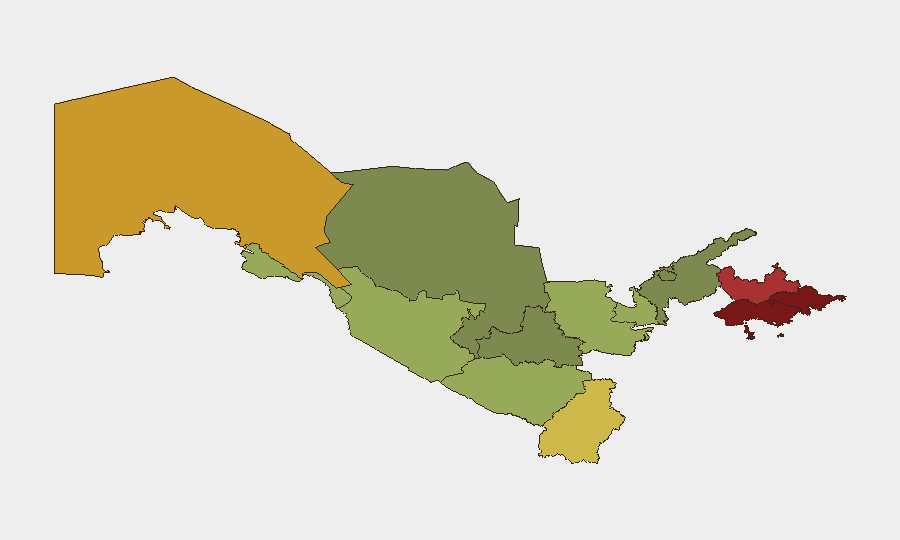
Situation Summary
Uzbekistan remains stable at the national level with a composite threat score of 5 and minimal tracked incidents in the last 24–48 hours. The country's security profile is dominated by persistent regional disparities, particularly in the Fergana Valley periphery (Andijan, Fergana, and Namangan regions), where historical grievances, porous borders, and transnational crime networks create sustained elevated risk. No discrete security incidents have been identified in the last 48 hours; the threat environment reflects chronic rather than acute drivers.
Key Developments
No specific, dated security incidents in Uzbekistan have been confirmed in the last 24–48 hours based on available open-source intelligence. The most recent tracked event signal (2026-06-13) references a China–Kazakhstan public statement and does not concern in-country Uzbek security dynamics.
*Note: A standing security assessment (terrorism, crime, border management, infrastructure) based on events and patterns predating this 48-hour window is available on request.*
Highest-Risk Areas
Andijan Region (risk score 88) and Fergana Region (82) drive the national risk ranking, followed by Namangan (78). These three contiguous areas form the core of the Fergana Valley, where geographic isolation, dense populations, weak state penetration, and historical separatist sentiment create persistent vulnerability to militant recruitment, smuggling, and trafficking. Karakalpakstan (72) presents distinct risks tied to resource scarcity, demographic stress, and its position on the Aral Sea crisis zone. Surxondaryo Region (65) and Qashqadaryo Region (58) remain elevated owing to proximity to Afghanistan and historical criminal networks. Central and western regions (Samarqand, Bukhara, Navoiy, Xorazm) are substantially lower-risk, reflecting stronger state capacity and lower transnational exposure.
How GeoBit Would Assist
Teams with personnel or assets in Uzbekistan should employ AOI Monitoring & Early Warning on high-risk regions (Andijan, Fergana, Namangan) to detect emerging protest, militant activity, or cross-border trafficking in near-real-time. Network & Actor Analysis and Telegram/social OSINT provide visibility into underground financial flows, recruitment rhetoric, and criminal coordination that precede incidents. Routing & Network Analysis enables alternative journey and supply-chain planning around Fergana Valley bottlenecks during periods of heightened tension. Conflict & Military and Border & Disputed-Territory search capabilities track state security force posture and Afghan spillover risk.
7-Day Outlook
No acute escalation indicators are visible in the immediate term. Uzbekistan's medium-term trajectory remains stable provided regional (Afghan Taliban policy, Kyrgyz border tensions) and transnational (Central Asian trafficking networks) drivers do not sharpen. Routine duty-of-care protocols for the Fergana Valley and southern border zones should remain in effect; no elevated alert level is warranted at this time.
Highest-Risk Areas — Ranked
| # | State / Region | Risk |
|---|---|---|
| 1 | Andijan Region | 88 |
| 2 | Fergana Region | 82 |
| 3 | Namangan Region | 78 |
| 4 | Republic of Karakalpakstan | 72 |
| 5 | Surxondaryo Region | 65 |
| 6 | Qashqadaryo Region | 58 |
| 7 | Sirdaryo Region | 55 |
| 8 | Jizzakh Region | 48 |
| 9 | Xorazm Region | 45 |
| 10 | Bukhara Region | 42 |
| 11 | Navoiy Region | 38 |
| 12 | Samarqand Region | 35 |
Sources
Previous Daily Briefs
A new Uzbekistan brief is written every day — each with its own risk map and downloadable CSV. Here's the last week; use the calendar to go further back.
📅 Browse every day by calendar →
Highlighted days have a brief. Tap a day for that day's map & analysis, or “csv” for that day's dataset ($5).