Situation Summary
Estonia remains a low-threat environment globally (rank #142, composite score 2.1), but faces elevated risk concentration in its northeastern and central industrial regions. The past 48 hours have recorded scattered protest activity and police response incidents, alongside persistent cyber-infrastructure vulnerabilities documented at national level. Drone-related security concerns have been flagged by the Estonian government, though specific incident details remain limited in current reporting.
Key Developments
- Tallinn / nationwide, 2026-06-03 – Police and protester clashes recorded; both violent repression by police and violent protest/riot signals logged, with unconventional violence reported by protester groups. Scope and casualty status unclear from available event data.
- Tallinn / state digital services – Ongoing cyber-infrastructure exposure: eesti.ee portal previously vulnerable to unauthorized document access (affecting ~300,000 users); X-Road data-exchange layer targeted in 2024 with 6,515 reported incidents, 580 DDoS attacks, and service disruptions to tax, customs, and emergency systems.
- Estonia airspace / Gulf of Finland, September 2025 – NATO consulted after reported Russian MiG-31 incursion (12 minutes). Italy's F-35s activated under Baltic air-policing mission. Russia denied violation; no escalation reported.
- Nationwide, recent – Government security briefing confirms active drone-related incidents linked to countermeasures; specific locations and tactical context not yet public.
- Investor threat signals, 2026-06-02 – Investor-directed threats and disapproval statements logged; geopolitical spillover (Israeli-Palestinian, Palestine-Sydney, protester-UK/Chile/Minnesota/Tehran signals) suggests internationalized protest climate affecting Estonia's public space.
Highest-Risk Areas
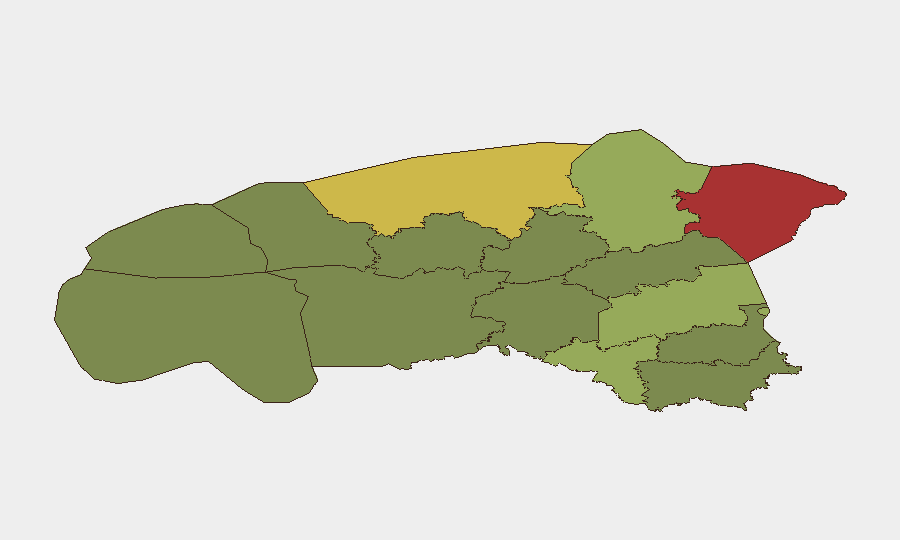
Ida-Viru County (risk 78) and Harju County (risk 68) dominate Estonia's subnational risk profile, with Tartu County (58) and Valga County (55) forming a secondary cluster. Ida-Viru's northeastern position near the Russian border and its industrial/energy infrastructure make it the highest-priority zone; Harju (which includes Tallinn) concentrates critical state digital services, finance, and international business presence. Together, these two counties account for the majority of tracked threat events and cyber-targeting activity. Tartu's university and tech sector, plus Valga's border adjacency, elevate their relevance for supply-chain and infrastructure security.
How GeoBit Would Assist
Intel Sweep and OSINT fusion would consolidate real-time protest, cyber-incident, and drone-activity reporting across Estonian government, media, and international NATO channels to establish early warning of escalation. AOI Monitoring with persistent alerting on Ida-Viru and Harju counties would flag emerging protest, drone, or cyber events within 2–4 hours of occurrence. Cyber search and vulnerability tracking via Shodan and breach-database monitoring would enable rapid detection of state-service exposure and investor-alert updates. Network and actor analysis would map protest organizers, state-response coordination, and foreign-actor influence across social media and Telegram, supporting threat-classification and duty-of-care escalation.
7-Day Outlook
Protest activity is likely to persist at low-to-moderate intensity given the internationalized geopolitical climate and spillover from Middle Eastern and Nordic demonstrations. Cyber-infrastructure remains under sustained pressure; additional DDoS or vulnerability-exploitation attempts should be expected, particularly targeting state portals and critical services. Drone incidents and NATO air-policing operations will continue as routine deterrence; no major military escalation is indicated, but monitoring of Russian-airspace behavior and NATO response coordination remains essential.
Highest-Risk Areas — Ranked
| # | State / Region | Risk |
|---|---|---|
| 1 | Ida-Viru County | 78 |
| 2 | Harju County | 68 |
| 3 | Tartu County | 58 |
| 4 | Valga County | 55 |
| 5 | Lääne-Viru County | 52 |
| 6 | Pärnu County | 35 |
| 7 | Rapla County | 32 |
| 8 | Jõgeva County | 30 |
| 9 | Järva County | 28 |
| 10 | Viljandi County | 25 |
| 11 | Põlva County | 22 |
| 12 | Võru County | 18 |