Situation Summary
Albania faces escalating political and social instability centered on anti-government protests in Tirana and environmental resistance in the Vlora region, both triggered by a luxury resort project linked to Jared Kushner/Trump family interests. Mass demonstrations involving tens of thousands have grown over consecutive nights (20–21 June), with protest organizers explicitly demanding Prime Minister Edi Rama's resignation and framing the issue as a catalyst for broader anti-corruption reform. The concurrent freeze of resort-linked assets by anti-corruption prosecutors and the arrest of private security guards following violent removal of activists have compounded public anger and signaled internal state pressure on the government. The overall threat trajectory is upward, with coordination among civil-society groups and diaspora amplifying the protest narrative beyond a single project dispute into a potential regime-stability challenge.
Key Developments
- Tirana – nightly mass anti-government protests (20–21 June): Thousands to tens of thousands gathered on consecutive evenings in front of the Prime Minister's Office and main boulevards, with organizers pledging continued demonstrations until Rama's resignation. Chants focused on corruption and resource sovereignty ("Albania is not for sale").
- Vlora/Zvërnec – ongoing site resistance and activist mobilization (20–21 June): Activists and residents continued gathering near the fenced construction site following widely circulated video of private security forcibly removing protesters. Authorities revoked licenses of two security firms and arrested one guard.
- Tirana – "Flamingo Movement" coordination (20–21 June): Opposition and civil-society groups formalized coordination around a broader anti-corruption, pro-reform campaign using the resort dispute as a mobilization focal point, with public statements demanding accountability and political renewal.
- Tirana – SPAK asset freeze reinforces protest narrative (20–21 June coverage): Anti-corruption prosecutors' ongoing freeze of bank accounts tied to Albania Land Development and Qatari investors was highlighted by protest leaders as evidence of project irregularities, boosting claims of state-level concern.
- Tirana & European capitals – diaspora solidarity amplification (20–21 June): Parallel rallies and messaging campaigns by Albanian diaspora in multiple European cities framed the Albania protests as part of a wider struggle against democratic backsliding and resource privatization.
- National political rhetoric escalation (20–21 June): Protest leaders and opposition-aligned figures intensified language calling for government "overthrow" or resignation, while maintaining stated commitment to peaceful demonstration. Messaging evolved from single-project opposition to broader anti-government and anti-corruption positioning.
Highest-Risk Areas
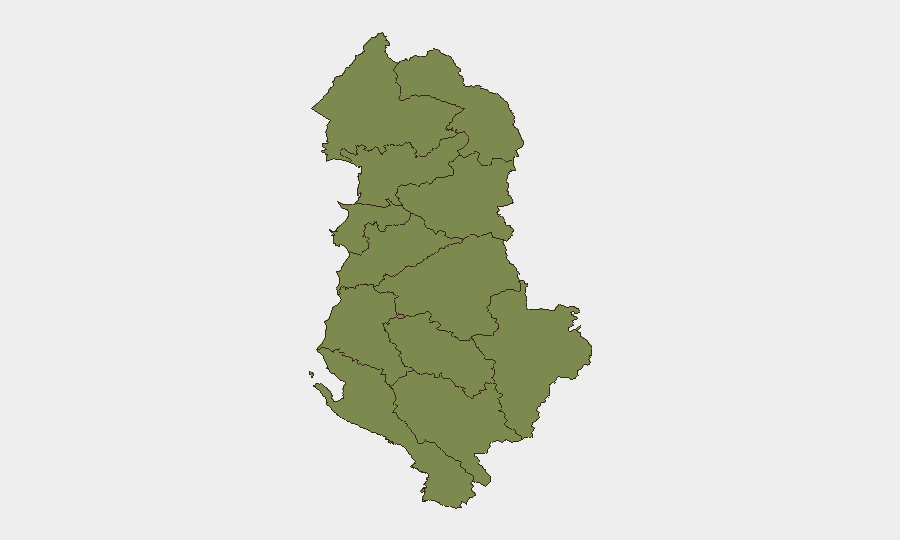
Vlorë County (risk 31.5) is the clear driver of sub-national instability, reflecting ongoing tension at the Vjosa-Narta protected landscape and the Zvërnec resort construction site, where environmental, legal, and activist resistance intersects with state security responses. Elbasan County (13.9) contributes secondary risk, though the primary focus of current events remains coastal. Tirana County (6.7), while lower-ranked than Vlorë, hosts the epicenter of political mobilization and mass demonstrations, making it operationally critical for corporate assets and personnel. The remaining counties show minimal current threat (≤2), suggesting risk concentration in the southwestern and central regions.
How GeoBit Would Assist
Security and risk teams would deploy AOI Monitoring & Early Warning on Tirana city center and Vlora/Zvërnec to track protest size, timing, and geographic spread with real-time alerting. OSINT fusion (X/Telegram, YouTube, multi-language search, entity extraction, and sentiment analysis) would monitor protest organizers, opposition coordination, and diaspora messaging to forecast escalation and identify public statements signaling violence or disruption. Network & Actor Analysis would map civil-society, opposition, and activist leadership to anticipate tactical shifts and likely flashpoints for personnel safety and supply-chain impact.
7-Day Outlook
Protests are likely to persist and potentially expand in size and geographic scope unless the government makes credible concessions (asset freeze removal, investigation acceleration, or policy reversal). Risk of localized clashes between protesters and security forces remains elevated, particularly in Vlora near active construction. Political pressure on Rama may intensify from within government or prosecution organs, increasing unpredictability around policy and enforcement over the coming week.
Highest-Risk Areas — Ranked
| # | State / Region | Risk |
|---|---|---|
| 1 | Vlorë County | 31.5 |
| 2 | Elbasan County | 13.9 |
| 3 | Tirana County | 6.7 |
| 4 | Korçë County | 2 |
| 5 | Durrës County | 1.5 |
| 6 | Shkodër County | 1.5 |
| 7 | Kukës County | 1.5 |
| 8 | Lezhë County | 1.5 |
| 9 | Dibër County | 1.5 |
| 10 | Fier County | 1.5 |
| 11 | Berat County | 1.5 |
| 12 | Gjirokastër County | 1.5 |
Sources
Previous Daily Briefs
A new Albania brief is written every day — each with its own risk map and downloadable CSV. Here's the last week; use the calendar to go further back.
📅 Browse every day by calendar →
Highlighted days have a brief. Tap a day for that day's map & analysis, or “csv” for that day's dataset ($5).