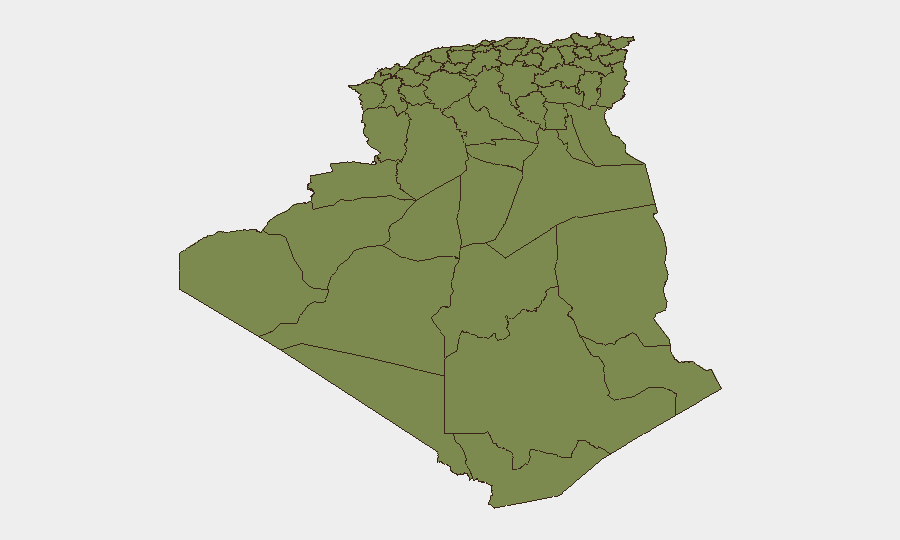
Situation Summary
Algeria remains a moderate-risk environment (global rank #84, composite threat 2.2) with a bifurcated threat landscape: acute militancy concentrated in the remote central Sahara and southern border regions, and latent political friction in the capital following July legislative elections. The recent diplomatic reset with Mali (airspace and ambassador redeployment, effective 10 July) reduces immediate state-to-state tension but does not materially change underlying non-state armed-group activity in the Sahel corridor. Open-source reporting confirms no major security incidents, civil unrest, or infrastructure disruption inside Algeria within the last 48 hours; the current environment is characterized by structural vulnerabilities rather than acute events.
Key Developments
- Mali–Algeria airspace reopening (10 July) – Both nations simultaneously announced restoration of civil and military flight corridors and return of ambassadors, formally ending a 15-month rupture. This reduces diplomatic friction but does not affect border-zone militancy or cross-border armed-group movements.
- Ambassador redeployment messaging (10–11 July) – Algerian President Tebboune ordered Ambassador Kamal Retieb back to Bamako; Mali reciprocated. Official statements frame this as a step toward Sahel security cooperation, but implementation and operational coordination remain contingent on evolving Mali–Niger–Burkina Faso military dynamics.
- Post-election political commentary (10–11 July) – Algerian and regional media analysis highlights low electoral turnout and public disillusionment following the 2 July legislative elections, with latent risk of small localized demonstrations near political institutions in Algiers. No corroborated reports of large-scale protests or clashes in the capital within the last 48 hours.
- Absence of reported terrorist or criminal incidents (last 48h) – Cross-check of international media, regional outlets, and social platforms shows no widely confirmed attacks, riots, significant political violence, or major infrastructure failures in Algeria during this period beyond routine criminality.
Highest-Risk Areas
In Salah (composite risk 31.5) and Algiers (18.2) dominate the threat ranking and warrant distinct monitoring. In Salah's extreme score reflects its position in the central Sahara corridor—a lawless rear base for non-state armed groups, with limited state presence and ongoing cross-border militancy from Mali-based actors. Algiers, while substantially lower-risk, carries political and diplomatic sensitivity; post-election disillusionment and structural economic constraints create conditions for periodic demonstrations and low-level unrest near government institutions. The remaining ten regions score uniformly at 1.5, indicating baseline or below-average risk and concentrated vulnerability along the southern and southwestern borders.
How GeoBit Would Assist
Corporate security and duty-of-care teams should deploy AOI Monitoring & Early Warning on In Salah, the Mali–Algeria border corridor, and central Algiers to detect escalation signals—armed-group activity, protest clustering, and diplomatic incidents—in near-real time. Intel Sweep and multi-language OSINT (X/Twitter, Telegram, regional media, YouTube) will surface emerging threats and sentiment shifts faster than traditional news cycles. Routing & Network Analysis supports alternative journey planning for personnel transiting the central Sahara, identifying safer overland and air corridors as regional conditions evolve.
7-Day Outlook
Near-term trajectory is stable with moderate baseline risk. The Mali airspace reopening reduces state-level friction but does not suppress armed-group activity in remote border zones; non-state threats will persist. Political disillusionment in Algiers may generate scattered, small demonstrations around government institutions through mid-July, but no large-scale unrest is forecast absent new triggering events. Monitor Algerian media and diplomatic signals for any deterioration in the Mali reset, which could quickly reset border tensions.
Highest-Risk Areas — Ranked
| # | State / Region | Risk |
|---|---|---|
| 1 | In Salah | 31.5 |
| 2 | Algiers | 18.2 |
| 3 | Bechar | 1.5 |
| 4 | Beni Abbes | 1.5 |
| 5 | Adrar | 1.5 |
| 6 | Bordj Badji Mokhtar | 1.5 |
| 7 | El Bayadh | 1.5 |
| 8 | Ghardaia | 1.5 |
| 9 | Saïda | 1.5 |
| 10 | Boumerdes | 1.5 |
| 11 | Tizi Ouzou | 1.5 |
| 12 | Chlef | 1.5 |
Sources
Previous Daily Briefs
A new Algeria brief is written every day — each with its own risk map and downloadable CSV. Here's the last week; use the calendar to go further back.
📅 Browse every day by calendar →
Highlighted days have a brief. Tap a day for that day's map & analysis, or “csv” for that day's dataset ($5).
Atlas — our AI intelligence desk — emails them this snapshot personally. Nothing else, no list.