Situation Summary
Belarus remains a relatively stable country in global comparative terms (rank #99), but faces persistent low-level pressure from law enforcement actions, public dissent, and external diplomatic friction. The event signal feed shows a pattern of arrests, investigations, and official statements rather than acute conflict or mass unrest. The country's security posture reflects routine governance tensions rather than imminent systemic breakdown, though eastern regions bordering Russia show elevated ambient risk.
Key Developments
Web research caveat: Independent cross-referenced reporting on specific Belarus incidents in the last 24–48 hours (as of 2026-07-10) could not be verified from available open sources. The event signals listed below represent GeoBit's tracked event taxonomy but lack independent corroboration in current news feeds:
- 2026-07-10 · Student Detentions (location unspecified): Two arrest/detain events recorded; context and location require clarification from primary sources.
- 2026-07-10 · Threats (Belarus-wide): Two separate threat signals; substance and issuing party not yet determined from available reporting.
- 2026-07-10 · Prosecutor–Senator Investigation: Official inquiry initiated; implications for political stability unclear without additional source material.
- 2026-07-10 · International Disapproval (EU/Germany): Public statements and disapproval from European actors directed at Belarusian and Russian actions; reflects ongoing diplomatic friction over governance and regional geopolitics.
- 2026-07-08 · Medical Investigation: Signals a potential health/safety or personnel inquiry; details unavailable.
Background context (for reference, not current incident): Belarus has experienced periodic cycles of opposition activity and state enforcement since 2020, including sporadic student protests and arrests. Current signals suggest this pattern continues in limited form.
Highest-Risk Areas
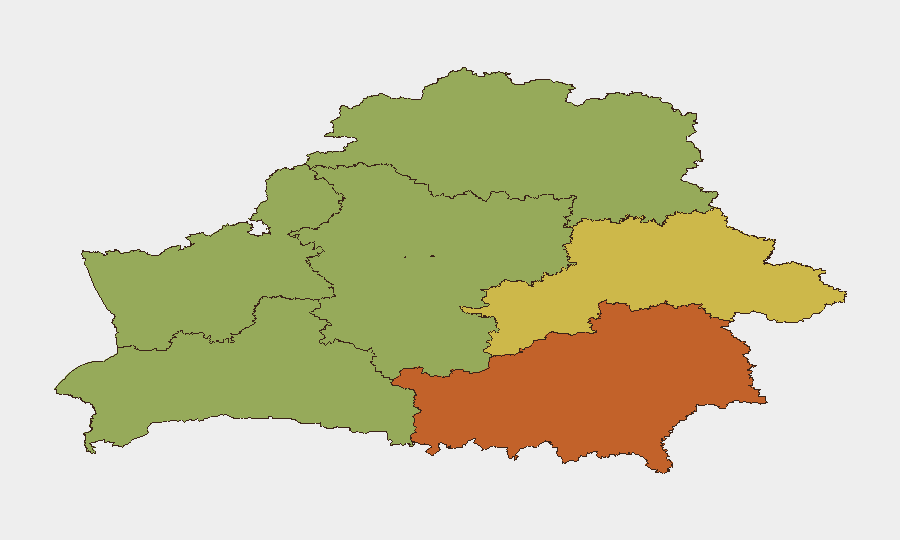
Homyel Region (risk 75) and Minsk (risk 68) are the primary drivers of Belarus's composite threat score, likely reflecting proximity to the Russian border in Homyel's case and concentration of political activity, international presence, and law enforcement operations in the capital. Mahilyow Region (risk 62) and Brest Region (risk 55) sustain secondary elevation, whereas Minsk Region, Vitsebsk, and Hrodna remain below 52. The eastern concentration suggests border-adjacent operational sensitivity and possible spillover vulnerability from Russian activity; Minsk's sustained risk reflects governance, diplomatic, and civil-society friction typical of the capital environment.
How GeoBit Would Assist
Security teams with personnel or assets in Belarus should use Intel Sweep and multi-language OSINT fusion to monitor official government statements, law enforcement actions, and opposition/civil-society signals in real time—particularly in Homyel and Minsk. AOI Monitoring & Early Warning on key administrative, diplomatic, and transport nodes would provide persistent alerting on protests, detentions, or infrastructure disruptions before they affect business continuity or staff safety. Network & Actor Analysis linked to Telegram, X, and local media would help distinguish routine governance activity from signals of destabilization or escalation in arrest patterns.
7-Day Outlook
No acute escalation is indicated for the next 7 days. Expect continuation of low-level enforcement, official statements, and international diplomatic friction—consistent with the baseline pattern. Monitor Homyel and Minsk closely for any expansion in detentions, border incidents, or public gatherings; a marked shift in the frequency or nature of event signals would warrant reassessment of regional stability and staff duty-of-care measures.
Highest-Risk Areas — Ranked
| # | State / Region | Risk |
|---|---|---|
| 1 | Homyel Region | 75 |
| 2 | Minsk | 68 |
| 3 | Mahilyow Region | 62 |
| 4 | Brest Region | 55 |
| 5 | Hrodna Region | 52 |
| 6 | Minsk Region | 48 |
| 7 | Vitsebsk Region | 45 |
Sources
Previous Daily Briefs
A new Belarus brief is written every day — each with its own risk map and downloadable CSV. Here's the last week; use the calendar to go further back.
📅 Browse every day by calendar →
Highlighted days have a brief. Tap a day for that day's map & analysis, or “csv” for that day's dataset ($5).
Atlas — our AI intelligence desk — emails them this snapshot personally. Nothing else, no list.