Situation Summary
Bhutan remains a low-threat environment with a composite global threat score of 7 and minimal acute security incidents in the last 48 hours. Two tracked events in the current cycle—one arrest/detention and multiple public statements by government officials between 11–12 June—do not suggest systemic instability or travel risk elevation. The country's overall security posture remains stable, though sub-national variation in risk warrants targeted monitoring in border and southern districts.
Key Developments
- 11–12 June 2026 · Multiple Public Statements – Bhutanese government and Prime Minister issued public statements without indication of crisis or emergency context. Open-source reporting provides no detail on content or drivers; statements appear routine in character.
- 12 June 2026 · Arrest/Detention (Police Action) – A police arrest or detention event was recorded; no credible open reporting confirms involvement of international personnel, critical infrastructure impact, or broader security escalation.
- 13 June 2026 · Dehradun, India (Bhutanese Military Cadet) – A Bhutanese foreign officer cadet at the Indian Military Academy participated in a public reflection on training and upcoming Passing Out Parade. No security incidents or personnel complications reported; event underscores routine India–Bhutan defence cooperation.
- No new civil unrest, crime spikes, infrastructure incidents, or political instability reported in last 24–48 hours based on available open web, social media, and news sources. Recent mentions of Bhutan in search results relate to development projects (World Bank implementation reports), civic engagement, and general policy analysis—none flagging acute risks.
Highest-Risk Areas
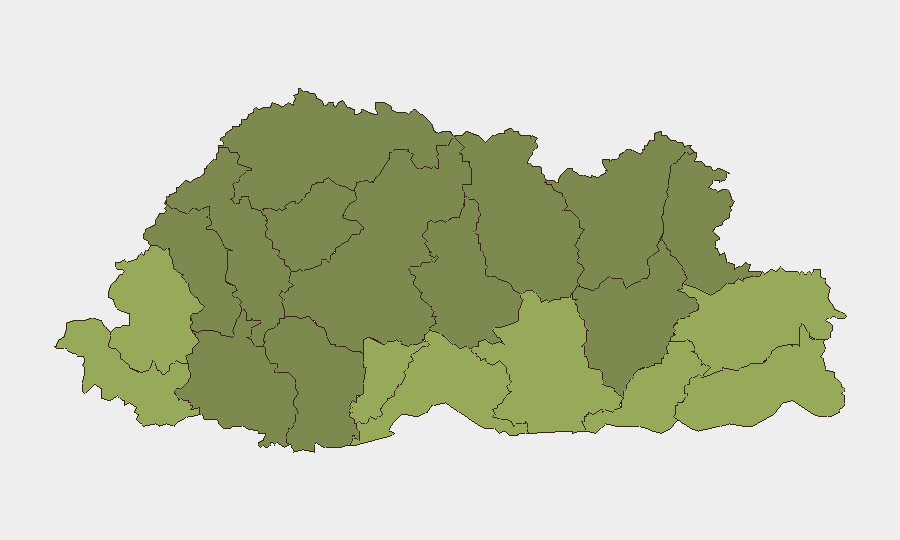
Samtse, Sarpang, and Haa districts in southern and southwestern Bhutan drive the country's regional risk profile, with composite scores of 58, 55, and 52 respectively. These border-adjacent areas face elevated exposure to transnational crime, irregular migration, and smuggling networks operating across Bhutan–India boundaries. Pemagatshel, Samdrup Jongkhar, and Tsirang districts similarly rank above the country median (scores 50, 48, 45), reflecting continued southern vulnerability. Northern and central districts (Gasa, Lhuntse, Wangdue Phodrang) register lower composite risk, suggesting that localized border-region dynamics—not nationwide political or conflict drivers—account for variation.
How GeoBit Would Assist
Security teams with people or assets in Bhutan should use AOI Monitoring & Early Warning to establish persistent watch on Samtse, Sarpang, and Haa districts, with automated alerting on crime, border-crossing irregularities, or civil disturbances. Multi-language OSINT and X/Twitter monitoring combined with sentiment and temporal analysis will track emerging government statements and social signals ahead of public announcement. Routing & Network Analysis can identify alternative movement corridors in high-risk southern districts if operational or duty-of-care constraints arise.
7-Day Outlook
No escalation in national-level political instability or conflict is anticipated over the next week. Routine monitoring of southern border districts for transnational crime and irregular movement should continue; the current two-event signal suggests no imminent shift in baseline risk. Teams should maintain standard duty-of-care protocols and confirm local contact networks in Samtse and Sarpang districts if personnel are based there.
Highest-Risk Areas — Ranked
| # | State / Region | Risk |
|---|---|---|
| 1 | Samtse District | 58 |
| 2 | Sarpang District | 55 |
| 3 | Haa District | 52 |
| 4 | Pemagatshel District | 50 |
| 5 | Samdrup Jongkhar District | 48 |
| 6 | Tsirang District | 45 |
| 7 | Zhemgang District | 42 |
| 8 | Trashigang District | 40 |
| 9 | Mongar District | 38 |
| 10 | Gasa District | 35 |
| 11 | Lhuntse District | 32 |
| 12 | Wangdue Phodrang District | 30 |
Sources
Previous Daily Briefs
A new Bhutan brief is written every day — each with its own risk map and downloadable CSV. Here's the last week; use the calendar to go further back.
📅 Browse every day by calendar →
Highlighted days have a brief. Tap a day for that day's map & analysis, or “csv” for that day's dataset ($5).