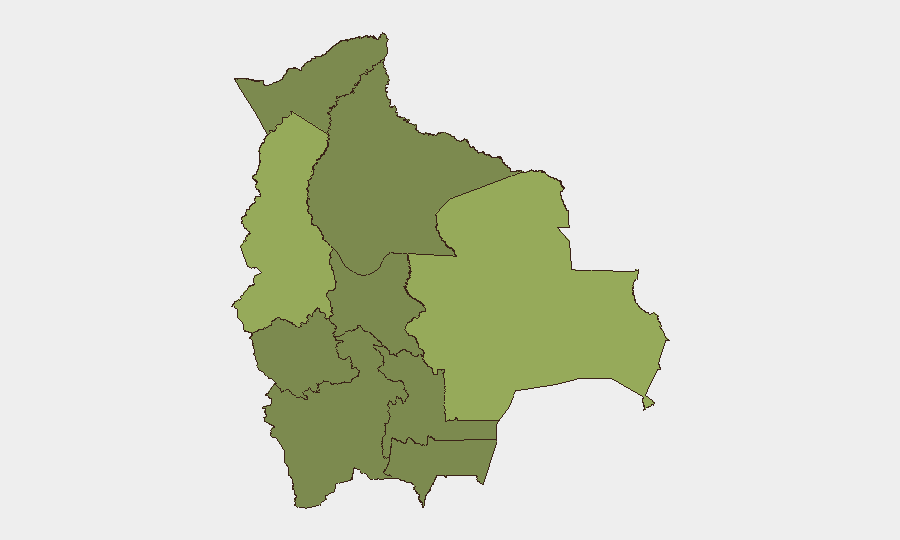
Situation Summary
Bolivia is experiencing escalating political and civil unrest centered on presidential directives and protest activity, with the legislature having passed emergency-powers legislation on 9 June that permits military deployment against demonstrations. Santa Cruz and La Paz departments carry the highest composite threat scores (54.1 and 43.5 respectively), driven by ongoing blockades, security-force interventions, and protest mobilization. The national threat trajectory remains elevated but volatile, dependent on whether emergency powers are formally invoked and the scale of any subsequent military response.
Key Developments
- National (9 June 2026) – Legislature passed emergency legislation enabling President Paz to declare a state of emergency and authorize military action against protests, removing procedural constraints on security-force deployment.
- La Paz (10 June 2026) – President issued demand/public directive; concurrent parliamentary disapproval signal suggests deepening friction between executive and legislative branches over protest response.
- Santa Cruz Department (8–9 June 2026) – Police investigation initiated and administrative sanctions applied to protesters, indicating formal law-enforcement escalation and potential detention or charges against demonstration organizers.
- National (8 June 2026) – Two separate conventional military-force events recorded, consistent with pre-positioning or readiness signaling ahead of possible emergency declaration.
- National (9 June 2026) – Demonstration/rally activity against administration reported; geographic specificity limited in available signals, but event count suggests broad participation across multiple sites.
- International dimension (8–10 June) – Belarus and China issued public statements; EU relationship signal tied to third-party actor (Robert Mugabe context unclear from provided data). These may indicate diplomatic positioning or concern regarding Bolivia's internal trajectory.
Note: Earlier June reporting (6 June, San Julián, Santa Cruz) documented security-force intervention in protest blockades on critical highway infrastructure with dozens injured, but falls outside the 24–48-hour window. It remains contextually relevant to current Santa Cruz risk elevation.
Highest-Risk Areas
Santa Cruz (54.1) and La Paz (43.5) dominate the risk profile. Santa Cruz's elevation is driven by recent blockade incidents, security-force interventions, and highway infrastructure disruption affecting national commerce and movement. La Paz, as the administrative capital, is the locus of presidential directives, legislative action, and concentrated protest activity. Cochabamba (34.8) shows moderate elevation, likely from demonstration spillover. The remaining departments cluster at 24.1, suggesting dispersed but lower-intensity risk. Organizations with personnel or supply chains dependent on Santa Cruz–La Paz corridor or critical infrastructure (fuel, commerce, transport) face the highest operational disruption risk.
How GeoBit Would Assist
Intel Sweep and multi-language OSINT (X, Telegram, local news feeds) would track real-time protest mobilization, military positioning statements, and ministerial announcements to detect if and when emergency powers are formally invoked. AOI Monitoring & Early Warning on Santa Cruz highway corridors and La Paz administrative zones would provide persistent, granular alert capability for blockade resumption, military deployment, or violence escalation. Sentiment & Temporal Analysis on political statements and protest rhetoric would distinguish short-term pressure release from escalatory trajectory, enabling duty-of-care teams to time staffing changes or asset repositioning.
7-Day Outlook
If emergency powers are declared within the next 72 hours, expect rapid military mobilization and potential use of force against blockades, particularly in Santa Cruz, with accompanying communication blackouts or transport restrictions. If no formal declaration occurs, protest activity will likely persist at current intensity, with intermittent security-force responses and negotiation attempts. Either scenario carries elevated risk of incidents affecting foreign nationals, supply chains, and critical services through mid-June.
Highest-Risk Areas — Ranked
| # | State / Region | Risk |
|---|---|---|
| 1 | Santa Cruz | 54.1 |
| 2 | La Paz | 43.5 |
| 3 | Cochabamba | 34.8 |
| 4 | Potosí | 24.8 |
| 5 | Tarija | 24.1 |
| 6 | Pando | 24.1 |
| 7 | Beni | 24.1 |
| 8 | Oruro | 24.1 |
| 9 | Chuquisaca | 24.1 |
Sources
Previous Daily Briefs
A new Bolivia brief is written every day — each with its own risk map and downloadable CSV. Here's the last week; use the calendar to go further back.
📅 Browse every day by calendar →
Highlighted days have a brief. Tap a day for that day's map & analysis, or “csv” for that day's dataset ($5).