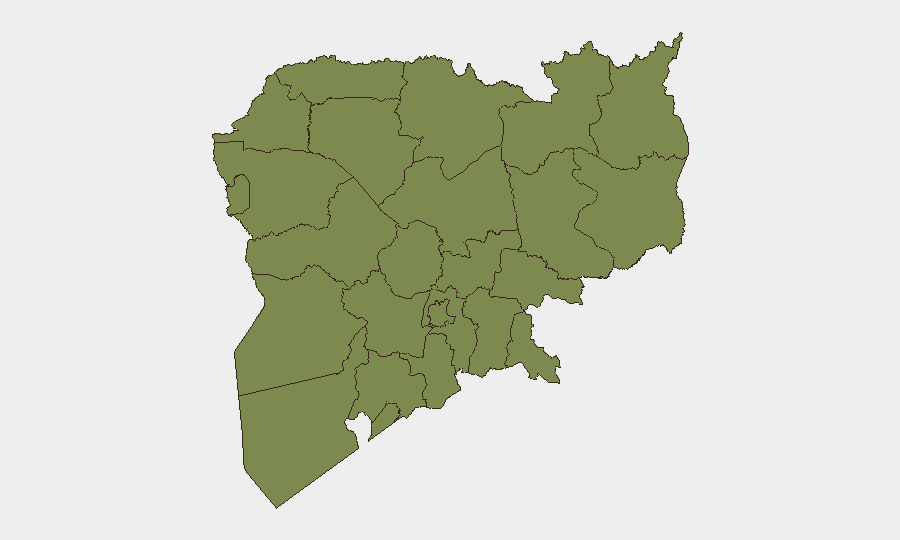
Situation Summary
Cambodia remains a low-to-moderate threat environment (global rank #87, composite score 14) with no acute security incidents reported in the last 24–48 hours. The security landscape is stable domestically, though a border-fence construction project near the Thai–Cambodian frontier has surfaced diplomatic framing around sovereignty and border management. Risk concentration is heavily skewed toward Phnom Penh, which accounts for the majority of tracked threat activity; all other provinces score substantially lower.
Key Developments
- Thai–Cambodian border (Chanthaburi Province, Thailand / adjacent Cambodia), June 28, 2026: Thai parliamentary delegation inspected an 8.3 km security fence under construction along the border; Thai military confirmed the project is ~45% complete, border crossings in the area remain closed, and Cambodia has been invited to observe construction. Thai government statements (via official Facebook, June 28) reframed the dispute as a sovereignty-related diplomatic matter rather than an active security incident, and called for joint fact-finding to prevent escalation.
- No discrete conflict, civil unrest, crime spike, infrastructure disruption, or acute travel-risk incidents were identified inside Cambodia during June 27–28, 2026 across available corroborated sources.
- Longer-term context (not a current development): China–Cambodia security partnership discussions were reported June 26, reflecting ongoing strategic alignment rather than new acute threats.
Highest-Risk Areas
Phnom Penh dominates the threat profile, with a composite risk score of 31.8—nearly double that of the second-ranked province, Kampong Thom (16.8). The capital concentrates urban crime, civil unrest potential, and political-activity monitoring. All remaining 10 tracked provinces cluster at a much lower baseline (risk 1.8 each), indicating that threat drivers—whether crime, protest, or instability—are geographically concentrated in the capital and, to a lesser extent, in central Kampong Thom. Regional stability appears robust outside these two zones.
How GeoBit Would Assist
Security teams operating in Cambodia should deploy AOI (Area of Interest) Monitoring & Early Warning on Phnom Penh and border zones to catch emerging protest, crime, or diplomatic friction with real-time alerting. Intel Sweep and multi-language OSINT (social media, local media, Telegram channels) provide continuous signal detection for unrest or incidents before they escalate. For duty-of-care teams with travel or supply-chain exposure near borders, Routing & Network Analysis identifies alternative corridors if diplomatic tensions or temporary border-crossing closures disrupt planned routes.
7-Day Outlook
No imminent security escalation is forecast. The Thai border-fence situation appears diplomatically managed rather than operationally hostile. Phnom Penh will remain the primary focus for routine crime and political monitoring; provincial areas pose minimal near-term risk. Continued diplomatic engagement between Thailand and Cambodia is expected to stabilize border framing over the coming week.
Report Date: 2026-06-29 | GeoBit Threat Rank: #87 global | Confidence: Moderate (limited real-time incident reporting in current window)
Highest-Risk Areas — Ranked
| # | State / Region | Risk |
|---|---|---|
| 1 | Phnom Penh | 31.8 |
| 2 | Kampong Thom | 16.8 |
| 3 | Koh Kong | 1.8 |
| 4 | Kampong Speu | 1.8 |
| 5 | Kandal | 1.8 |
| 6 | Prey Veng | 1.8 |
| 7 | Khaet Preah Sihanouk | 1.8 |
| 8 | Kampot | 1.8 |
| 9 | Kep | 1.8 |
| 10 | Takeo | 1.8 |
| 11 | Svay Rieng | 1.8 |
| 12 | Oddar Meanchey | 1.8 |
Sources
Previous Daily Briefs
A new Cambodia brief is written every day — each with its own risk map and downloadable CSV. Here's the last week; use the calendar to go further back.
📅 Browse every day by calendar →
Highlighted days have a brief. Tap a day for that day's map & analysis, or “csv” for that day's dataset ($5).