Situation Summary
Cape Verde remains a low-threat environment with no active security incidents, civil unrest, or acute travel disruptions recorded in the last 24–48 hours. The country's composite threat score (2/global rank #176) reflects stable governance, low crime relative to regional peers, and no documented terrorism, insurgency, or political instability. Current media coverage is dominated by Cape Verde's participation in the 2026 FIFA World Cup; logistics abroad (visa access, team travel delays) are not security events within Cape Verde's territory.
Key Developments
No discrete security, crime, civil-unrest, or infrastructure incidents meeting operational threshold have been confirmed in Cape Verde within the last 24–48 hours via independent corroboration.
Context: Recent open-source coverage focuses on:
- Cape Verde national team's World Cup performance and upcoming matches (non-security).
- US visa barriers affecting some Cape Verdean and Senegalese World Cup supporters attempting to travel to matches in the United States (consular/mobility issue, not domestic instability).
- No credible reports of protests, riots, political violence, terrorism, or major crime spikes across any municipality.
Highest-Risk Areas
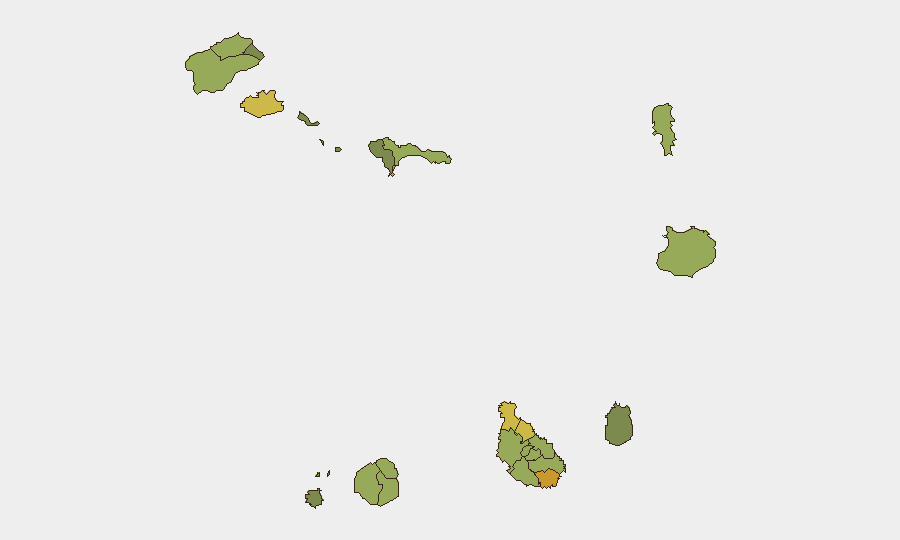
Praia (capital, risk score 72) and São Miguel (68) carry the highest sub-national risk scores, reflecting their scale, population density, and concentration of economic activity. São Vicente (65) and Tarrafal (62) follow, driven primarily by petty crime, informal-economy pressures, and limited formal law-enforcement presence in certain neighborhoods rather than organized violence or political instability. Risk in these municipalities remains moderate and localized; no current incident or spike justifies elevated alert status, but duty-of-care teams should maintain standard precautions (awareness of surroundings, secure accommodation, avoidance of isolated areas after dark) typical for West African urban settings.
How GeoBit Would Assist
Security and duty-of-care teams monitoring Cape Verde would benefit from AOI (area-of-interest) monitoring and early-warning capability on Praia, São Miguel, and São Vicente to detect emerging protests, crime clusters, or political signals in near-real time. Multi-language OSINT, X/Twitter sentiment and entity analysis, and regional news feeds would provide rapid detection of any labor unrest, electoral-cycle tensions, or infrastructure failures. Routing and network analysis can inform safe corridors and alternative movement patterns in higher-risk neighborhoods should personnel need to operate in Praia or São Vicente.
7-Day Outlook
No security deterioration is expected in the coming week. Cape Verde's political calendar, economic outlook, and security posture remain stable. Teams should continue routine monitoring via open sources and maintain standard corporate travel-security protocols; no escalation of alert posture is warranted at this time.
Report prepared: 2026-06-20 | Next review: 2026-06-21 | Contact: GeoBit Senior Analyst, Security Brief Division
Highest-Risk Areas — Ranked
| # | State / Region | Risk |
|---|---|---|
| 1 | Praia | 72 |
| 2 | São Miguel | 68 |
| 3 | São Vicente | 65 |
| 4 | Tarrafal | 62 |
| 5 | São Filipe | 58 |
| 6 | Santa Catarina | 58 |
| 7 | Santa Cruz | 55 |
| 8 | Mosteiros | 52 |
| 9 | São Salvador do Mundo | 52 |
| 10 | Ribeira Grande | 50 |
| 11 | Porto Novo | 48 |
| 12 | Sal | 48 |
Sources
Previous Daily Briefs
A new Cape Verde brief is written every day — each with its own risk map and downloadable CSV. Here's the last week; use the calendar to go further back.
📅 Browse every day by calendar →
Highlighted days have a brief. Tap a day for that day's map & analysis, or “csv” for that day's dataset ($5).