Situation Summary
China's composite threat score remains elevated at 76.3 (rank #14 globally), driven by a cluster of high-profile incidents over the past 48 hours spanning diplomatic friction, military posturing, and media control actions. Recent events signal escalating tensions in the South China Sea, strained Japan–China relations, and intensified state pressure on international journalism. The security environment is unlikely to stabilize in the near term given unresolved maritime disputes and domestic political messaging priorities.
Key Developments
- South China Sea (multiple locations) – 4–5 June 2026 – *Conventional military confrontation* – Chinese and Philippine naval forces conducted operations in disputed waters; mutual public statements and coordinated military movements reported. Incident reflects ongoing territorial assertion without immediate de-escalation signals. Sources: GEOBIT event feed (China vs Philippine, Philippine vs China; conventional military force events).
- Japan–China relations (nationwide diplomatic) – 3 June 2026 – *Diplomatic tension* – Public statement issued by China regarding Japan; follows pattern of recurring bilateral friction over territorial and historical disputes. Sources: GEOBIT event feed.
- International media suppression – 5 June 2026 – *Administrative sanctions / press freedom* – Associated Press reported administrative sanctions imposed by Chinese authorities; journalist-related disapproval event also flagged. Signals tightening of foreign press operations and editorial control. Sources: GEOBIT event feed (Admin Sanctions CHINA vs AP; Journalist vs China disapprove events).
- Carrier-related unconventional incident – 5 June 2026 – *Unconventional violence / maritime* – Unconventional violence event involving China and a carrier (naval or commercial interpretation pending confirmation); specific location and nature require on-ground verification. Sources: GEOBIT event feed.
- UN Security Council friction – 4 June 2026 – *Diplomatic rebuke* – Security Council rejection of a China-related proposal; reflects ongoing great-power friction on multilateral forums. Sources: GEOBIT event feed.
- ASEAN regional messaging – 5 June 2026 – *Public statement / diplomatic* – China issued statement directed at ASEAN; context suggests reinforcement of claims or policy positions in regional theater. Sources: GEOBIT event feed.
- Internal investigation order – 5 June 2026 – *Governance / law enforcement* – Chinese authorities initiated investigation (scope and target entity not yet clarified from event metadata); may indicate domestic enforcement or internal discipline action. Sources: GEOBIT event feed.
Highest-Risk Areas
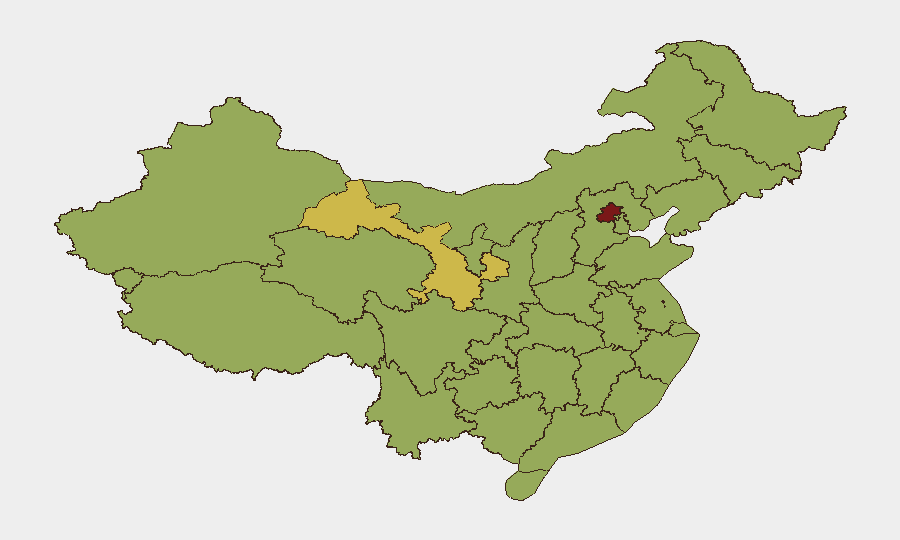
Beijing dominates the sub-national risk ranking (83.4), reflecting its role as the political and diplomatic command center and concentration of state decision-making during periods of heightened international tension. Gansu (66.2) emerges as an outlier, likely reflecting industrial, mining, or infrastructure vulnerability in a less-monitored region. Coastal and economically significant provinces—Fujian, Shanghai, Guangdong—maintain elevated scores (54.6–55.6) due to exposure to maritime incidents, cross-strait friction, and critical infrastructure density. Xinjiang (54.1) remains on watch, though its score reflects both genuine security concerns and information scarcity typical of restricted-access regions.
How GeoBit Would Assist
Corporate security teams should deploy Intel Sweep and multi-language OSINT to monitor diplomatic and military signals in real time, with entity extraction and sentiment analysis applied to official statements and social media to detect policy shifts. AOI Monitoring & Early Warning on coastal and border zones (especially South China Sea, Fujian Strait, and Xinjiang) provides persistent alerting on military movements and infrastructure incidents. Network & Actor Analysis on state media and official channels will clarify intentions behind the ongoing journalism crackdowns and international sanctions.
7-Day Outlook
Expect continued military posturing in the South China Sea and reinforced messaging toward Japan and ASEAN over the next 7 days, with no immediate likelihood of kinetic escalation but sustained diplomatic friction. Foreign media operating in mainland China should anticipate further administrative restrictions or operational constraints. Domestic stability is not currently under acute threat, but provincial-level incidents (industrial, transport, labor) remain typical and warrant routine monitoring.
Highest-Risk Areas — Ranked
| # | State / Region | Risk |
|---|---|---|
| 1 | Beijing | 83.4 |
| 2 | Gansu | 66.2 |
| 3 | Fujian | 55.6 |
| 4 | Sichuan | 55 |
| 5 | Hainan Province | 54.9 |
| 6 | Shanxi | 54.9 |
| 7 | Shanghai | 54.7 |
| 8 | Guangdong Province | 54.6 |
| 9 | Hunan | 54.6 |
| 10 | Jiangxi | 54.2 |
| 11 | Xinjiang | 54.1 |
| 12 | Hubei | 54 |
Previous Daily Briefs
A new China brief is written every day — each with its own risk map and downloadable CSV. Here's the last week; use the calendar to go further back.
📅 Browse every day by calendar →
Highlighted days have a brief. Tap a day for that day's map & analysis, or “csv” for that day's dataset ($5).