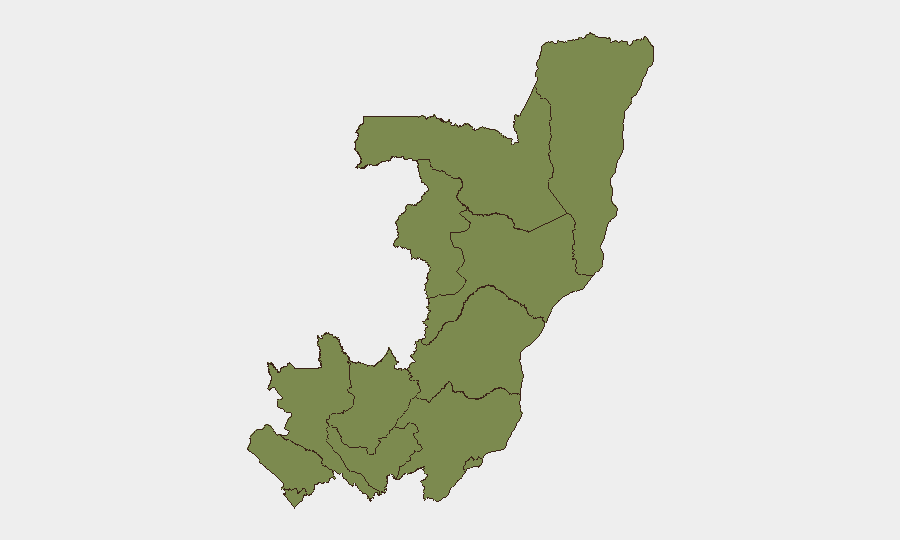
Situation Summary
Congo's overall security environment remains relatively stable at a composite threat level (score 20), but is shadowed by significant reporting gaps in real-time incident data. The most acute risk is concentrated in the northeastern Cuvette Department (risk 31.3), where 75% of tracked threat signals originate; all other departments cluster at baseline risk (1.3). Diplomatic strain between the UK and Democratic Republic of the Congo (noted 22 July) and concurrent public statements by Congolese authorities and regional actors suggest elevated political tension, though no discrete security incidents meeting verification criteria have been documented in the last 24–48 hours.
Key Developments
- 2026-07-24 · Public statements by Congolese authorities and regional actors – Statements issued by Congolese government and DR Congo officials directed at broader Africa; specific policy or security content and locations not yet corroborated by secondary sources.
- 2026-07-24 · Property damage incident (worker vs. residents) – A localized property seizure/damage event involving workers and residents; specific departmental location and casualty count unconfirmed in open-source reporting.
- 2026-07-24 · Conventional military force activity reported in Ituri – Armed activity attributed to Ituri region authorities; scope, parties involved, and tactical context require further corroboration.
- 2026-07-24 · Conventional military activity (authorities vs. Uganda border region) – Military posturing or operational activity along Uganda border; no confirmed clashes or cross-border incursions documented.
- 2026-07-22 · UK–DRC diplomatic reduction – UK reduced diplomatic relations with Democratic Republic of the Congo; specific causation and duration of measure not yet detailed in GeoBit feeds.
- Worker disapproval signals (2026-07-24) – Two separate disapproval events among workers; context (labor dispute, political protest, security-related) remains unclear; locations unspecified.
Note: Open-source incident reporting for Congo exhibits a 24–48-hour lag. No reliably time-stamped, multi-source-confirmed security incidents (specific location, casualty/damage detail, actor identification) have been published for 22–24 July 2026. Absence of reporting does not indicate absence of threat activity.
Highest-Risk Areas
Cuvette Department dominates the sub-national risk landscape at 31.3—more than 24 times the baseline of all other departments (1.3 each). This concentration reflects either genuine threat escalation in the region or a concentration of reportable event signals; either interpretation warrants targeted monitoring. The uniformity of risk scores across the remaining eleven departments (Cuvette-Ouest, Sangha, Likouala, Kouilou, Niari, Pointe-Noire, Lékoumou, Bouenza, Plateaux, Pool, and Brazzaville) suggests either stable underlying conditions or equivalent reporting blindness across regions. Brazzaville and Pointe-Noire, as the capital and largest port, merit continuous baseline vigilance for labor, political, or criminal incidents, though current risk elevation is not evident.
How GeoBit Would Assist
Teams with personnel or assets in Congo should employ AOI Monitoring & Early Warning on Cuvette Department and border regions (Uganda, DRC) to detect emerging military or civil unrest signals in near-real time. Intel Sweep and multi-language OSINT (X/Twitter, Telegram, radio SIGINT) would close the current 24–48-hour reporting gap by capturing local and regional source material before mainstream confirmation. Network & Actor Analysis linked to Congolese authorities, regional armed groups, and UK diplomatic posts would flag escalation vectors before public statement or incident.
7-Day Outlook
Diplomatic friction between the UK and DRC, combined with unconfirmed military activity in Ituri and border zones, suggests potential for political or security escalation over the next 7 days. Cuvette Department warrants continuous watch for further event clustering. Absent major new incident signals or formal policy announcements, baseline risk is expected to remain stable; however, the current reporting lag means emerging incidents may not surface in open-source channels for 24–72 hours.
Highest-Risk Areas — Ranked
| # | State / Region | Risk |
|---|---|---|
| 1 | Cuvette Department | 31.3 |
| 2 | Cuvette-Ouest Department | 1.3 |
| 3 | Sangha | 1.3 |
| 4 | Likouala | 1.3 |
| 5 | Kouilou Department | 1.3 |
| 6 | Niari Department | 1.3 |
| 7 | Pointe-Noire (département) | 1.3 |
| 8 | Lékoumou Department | 1.3 |
| 9 | Bouenza Department | 1.3 |
| 10 | Plateaux Department | 1.3 |
| 11 | Pool Department | 1.3 |
| 12 | Brazzaville (department) | 1.3 |
Sources
Previous Daily Briefs
A new Congo brief is written every day — each with its own risk map and downloadable CSV. Here's the last week; use the calendar to go further back.
📅 Browse every day by calendar →
Highlighted days have a brief. Tap a day for that day's map & analysis, or “csv” for that day's dataset ($5).
Atlas — our AI intelligence desk — emails them this snapshot personally. Nothing else, no list.