Situation Summary
Eswatini remains a low-threat environment (composite global rank #150, score 9) with no confirmed security incidents recorded in the reporting period. The country's security posture is stable, though sub-national risk concentration in the southern regions (Lubombo and Shiselweni) warrants continued monitoring. Recent diplomatic engagement and cross-border cooperation initiatives suggest a stable operating environment for corporate and international personnel, provided standard duty-of-care protocols remain in place.
Key Developments
- 7 October — Manzini: Eswatini and Lesotho's communications regulators formally announced a bilateral cooperation agreement focused on cybersecurity coordination, regulatory alignment, and protection against emerging digital threats. This represents a proactive regional security posture on ICT infrastructure resilience.
- 11 October — Eswatini (nationwide): King Mswati III concluded a state visit to Taiwan during which Taiwan-donated medevac helicopters were highlighted as operationally active in Eswatini. The visit included specialized training delivery to 11 Eswatini personnel, signaling capability enhancement in emergency medical services and disaster response infrastructure.
- 7 October — Unspecified informal border crossings (unverified): *Swaziland News* alleged that Eswatini authorities were facilitating nighttime release and transit of some U.S. deportees toward South Africa through informal crossing points. This claim lacks independent corroboration and should be treated as single-source allegation pending verification.
- 13 October — Eswatini / diplomatic risk (unverified): *Swaziland News* reported unconfirmed allegations that Eswatini had granted former Democratic Republic of Congo (DRC) President Joseph Kabila citizenship and diplomatic credentials, potentially amid links to a newly formed DRC politico-military faction. The king's office publicly denied the claim; no independent corroboration has emerged. Diplomatic risk exposure should be monitored pending clarification.
Highest-Risk Areas
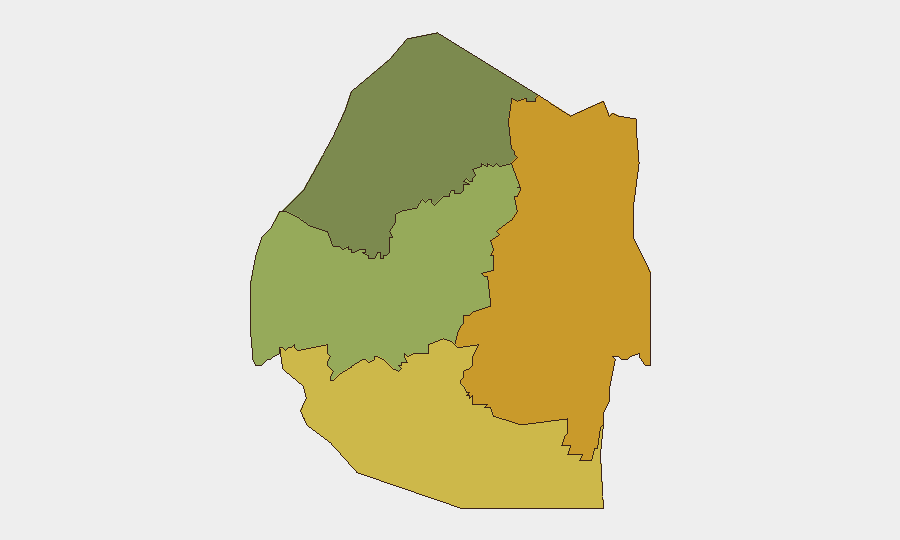
Lubombo Region (risk score 72) and Shiselweni Region (risk score 68) together account for the majority of tracked sub-national risk exposure, likely reflecting cross-border trafficking, informal settlement activity, and proximity to South Africa's high-crime zones. Manzini Region (score 55) presents moderate concentration risk, while Hhohho Region (score 35) shows substantially lower threat density. Organizations with personnel or assets in the southern regions should maintain heightened situational awareness and implement targeted protective measures; Hhohho and central areas present reduced operational friction.
How GeoBit Would Assist
Security teams operating in Eswatini should deploy AOI Monitoring & Early Warning on Lubombo and Shiselweni to detect emerging trafficking, border-crossing anomalies, or civil unrest in real time. Intel Sweep and multi-language OSINT (including Telegram, X, and local news) enable continuous tracking of diplomatic and cross-border developments—particularly the unverified allegations regarding DRC political actors and deportee transit. Routing & Network Analysis supports safer personnel movement planning in high-risk southern regions by identifying lower-risk corridors and waypoints.
7-Day Outlook
No acute security deterioration is anticipated over the near term; Eswatini's composite threat score and absence of confirmed incidents suggest stability will persist. However, the unverified allegations regarding diplomatic passport issuance and cross-border deportee activity merit 10–14 day monitoring to determine whether independent corroboration or official clarification emerges, particularly given potential implications for border management and transnational criminal networks. Standard protective protocols should remain in effect, with emphasis on southern-region risk awareness.
Highest-Risk Areas — Ranked
| # | State / Region | Risk |
|---|---|---|
| 1 | Lubombo | 72 |
| 2 | Shiselweni | 68 |
| 3 | Manzini Region | 55 |
| 4 | Hhohho Region | 35 |
Sources
Previous Weekly Briefs
A new Eswatini brief is written every Monday, covering the week — each with its own risk map and downloadable CSV. Use the calendar to go further back.
- October 6, 2026
- September 29, 2026
- September 22, 2026
- September 15, 2026
- September 8, 2026
- September 1, 2026
- August 30, 2026
📅 Browse past briefs by calendar →
Highlighted days have a brief. Tap a day for that day's map & analysis, or “csv” for that day's dataset ($5).
Atlas — our AI intelligence desk — emails them this snapshot personally. Nothing else, no list.