Situation Summary
Ethiopia remains a complex, fragmented conflict environment with civil tensions, regional armed group activity, and intermittent conventional military clashes across multiple zones. The country's composite threat score of 72.7 (rank #22 globally) reflects sustained low-to-moderate intensity civil conflict rather than acute national collapse, but volatility persists across at least six high-risk regions. Diplomatic activity and public statements from neighbouring states (Djibouti, Eritrea) and international actors over the past 48 hours suggest ongoing regional friction and external engagement in Ethiopia's internal dynamics. The security picture remains fluid and regionally fragmented rather than nationally coordinated.
Key Developments
- 2026-06-06 · Abduction/Hostage Incident (Location/Actor Unconfirmed): An abduction or hostage-taking event was flagged in the event feed; specific location, parties involved, and casualty details require urgent clarification from field sources or official statements.
- 2026-06-04 · Diplomatic Escalation (Djibouti–Ethiopia): Multiple public statements from Djibouti directed at Ethiopia suggest either border tensions, regional proxy activity, or humanitarian/migration concerns; nature and underlying trigger remain unclear from available open reporting.
- 2026-06-04 · Military Activity (Ethiopia/Government Forces): Conventional military force signals indicate active operational tempo between Ethiopian federal or regional forces and unidentified opposition elements; location and scale unconfirmed.
- 2026-06-04 · Eritrean Public Statement: Eritrea issued a public statement on or regarding Ethiopia; context (support, criticism, warning) is not yet detailed in available summaries.
- 2026-06-04 · Media Allegations (Amhara Region): Media outlets reported on events or actions affecting the Amhara region; specifics (protest, military action, humanitarian incident) require source review.
- 2026-06-05 · Corporate/Aviation Signal (Boeing–British Airways): An investigation-level flag involving Boeing and British Airways in Ethiopia context was logged; link to on-ground security risk (aircraft incident, sanctions, supply-chain disruption) is unclear and warrants clarification.
Note on Incident Confirmation: Open-source reporting available within the strict 24–48 hour window lacks sufficient granularity to confirm locations, casualty counts, or operational details for most events. Multi-source validation and direct contact with on-ground operators, diplomatic missions, or UN field offices is essential.
Highest-Risk Areas
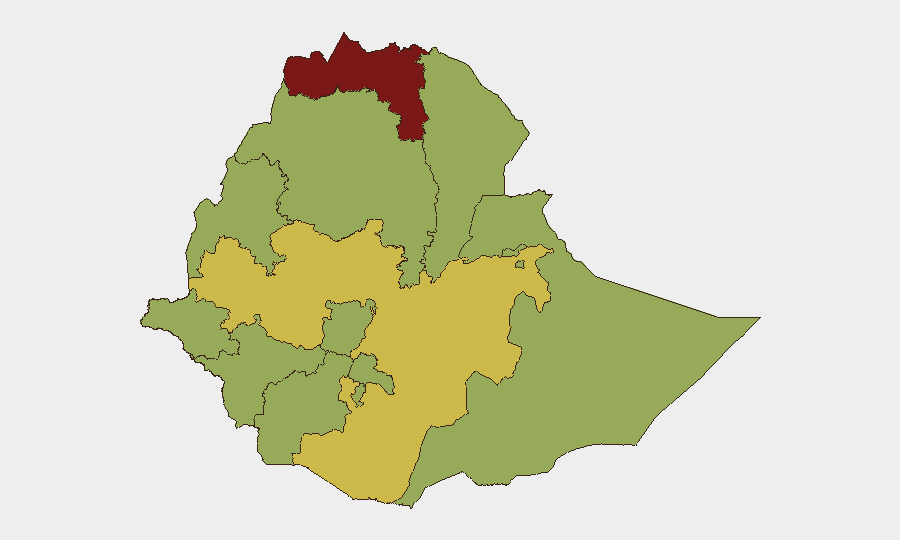
Tigray region dominates the sub-national risk profile (80.9), reflecting residual armed-group presence and limited state authority despite nominal ceasefire agreements. Oromia Region (68.0) remains volatile due to ongoing OLF/OPDO friction, pastoralist-communal clashes, and periodic security-force sweeps. Central Ethiopia Regional State (57.3) and Amhara Region (55.2) are secondary concern zones with localized communal violence, militia activity, and state-rebel dynamics. All other regions cluster at 50.9, indicating a broad baseline of civil tension, banditry, and tribal/ethnic conflict rather than pockets of stability. Addis Ababa itself carries equal risk (50.9), suggesting urban security concerns—protest, targeted crime, or spillover from regional conflict—warrant attention for corporate and expatriate personnel.
How GeoBit Would Assist
Teams should deploy AOI Monitoring & Early Warning (persistent watch on Tigray, Oromia, and Amhara) coupled with Intel Sweep and multi-language OSINT to detect emerging incidents, military repositioning, and diplomatic signals in real time. Conflict & Military (battle mapping, force-structure tracking) and Network & Actor Analysis enable identification of armed-group activity and command changes. Routing & Network Analysis supports duty-of-care teams in planning movement corridors and identifying alternative transit routes away from active flashpoints.
7-Day Outlook
Near-term risk remains stable at current elevated baseline, with continued diplomatic activity and low-intensity regional friction likely. The hostage/abduction incident and renewed military signals warrant close 48–72 hour monitoring for any cascade or escalation. Rainy-season logistics constraints may degrade access and increase banditry and communal-resource conflicts in rural zones.
Highest-Risk Areas — Ranked
| # | State / Region | Risk |
|---|---|---|
| 1 | Tigray | 80.9 |
| 2 | Oromia Region | 68 |
| 3 | Central Ethiopia Regional State | 57.3 |
| 4 | Amhara Region | 55.2 |
| 5 | Afar Region | 50.9 |
| 6 | Benishangul-Gumuz Region | 50.9 |
| 7 | Somali Region | 50.9 |
| 8 | Gambela Region | 50.9 |
| 9 | South West Ethiopia Peoples | 50.9 |
| 10 | Addis Ababa | 50.9 |
| 11 | South Ethiopia Regional State | 50.9 |
| 12 | Sidama | 50.9 |
Sources
Previous Daily Briefs
A new Ethiopia brief is written every day — each with its own risk map and downloadable CSV. Here's the last week; use the calendar to go further back.
📅 Browse every day by calendar →
Highlighted days have a brief. Tap a day for that day's map & analysis, or “csv” for that day's dataset ($5).