Situation Summary
Greece maintains a low-threat security environment as of 25 June 2026, with no confirmed discrete security incidents, civil unrest, or significant crime events reported in the preceding 24–48 hours. The country's composite threat score of 11 (rank #97 globally) reflects manageable risk across most regions, though Attica's elevated sub-national score warrants continued monitoring. The threat landscape shows no signs of material deterioration, and routine security postures remain appropriate for most operational contexts.
Key Developments
Open-source intelligence feeds and specialized Greece security monitoring covering the 24–48 hour window preceding this brief report no confirmed incidents meeting discrete event criteria. A dedicated Greece security assessment explicitly notes the absence of tracked security events, civil unrest, crime incidents, or travel-risk developments in this timeframe. Event signals flagged in the platform's broader feed (dated 23–25 June) reflect administrative, regulatory, and procedural activities (investigations, ministerial statements, public disapprovals) rather than acute security incidents. No cross-referenced corroboration of material security deterioration is available from current open-source feeds. Routine police and regulatory operations continue without indication of operational disruption or systemic instability. No protests, demonstrations, or armed incidents are confirmed in major urban or transport hubs as of 25 June. Existing administrative and judicial processes (flagged in platform signals) remain within normal governance parameters and do not indicate imminent public-order risk.
Highest-Risk Areas
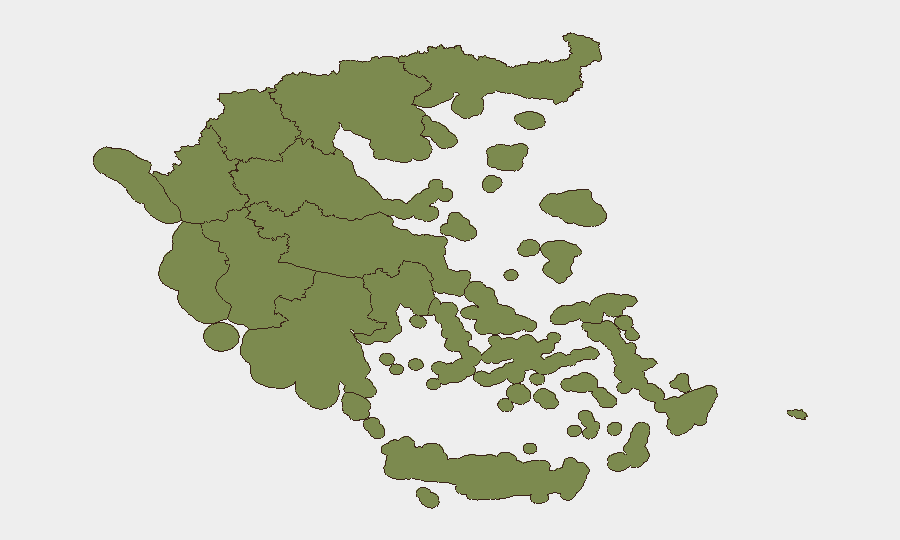
Attica (Athens metropolitan region and surrounds) carries substantially elevated risk relative to other Greek regions, with a composite score of 32—nearly 2.5× the second-ranked Central Greece (12.9). Attica's concentration of national government, dense population, critical infrastructure, and historical susceptibility to protest activity and political volatility drive this profile. Central Greece ranks second, likely reflecting agricultural/labor sensitivities and regional economic conditions. All other regions score below 5, indicating dispersed, manageable risk; Crete, Epirus, and the Ionian Islands remain low-threat. Organizations with personnel or assets concentrated in the greater Athens area should maintain heightened awareness protocols; dispersed operations across lower-risk regions face proportionally lower duty-of-care burden.
How GeoBit Would Assist
Security teams should leverage AOI (Area-of-Interest) Monitoring & Early Warning to establish persistent watch on Attica (Athens city center, transport nodes, government districts) with automated alerting for demonstrations, unrest, or incidents. Intel Sweep and multi-language OSINT fusion (X/Twitter, Telegram, local news aggregation) provide real-time coverage of emerging labor, political, or civil-order developments before they escalate to operational impact. Routing & Network Analysis enables alternative travel and supply-chain planning for staff and assets in Attica, mitigating exposure to transport disruptions during periods of heightened tension.
7-Day Outlook
No significant threat escalation is anticipated over the coming week based on current trend data and absence of imminent triggering events. Routine administrative and regulatory processes will continue; security postures in Attica should remain elevated but do not require emergency-level activation. Organizations should maintain standard monitoring cadence and review duty-of-care protocols for Attica-based operations quarterly or upon platform alert triggers.
Highest-Risk Areas — Ranked
| # | State / Region | Risk |
|---|---|---|
| 1 | Attica | 32 |
| 2 | Central Greece | 12.9 |
| 3 | Crete | 4.4 |
| 4 | Epirus | 3.6 |
| 5 | Ioanian Islands | 3.2 |
| 6 | Thessaly | 2.8 |
| 7 | Peloponnese Region | 2.4 |
| 8 | Western Macedonia | 2 |
| 9 | Central Macedonia | 2 |
| 10 | Eastern Macedonia and Thrace | 2 |
| 11 | Western Greece | 2 |
| 12 | Autonomous Monastic State of the Holy Mountain | 2 |
Sources
Previous Daily Briefs
A new Greece brief is written every day — each with its own risk map and downloadable CSV. Here's the last week; use the calendar to go further back.
📅 Browse every day by calendar →
Highlighted days have a brief. Tap a day for that day's map & analysis, or “csv” for that day's dataset ($5).