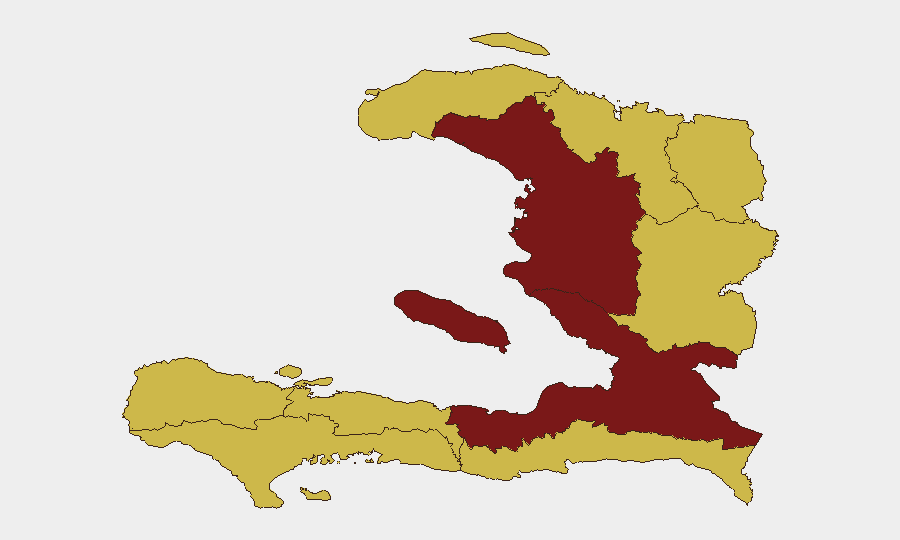
Situation Summary
Haiti's security environment has deteriorated sharply over the past 48 hours, with gang violence reaching critical intensity in Port-au-Prince and triggering mass civilian displacement. The abduction of James Boyard—a high-ranking cabinet official and former police inspector general—on June 13 represents an unprecedented breach of state security and has catalyzed public loss of confidence in law enforcement. Armed gangs now control multiple zones of the capital, severely constraining movement and essential services; the UN Secretary-General's office has publicly flagged the country as "collapsing into chaos." The convergence of organized criminal activity, state-security compromise, and humanitarian crisis signals acute and immediate risk to foreign nationals and local populations.
Key Developments
- Port-au-Prince, June 13: James Boyard, cabinet director, chief of staff to the Defense Minister, and former inspector general of the Haitian National Police, was kidnapped by armed gunmen—the highest-ranking official abducted amid the current violence wave.
- Port-au-Prince, June 13: Civilians and police officers staged public protests demanding the dismissal and arrest of Haiti's police chief, citing failure to contain gang violence and protect senior officials; demonstrations coincided with accounts of intensified gang attacks in the capital.
- Port-au-Prince (multiple neighborhoods), June 13: Heavily armed gangs launched coordinated attacks across residential districts, forcing hundreds of families to flee homes and seek shelter along roads and in open areas; displacement is ongoing and widespread.
- Port-au-Prince metropolitan area, June 13: Gangs maintain operational control over multiple zones of the capital, severely restricting civilian and commercial movement and access to services; international monitoring confirms gangs' ability to project force with impunity.
- Port-au-Prince, June 13–14: UN and international humanitarian bodies have escalated situational alerts, describing immediate risks to aid workers, travelers, and civilians; high-level diplomatic focus on Haiti's security collapse has been activated.
- Regional context (since February 2026): Artibonite and de l'Ouest departments remain the highest-risk areas (composite scores 93.3 and 92.4, respectively), but gang violence and criminal networks now concentrate in Port-au-Prince, where state institutions show signs of compromise.
Highest-Risk Areas
Artibonite and de l'Ouest departments register the highest composite risk scores, reflecting sustained gang activity and limited state presence; however, the June 13 spike in Port-au-Prince violence and the kidnapping of a cabinet-level security official indicate that risk concentration has shifted toward the capital and its immediate periphery. The abduction of Boyard signals potential penetration of state security structures by organized criminal actors, elevating risk for all foreigners and high-profile individuals in the metropolitan area. Remaining departments (Nippes through Sud-Est) show elevated but secondary risk; however, gang networks' demonstrated mobility suggests risk can spread rapidly beyond tracked hotspots.
How GeoBit Would Assist
Security teams operating in Haiti would benefit from AOI Monitoring & Early Warning (persistent Port-au-Prince and departmental watches with real-time alerting on gang movements and state-security incidents), OSINT fusion & corroboration (systematic tracking of gang communications, public statements, and reports across social media and humanitarian channels to validate threat signals), and Routing & Network Analysis (alternative movement planning and safe-passage assessment as gang control zones shift). Additionally, Intel Sweep and multi-language event feeds enable rapid correlation of kidnappings, protests, and military responses to anticipate second- and third-order effects on duty-of-care obligations.
7-Day Outlook
Gang consolidation of Port-au-Prince territory is likely to continue absent rapid state or international security intervention; further abductions or attacks targeting foreigners or business interests remain probable. Displacement and humanitarian deterioration will accelerate, potentially prompting evacuation pressure and logistical bottlenecks. Risk to corporate personnel and assets will remain acute through mid-to-late June absent significant change in operational environment.
Highest-Risk Areas — Ranked
| # | State / Region | Risk |
|---|---|---|
| 1 | Artibonite Department | 93.3 |
| 2 | de l'Ouest Department | 92.4 |
| 3 | Nippes Department | 65.2 |
| 4 | Grande-Anse Department | 63.3 |
| 5 | Sud Department | 63.3 |
| 6 | Nord-Ouest Department | 63.3 |
| 7 | Nord Department | 63.3 |
| 8 | Nord-Est Department | 63.3 |
| 9 | Centre Department | 63.3 |
| 10 | Sud-Est Department | 63.3 |
Sources
Previous Daily Briefs
A new Haiti brief is written every day — each with its own risk map and downloadable CSV. Here's the last week; use the calendar to go further back.
📅 Browse every day by calendar →
Highlighted days have a brief. Tap a day for that day's map & analysis, or “csv” for that day's dataset ($5).