Situation Summary
Iraq remains in a fragile equilibrium between state consolidation efforts and persistent cross-border threats. The composite national threat score of 80.8—driven primarily by insurgency and militia activity—reflects ongoing U.S.–Iran proxy dynamics, residual ISIS cells, and weapons-control pressures on armed factions. Recent escalation involving Iranian missile strikes on Kurdish separatist targets in northern Iraq, U.S. self-defense airstrikes, and credible militia attack warnings in Baghdad signal elevated near-term volatility, particularly around U.S. interests and state monopoly enforcement on weaponry.
Key Developments
- Baghdad, Central Zone (2026-06-03) – U.S. Embassy issued imminent-threat alert citing credible intelligence of Iran-aligned militia attacks within 24–48 hours; advised all U.S. citizens to depart Iraq immediately, indicating elevated complex-attack risk (IED, indirect fire).
- Northern Iraq / KRG Border (2026-06-02) – Iran conducted missile strikes on Iranian Kurdish separatist group headquarters; cross-border strike capability and willingness demonstrated, raising risk to assets in Erbil and Duhok governorates.
- Iraq, Unspecified Locations (2026-06-02) – U.S. conducted "self-defense" airstrikes against Iran-linked facilities; part of escalating U.S.–Iran proxy cycle likely to prompt further militia retaliation against U.S. personnel and bases.
- Western Nineveh Province (2026-06-02) – Popular Mobilization Forces killed a senior ISIS figure in counter-terror operation; confirms active ISIS cells remain along Syrian border and desert belts, requiring heightened vigilance in remote areas.
- Baghdad (2026-06-02) – Military intelligence arrested 10 drug traffickers; signals ongoing security sweeps that may impose temporary checkpoints and movement restrictions in capital.
- Nationwide (2026-06-03) – Iraq's Communications and Media Commission suspended Korek Telecom operations; major service gap in Kurdistan Region affects mobile banking, ride-hailing, and emergency communications.
- Baghdad, Political Zones (2026-06-02) – Emergency parliamentary session scheduled to complete cabinet formation; potential trigger for demonstrations or sit-ins in Green Zone and surrounding areas.
- National (2026-06-02) – State authorities moving to enforce weapons monopoly; Muqtada al-Sadr reaffirmed militia dismantling, but hardline resistance expected, raising intra-Shia faction tension risk.
Highest-Risk Areas
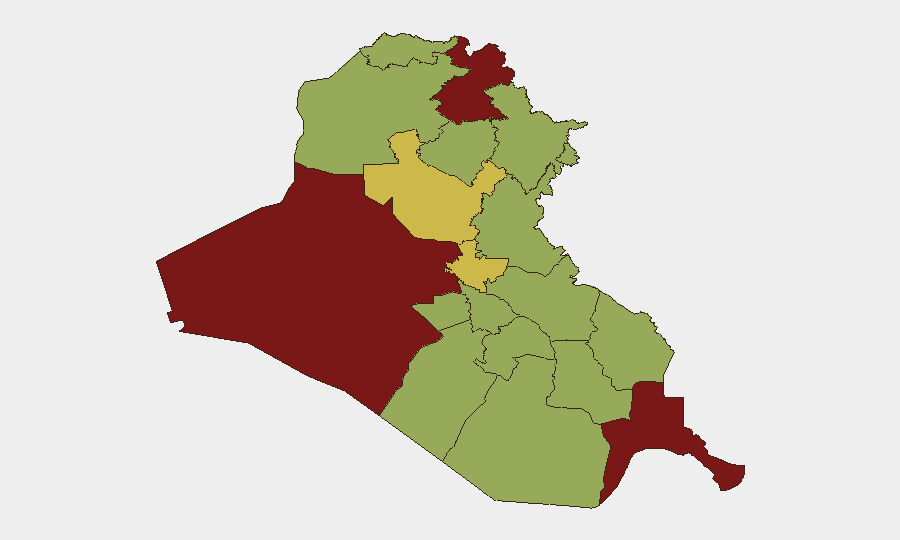
Al-Basra, Al-Anbar, and Erbil governorates rank highest (86.6, 80.7, and 80.2 respectively), driven by confluence of militia presence, U.S. military footprint, cross-border Iranian activity, and residual ISIS networks. Baghdad (61) remains significant due to capital concentration of political targets, diplomatic missions, and militia infrastructure. The Kurdistan region (Erbil, Duhok) faces particular cross-border strike risk following the recent Iranian missile attack and ongoing PJAK operations, while southern governorates reflect organized-crime and PMF power-struggle dynamics.
How GeoBit Would Assist
Security teams operating in Iraq should employ AOI Monitoring & Early Warning on Baghdad diplomatic zones, KRG border crossings, and key military installations to detect militia movement and threat indicators in real time. Network & Actor Analysis on Iran-aligned militia groups, ISIS cells, and armed-faction leadership enables identification of command nodes and escalation triggers. Routing & Network Analysis supports safe-passage planning and identification of checkpoint-heavy corridors, particularly critical given ongoing weapons sweeps and political tensions.
7-Day Outlook
The 24–48-hour militia-attack window cited in the U.S. Embassy alert suggests immediate volatility risk, with potential for direct action against U.S. personnel or facilities. Parallel weapons-monopoly enforcement and cabinet formation will generate secondary risks: checkpoints in Baghdad, potential protest activity, and possible intra-faction armed clashes. Cross-border Iranian strike capability remains active; further U.S. retaliation cycles should be expected if militia attacks materialize.
Highest-Risk Areas — Ranked
| # | State / Region | Risk |
|---|---|---|
| 1 | Al-Basra Governorate | 86.6 |
| 2 | Al-Anbar Governorate | 80.7 |
| 3 | Erbil Governorate | 80.2 |
| 4 | Baghdad Governorate | 61 |
| 5 | Saladin Governorate | 60.5 |
| 6 | Duhok Governorate | 57.1 |
| 7 | Babil Governorate | 56.6 |
| 8 | Wasit Governorate | 56.6 |
| 9 | Al-Qadisiyah Governorate | 56.6 |
| 10 | Dhi Qar Governorate | 56.6 |
| 11 | Al-Muthanna Governorate | 56.6 |
| 12 | Maysan Governorate | 56.6 |
Sources
Previous Daily Briefs
A new Iraq brief is written every day — each with its own risk map and downloadable CSV. Here's the last week; use the calendar to go further back.
📅 Browse every day by calendar →
Highlighted days have a brief. Tap a day for that day's map & analysis, or “csv” for that day's dataset ($5).