Situation Summary
Italy remains a moderate-threat environment (global rank #153, composite score 5) but faces a sharp near-term spike in political tension, diplomatic friction with the US, and coordinated civil unrest. A public dispute between Prime Minister Meloni and President Trump over Italy's military support for US operations in Iran, combined with nationwide pro-Palestinian strike activity and port blockades on 23–24 June, has elevated protest risk and created localized transit disruptions. Lazio (primarily Rome) and Umbria dominate the sub-national risk profile and remain the focus of monitoring; broader coordinated action across ~80 cities signals sustained activist mobilization through at least the near term.
Key Developments
- Rome, 24 June 2026 – Defense Minister Guido Crosetto publicly rejected NATO Secretary-General Mark Rutte's claims that 500 US aircraft operated from Italian bases for combat missions against Iran, asserting Italy authorized only non-kinetic logistical support. The statement underscores ongoing domestic political pressure over Italy's military alignment with the US.
- Rome, 24 June 2026 – Italian government formally labeled Rutte's account "totally misleading" and reiterated refusal to exceed non-kinetic support parameters, signaling hardened public diplomatic posture and potential for further political controversy.
- Rome, 23 June 2026 – Prime Minister Meloni stated US–Italy relations "had to return to normal" following an escalating public dispute with Trump over claims he made regarding her behavior at the G7 summit and her stance on Iran. Foreign Minister Tajani's planned US visit was cancelled as a signal of diplomatic strain.
- Rome & nationwide, 23–24 June 2026 – A coordinated wave of pro-Palestinian demonstrations, strikes, and port blockades involved teachers, students, dock workers, and activists from approximately 80 cities. Pro-Palestinian protesters near Rome's Termini station clashed with police, resulting in tear-gas dispersal and disruption to local metro and bus services.
- Genoa and Livorno, 23 June 2026 – Dock workers blocked port entrances at both locations as part of the nationwide solidarity action, creating operational disruptions to freight and logistics traffic.
- Nationwide, 23 June 2026 – Trump and Meloni's public dispute escalated across broadcast media and social platforms, with Trump renewing personal criticism of Meloni and her foreign-policy stance. This polarization is driving online amplification and raising the risk of further politically charged street demonstrations.
Highest-Risk Areas
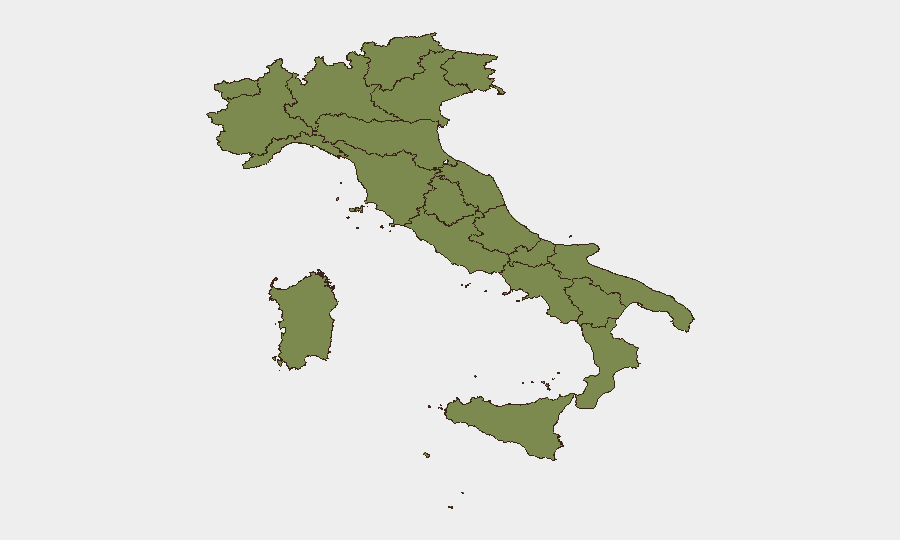
Lazio (risk score 32) and Umbria (24.9) substantially exceed all other regions and drive Italy's national threat profile. Lazio's dominance reflects Rome's concentration of government institutions, diplomatic sites, and protest-prone urban centers; current developments—the Trump–Meloni diplomatic rift, pro-Palestinian demonstrations, and ongoing NATO-related political dispute—are all centered in the capital and its immediate environs. Umbria's elevated score warrants close monitoring but specific recent event data for the region are limited. Lombardy (9.7) remains tertiary but merits standard monitoring for Milan-based business and financial activity.
How GeoBit Would Assist
Corporate security teams should deploy OSINT Fusion & Corroboration and Entity Extraction to track the evolving Trump–Meloni narrative across Italian broadcast and social-media channels in real time, and use Sentiment & Temporal Analysis to forecast protest-mobilization windows. AOI Monitoring & Early Warning configured for Rome (Termini, government districts, ports) and Genoa/Livorno would enable persistent alerting on street activity, transit disruptions, and port operations. Routing & Network Analysis can identify alternative travel and logistics pathways during port blockades or localized demo activity.
7-Day Outlook
The Trump–Meloni dispute and coordinated pro-Palestinian activism are likely to sustain elevated protest risk and sporadic transit/port disruptions through at least early July. Further demonstrations in Rome, secondary cities, and port areas are foreseeable; diplomatic tensions may fuel additional political rhetoric and online polarization, though a sharp escalation to violence remains low-probability absent a new trigger event.
Highest-Risk Areas — Ranked
| # | State / Region | Risk |
|---|---|---|
| 1 | Lazio | 32 |
| 2 | Umbria | 24.9 |
| 3 | Lombardy | 9.7 |
| 4 | Sicily | 5.8 |
| 5 | Marche | 3.7 |
| 6 | Abruzzo | 3.1 |
| 7 | Apulia | 2.9 |
| 8 | Tuscany | 2.7 |
| 9 | Veneto | 2.4 |
| 10 | Sardinia | 2.2 |
| 11 | Basilicata | 2.2 |
| 12 | Piedmont | 2.2 |
Sources
Previous Daily Briefs
A new Italy brief is written every day — each with its own risk map and downloadable CSV. Here's the last week; use the calendar to go further back.
📅 Browse every day by calendar →
Highlighted days have a brief. Tap a day for that day's map & analysis, or “csv” for that day's dataset ($5).