Situation Summary
Latvia remains at low operational risk with no acute armed conflict, major civil unrest, or infrastructure collapse reported within the last 24–48 hours. However, the security posture remains elevated due to persistent hybrid-threat pressure along the Belarus border, enhanced vigilance at critical energy infrastructure, and diplomatic impact from the Russian strike on Latvia's consulate in Sloviansk, Ukraine. Weather-related disruptions in eastern and western regions are operationally current but routine.
Key Developments
- Sloviansk, Donetsk region, Ukraine – 24 July 2026: Russian missile strike damaged Latvia's Honorary Consulate during a large-scale attack on Ukrainian cities. Ukraine's Prosecutor General initiated a pre-trial investigation for suspected war crimes; EU and Latvian officials issued public condemnation. No Latvian casualties confirmed in open sources.[3][4]
- Latvia–Belarus border sector – 22 July 2026: Latvian army deployed tear gas and fired a single warning shot to repel a group of at least five migrants attempting to cross from Belarus while acting aggressively and throwing logs at soldiers. The group retreated into Belarusian territory. Incident classified as part of ongoing hybrid-threat pressure campaign using migration.[6][8]
- Eastern Latvia – 24–25 July 2026: Severe thunderstorms caused power outages affecting thousands of residents and localized road disruptions. Repair works remain ongoing with residual outages possible in the short term. No major infrastructure failure or significant casualties reported.[1]
- Incukalns gas storage and hydroelectric infrastructure – status as of 25 July 2026: Enhanced security posture continues following mid-July intelligence on potential Russian sabotage operations. No sabotage, attack, or technical failure reported in the last 24–48 hours, though access restrictions and increased security presence remain in effect.[1][7]
- Latvian airspace – ongoing enforcement: Russian-operated and Russian-documented aircraft continue to be banned from Latvian airspace under sanctions policy, with narrow humanitarian exemptions only. No airspace security incidents reported in the last 24–48 hours.[1]
- Western and northern regions – weather advisory: Orange-level storm warnings issued earlier in the week for Kurzeme and parts of Vidzeme have largely passed, but lingering effects and hazardous driving conditions may persist in the short term.[1]
Highest-Risk Areas
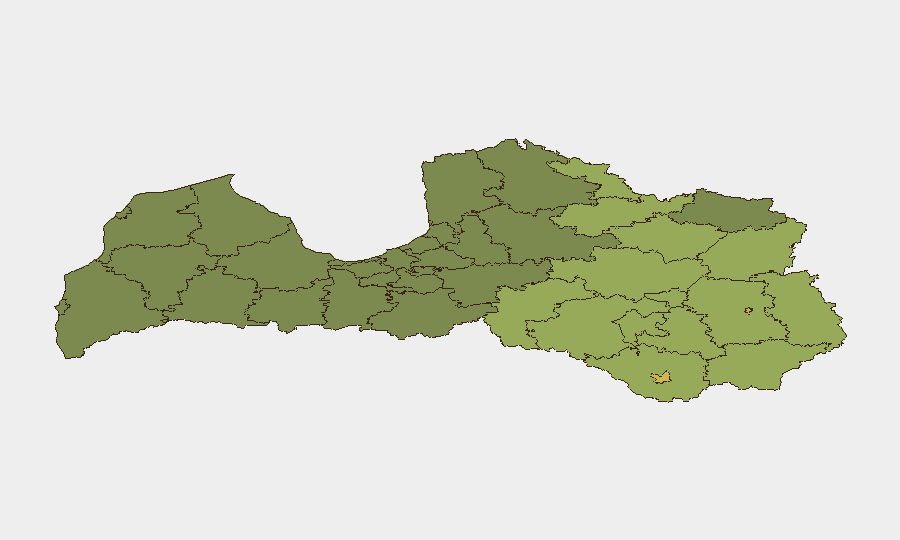
Eastern and southeastern Latvia—particularly Rēzekne (risk 68), Daugavpils (risk 65), and surrounding novads—dominate the sub-national risk ranking. These regions' elevated scores reflect proximity to the Belarus and Russia borders, exposure to hybrid-threat operations, migration pressure, and historical critical-infrastructure concentration. The cluster of high-risk districts along the eastern frontier indicates border-security challenges and potential sabotage vectors rather than active armed conflict or widespread civil disorder within the last 24–48 hours.
How GeoBit Would Assist
Security teams protecting assets and personnel in Latvia should employ GeoBit's AOI Monitoring & Early Warning capability to track the Latvia–Belarus border sector and critical energy facilities for signs of escalating hybrid activity or sabotage preparation. OSINT Fusion & Corroboration across Latvian, regional, and Russian-language sources—combined with Sentiment & Temporal Analysis—provides real-time detection of emerging threats before they materialize. GIS & Spatial Analysis and Routing & Network Analysis support rapid identification of safe travel corridors and alternative logistics pathways around high-risk border districts and weather-affected areas.
7-Day Outlook
No acute escalation is forecast for the next seven days, but border incidents and hybrid-threat probing are likely to continue at current levels. Weather disruptions in eastern and western regions should clear within 24–48 hours. Security teams should maintain heightened vigilance on critical-infrastructure access and border-zone operations while monitoring for any shift in Russian or Belarusian tactical posture.
Highest-Risk Areas — Ranked
| # | State / Region | Risk |
|---|---|---|
| 1 | Rēzekne | 68 |
| 2 | Daugavpils | 65 |
| 3 | Rēzeknes novads | 58 |
| 4 | Ludzas novads | 55 |
| 5 | Balvu novads | 52 |
| 6 | Preiļu novads | 50 |
| 7 | Krāslavas novads | 48 |
| 8 | Jēkabpils novads | 47 |
| 9 | Augšdaugavas novads | 46 |
| 10 | Aizkraukles novads | 45 |
| 11 | Varakļānu novads | 44 |
| 12 | Līvānu novads | 43 |
Previous Daily Briefs
A new Latvia brief is written every day — each with its own risk map and downloadable CSV. Here's the last week; use the calendar to go further back.
📅 Browse every day by calendar →
Highlighted days have a brief. Tap a day for that day's map & analysis, or “csv” for that day's dataset ($5).
Atlas — our AI intelligence desk — emails them this snapshot personally. Nothing else, no list.