Situation Summary
Lesotho remains at low overall threat globally (rank #146, composite score 6) with no corroborated security incidents, civil unrest, or infrastructure disruption reported in the last 24–48 hours. However, sub-national risk concentration in Mafeteng and Maseru districts (scores 31.8 and 24.2 respectively) reflects localized vulnerabilities that warrant sustained monitoring. The security environment is stable but asymmetric: two districts account for approximately 90% of tracked risk, while seven districts register minimal threat indicators.
Key Developments
- No significant incidents confirmed in last 24–48 hours. Open-source monitoring across mainstream news, social media, and official channels has not surfaced verified reports of violence, protests, political instability, or acute service disruptions in Lesotho as of 4 July 2026.
- Regional security engagement continues. Lesotho is participating in the 2026 African Chiefs of Defense Conference, a diplomatic security-cooperation initiative with no associated protests or travel advisories; this reflects routine engagement rather than crisis response.
- Geobit platform event signals active. Multiple signal types (public statements, demands, disapproval notices) generated on 4 July 2026 suggest ongoing institutional or policy activity, but no linked corroborated incident reports have been identified in parallel open-source search, indicating potential low-amplitude political or administrative activity rather than acute security events.
- U.S. State Department routine engagement noted. Official schedule activity involving Lesotho-related portfolios (July 2) reflects standard diplomatic operations with no crisis indicators.
Highest-Risk Areas
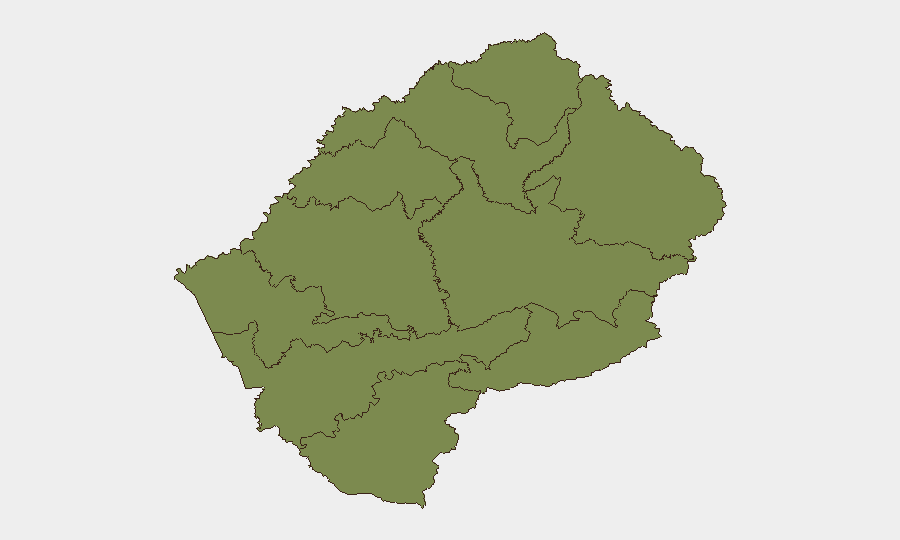
Mafeteng District dominates the risk landscape at 31.8, driven by historical patterns of border-related trafficking, stock theft, and localized armed robbery. Maseru District (24.2) concentrates urban crime risk, including gang activity and armed assault, compounded by dense population and proximity to South Africa. Together these two districts represent the operational security priority; the remaining eight districts each score ≤9.2, with seven at baseline 1.8. This concentration suggests that protective measures, monitoring, and asset management should prioritize the Mafeteng–Maseru corridor while maintaining proportionate but lighter vigilance elsewhere.
How GeoBit Would Assist
Intel Sweep and OSINT fusion capabilities enable real-time monitoring of Lesotho's media, social platforms, and official channels to detect emerging protests, crime spikes, or political instability before they amplify. AOI Monitoring & Early Warning with persistent area-of-interest watch on Mafeteng and Maseru districts would trigger alerts on new incident activity, allowing duty-of-care teams to issue timely employee and asset advisories. Routing & Network Analysis supports alternative journey planning for staff in high-risk districts, mitigating exposure to known crime corridors and enabling rapid re-routing if localised incidents occur.
7-Day Outlook
No acute escalation is anticipated in the next 7 days based on current signal patterns and open-source environment. Mafeteng and Maseru remain the persistent focus areas, where routine crime and minor administrative/political activity will likely continue; monitoring should remain active but heightened alerts are not warranted unless new corroborated incidents emerge. Staff and asset managers should maintain standard security protocols while monitoring local police advisories and embassy updates for any rapid changes.
Highest-Risk Areas — Ranked
| # | State / Region | Risk |
|---|---|---|
| 1 | Mafeteng District | 31.8 |
| 2 | Maseru District | 24.2 |
| 3 | Thaba-Tseka District | 9.2 |
| 4 | Berea District | 1.8 |
| 5 | Mohale's Hoek District | 1.8 |
| 6 | Quthing District | 1.8 |
| 7 | Butha-Buthe District | 1.8 |
| 8 | Leribe District | 1.8 |
| 9 | Mokhotlong District | 1.8 |
| 10 | Qacha's Nek District | 1.8 |
Previous Daily Briefs
A new Lesotho brief is written every day — each with its own risk map and downloadable CSV. Here's the last week; use the calendar to go further back.
📅 Browse every day by calendar →
Highlighted days have a brief. Tap a day for that day's map & analysis, or “csv” for that day's dataset ($5).
Atlas — our AI intelligence desk — emails them this snapshot personally. Nothing else, no list.