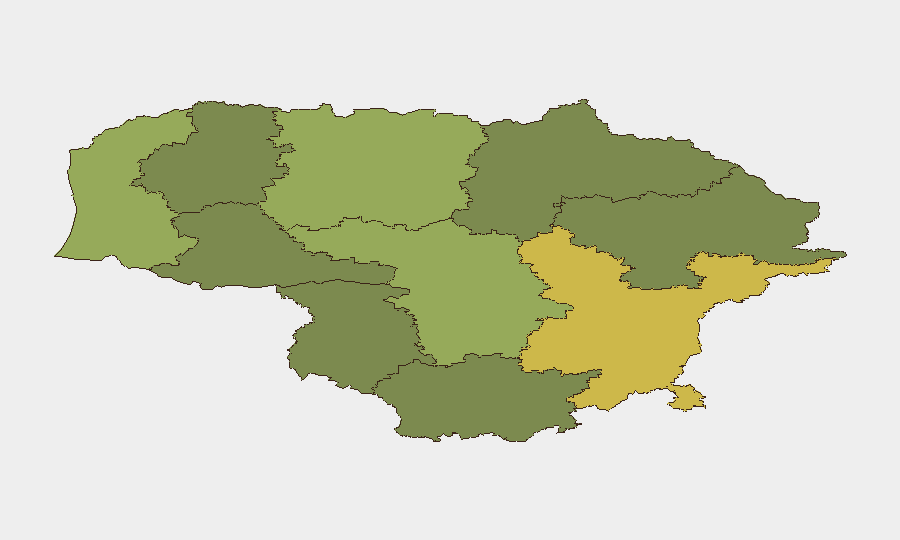
Situation Summary
Lithuania remains a low-to-moderate risk jurisdiction globally (rank #90, composite score 12) with no verified major security incidents, civil unrest, or infrastructure emergencies in the last 24–48 hours. However, the country is undergoing a significant strategic security realignment, driven by constitutional moves to lift its ban on nuclear weapons deployment and foreign military bases—a shift directly tied to regional Russian threat perception and NATO positioning. The political momentum is substantial but not immediately operationally destabilizing; risk remains concentrated in Vilnius County and cross-border dynamics rather than acute domestic threats.
Key Developments
- Berlin, Germany – 2026-07-03 – Lithuanian President Gitanas Nausėda announced initiation of a constitutional amendment to remove Lithuania's ban on nuclear weapons deployment on its territory, signaling a fundamental shift in deterrence posture and framing the existing constitutional restriction as "outdated" in the current regional security environment.
- Vilnius (Parliament) – 2026-07-02/03 – Fifty Lithuanian lawmakers formally submitted a constitutional amendment to end the ban on nuclear weapons and foreign military bases, triggering a multi-step parliamentary process requiring two votes by at least 94 of 141 MPs spaced three months apart; this represents the political codification of the strategic shift announced in Berlin.
- Berlin, Lithuania (defense posture) – 2026-07-03 – Lithuanian officials highlighted at the NATO pre-summit gathering that defense and security expenditure is approaching 7% of GDP (core defense ~5.38% plus dual-use spending), indicating sustained military capability expansion and infrastructure hardening.
- Lithuania nationwide (cyber domain) – current reporting cycle – The National Cyber Security Centre's latest Cyber Threats Report, widely cited in domestic media, warns of accelerating AI-enabled cyberattacks, particularly targeting cloud and SaaS platforms via sophisticated phishing and ransomware; this reflects an elevated and persistent cyber-risk environment for corporate and critical infrastructure assets.
- Regional political signals – 2026-07-02/04 – OSINT monitoring has detected public statements from Lithuanian, Estonian, and Ukrainian officials; a NATO-Lithuania detention/arrest event was flagged on 2026-07-04, though open-source confirmation of specifics remains limited and warrants clarification through official channels.
Highest-Risk Areas
Vilnius County drives the national risk ranking (score 68) due to concentration of political institutions, critical infrastructure, foreign diplomatic presence, and economic activity; Kaunas County (58) and Klaipeda County (52) follow as secondary urban and logistics nodes. The elevation of Vilnius County risk reflects the political volatility surrounding nuclear policy debate, potential domestic polarization, and the city's role as the focal point for NATO and EU strategic communications. Klaipeda's port and NATO positioning elevate logistics and maritime-adjacent risk. No acute geographical instability is evident; risk is primarily political and strategic rather than kinetic.
How GeoBit Would Assist
Corporate security teams should deploy AOI Monitoring & Early Warning on Vilnius County institutions, parliament, and critical infrastructure to detect protest activity or civil disorder linked to the constitutional amendment debate. Parallel use of OSINT fusion (X/Twitter, Telegram, multi-language media search) and sentiment analysis will track domestic and regional political messaging, opposition rhetoric, and NATO/Russian response narratives in real time. Cyber threat monitoring via the platform's capabilities should be paired with open-source tracking of Lithuanian National Cyber Security Centre advisories to provide early warning of sector-specific attacks targeting corporate networks or supply chains.
7-Day Outlook
The constitutional amendment process will dominate the political risk landscape over the next week, with parliamentary debate and international commentary likely to intensify ahead of the NATO summit. No acute security incidents are forecast; however, polarization around nuclear policy and potential Russian signaling/diplomatic pushback should be monitored for secondary effects on business operations, travel security, or expatriate safety.
Highest-Risk Areas — Ranked
| # | State / Region | Risk |
|---|---|---|
| 1 | Vilnius County | 68 |
| 2 | Kaunas County | 58 |
| 3 | Klaipeda County | 52 |
| 4 | Siauliai County | 42 |
| 5 | Panevezys County | 38 |
| 6 | Taurage County | 35 |
| 7 | Utena County | 33 |
| 8 | Alytus County | 32 |
| 9 | Telsiai County | 28 |
| 10 | Marijampole County | 25 |
Sources
Previous Daily Briefs
A new Lithuania brief is written every day — each with its own risk map and downloadable CSV. Here's the last week; use the calendar to go further back.
📅 Browse every day by calendar →
Highlighted days have a brief. Tap a day for that day's map & analysis, or “csv” for that day's dataset ($5).
Atlas — our AI intelligence desk — emails them this snapshot personally. Nothing else, no list.