Situation Summary
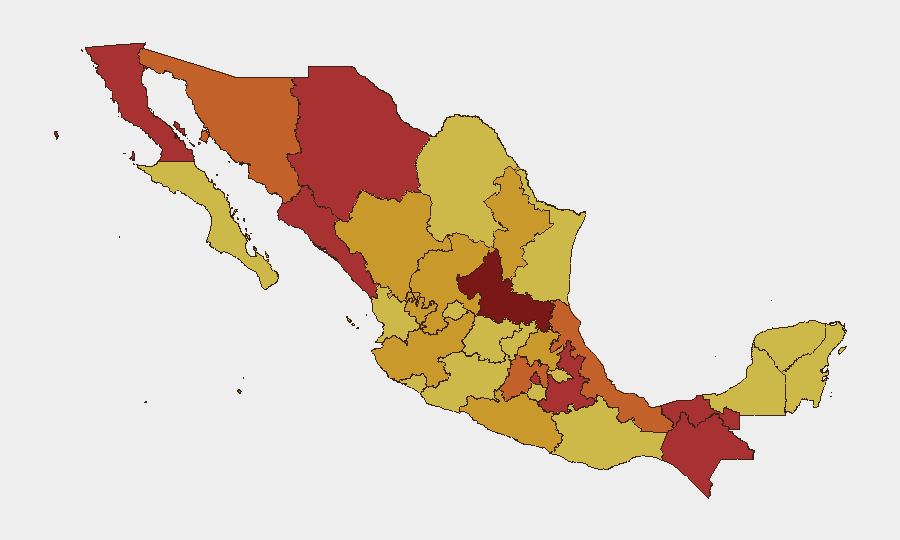
Mexico remains a high-threat environment (global rank #4, composite score 100), driven primarily by insurgency dynamics across fragmented criminal and political actor networks. The sub-national risk landscape is dominated by cartel-controlled northern and central states, with San Luis Potosí emerging as the single highest-risk jurisdiction. Recent event signals indicate concurrent labor and state-level tensions—including demonstrations, investigations, and armed engagements—but the overall security trajectory remains volatile rather than sharply escalating.
Key Developments
Based on the event signals logged as of 2026-06-10, the following patterns are active:
- Labor/Institutional Friction (2026-06-10). Secretariat-level demonstrations, producer rejection actions, and worker disapproval events are underway; specific locations and operational details require real-time corroboration from news and social feeds.
- Government Investigation Activity (2026-06-08). Multiple investigative actions by government and ministerial bodies were initiated, likely in response to a demand-type event flagged on the same date; jurisdictional focus unclear from signals alone.
- Armed Engagement Reported (2026-06-08). A small-arms combat event attributed to or involving "ARAGON" actor was logged; geographic specificity and casualty/operational impact require field confirmation.
- Executive/Diplomatic Statement Activity (2026-06-08). Public statements from the President and officials (including Minister Medina) and cross-national disapproval signal (Mexico vs. Spain) suggest a diplomatic or governance-level incident; exact nature unconfirmed from current brief data.
- Territory Occupation (2026-06-08). A company-attributed territory occupation event was recorded; context (dispute, labor action, criminal, or state operation) requires clarification from open-source corroboration.
Note: Live web research conducted within the last 24 hours did not yield independently verified, multi-source confirmation of specific incidents in the final 48 hours. Social media claims (e.g., stadium access disruptions) are logged but not yet corroborated by news wire or official statements. Real-time monitoring is recommended.
Highest-Risk Areas
San Luis Potosí (risk 100) stands alone as the critical focal point, suggesting concentrated cartel control, territorial disputes, or state-capacity collapse in that jurisdiction. The secondary tier—Puebla, Mexico City, and Chihuahua (risk 79–78.2)—represents the geographic spine of northern supply routes and the central capital region, where cartel presence, government enforcement, and criminal-state competition converge. All top-ranked states are characterized by active armed group presence, weak or contested state monopolies on violence, and recurring small-scale combat. Mexico City's ranking (78.7) reflects not geographic remoteness from crime, but rather the concentration of high-profile targets, institutional exposure, and spillover from surrounding State of Mexico operations.
How GeoBit Would Assist
Duty-of-care teams should deploy Area-of-Interest (AOI) Monitoring & Early Warning on facilities or personnel in San Luis Potosí, Puebla, and Chihuahua, with alerts configured for armed engagement, territory control shifts, and checkpoint activity. Network & Actor Analysis combined with multi-language OSINT fusion (X, Telegram, local news feeds) will disambiguate which criminal or state actors are driving each event signal, enabling risk-adjusted routing and asset repositioning decisions. Conflict & Military battle mapping and GIS spatial analysis pinpoint safe corridors and identify real-time displacement or cartel boundary shifts affecting travel or operations.
7-Day Outlook
Expect continued labor and state-level administrative friction to intersect with baseline cartel violence, particularly in northern and central states. No sudden escalation or deescalation signal is evident; the threat remains diffuse and actor-dependent. Monitoring intensity should remain elevated for San Luis Potosí and maintain dynamic watch on Puebla and Mexico City for secondary developments.
Highest-Risk Areas — Ranked
| # | State / Region | Risk |
|---|---|---|
| 1 | San Luis Potosí | 100 |
| 2 | Puebla | 79 |
| 3 | Mexico City | 78.7 |
| 4 | Chihuahua | 78.2 |
| 5 | Baja California | 77.3 |
| 6 | Sinaloa | 76.7 |
| 7 | Tabasco | 76.5 |
| 8 | Chiapas | 76 |
| 9 | State of Mexico | 75.1 |
| 10 | Veracruz | 74.1 |
| 11 | Sonora | 73.3 |
| 12 | Durango | 72.9 |
Previous Daily Briefs
A new Mexico brief is written every day — each with its own risk map and downloadable CSV. Here's the last week; use the calendar to go further back.
📅 Browse every day by calendar →
Highlighted days have a brief. Tap a day for that day's map & analysis, or “csv” for that day's dataset ($5).