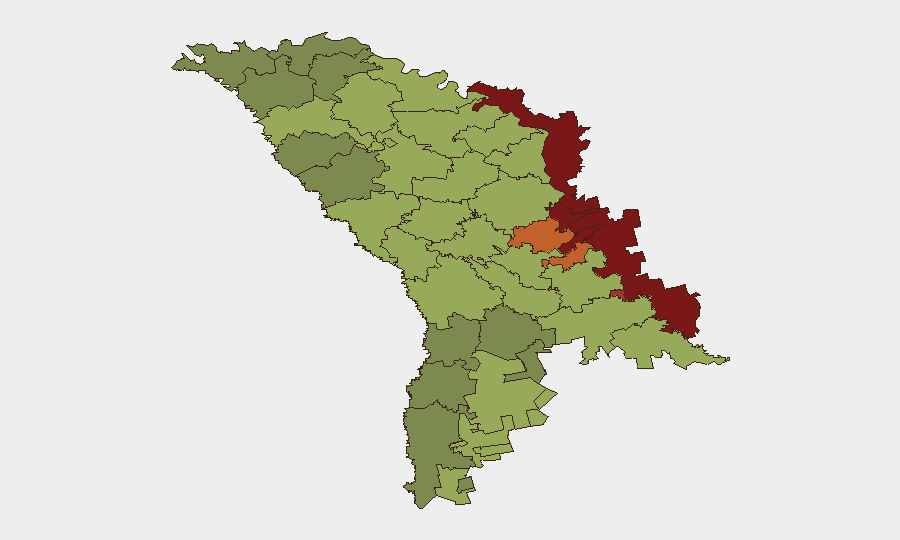
Situation Summary
Moldova faces an elevated but manageable near-term security environment shaped primarily by spillover risk from Russia's ongoing war in Ukraine, combined with domestic criminal activity and emerging electoral interference. On 12–13 July, a Russian Geran-2 drone crashed in Căușeni district after violating Moldovan airspace during strikes on Odesa, underscoring the physical threat posed by cross-border drone activity; authorities confirmed the warhead posed "catastrophic" risk to civilians had it detonated. Concurrently, Moldova's intelligence and security services have signaled elevated political-instability risk through disclosure of Russian election-interference preparations and a dismantled dual-use export scheme linked to Russian military procurement under sanctions. Overall trajectory remains stable but trending toward greater external pressure and internal friction.
Key Developments
- Copanca, Căușeni district (12–13 July): Russian Geran-2 drone entered Moldovan airspace during overnight attack on Odesa region, crashed and exploded on village outskirts ~30 km from Ukrainian border; no casualties reported but Ministry of Defence confirmed warhead could have destroyed residential structures; investigation ongoing.
- Căușeni district (13 July): Moldova's Ministry of Foreign Affairs formally condemned the airspace violation and framed the incident as part of a pattern of repeated Russian UAV incursions onto Moldovan territory during Ukraine-directed strikes, elevating diplomatic protest profile.
- National (13–14 July): European Union announced €120 million in new air-defence funding explicitly tied to increasing Russian drone and missile activity in the region, with Moldovan media linking the package announcement directly to the Copanca crash.
- Nationwide (13–14 July): Moldova's Intelligence and Security Service (SIS) and Prosecutor's Office announced dismantling of an illegal dual-use goods export scheme involving Moldovan entities and companies linked to Russian military-industrial complex under international sanctions; operational details not yet public.
- National (13–14 July): SIS publicly stated Russia is preparing to interfere in upcoming Moldovan elections through escalated disinformation campaigns and public-opinion influence operations, marking formal intelligence disclosure of electoral-interference risk.
- Chișinău International Airport (last 24 hours): Customs officers identified two new cases of undeclared goods at checkpoint; part of ongoing anti-smuggling enforcement at the country's primary international gateway.
- Nationwide (last 24 hours): General Police Inspectorate reported prevention of at least 152 telephone fraud attempts in 24-hour period; no new successful fraud cases logged in same window, reflecting persistent high-volume social-engineering threat.
Highest-Risk Areas
The Left Bank of the Dniester (risk 85), Dubăsari (82), and Bender (79) remain Moldova's highest-risk jurisdictions, driven by unresolved territorial status, proximity to active Russian military presence in Transnistria, and weak state control. The recent drone incident in Căușeni (risk 53) illustrates that even mid-ranked districts face direct kinetic spillover from the Ukraine conflict. Chișinău (risk 49), despite its capital status and stronger security infrastructure, remains exposed to urban-based criminal activity (fraud, smuggling) and serves as a focal point for electoral interference and disinformation operations. Risk concentration in the Left Bank and southern border districts reflects geopolitical fragmentation and proximity to conflict; mid-ranking areas face intermittent but acute kinetic hazards.
How GeoBit Would Assist
Security teams would deploy AOI Monitoring & Early Warning on Căușeni and adjacent districts to flag incoming drone activity and incursions in real time; Intel Sweep and multi-language OSINT fusion to track Russian disinformation narratives and interference operations ahead of elections; and Economic & Trade analysis plus Network & Actor Analysis to identify illicit procurement networks and sanctions-evasion schemes similar to those recently dismantled. Conflict & Military tracking and battle mapping provide situational awareness of Ukrainian air-defence operations and Russian strike patterns that inform spillover probability.
7-Day Outlook
Drone incursions and airspace violations are likely to continue as Russian strikes on Odesa and other Ukrainian targets persist; EU air-defence funding will require weeks to operationalize. Russian electoral interference and disinformation activity will intensify as Moldova approaches voting. Arrests or sanctions announcements related to the disclosed dual-use export scheme may follow within days, potentially triggering further geopolitical rhetoric.
Highest-Risk Areas — Ranked
| # | State / Region | Risk |
|---|---|---|
| 1 | Administrative-Territorial Units of the Left Bank of the Dniester | 85 |
| 2 | Dubăsari | 82 |
| 3 | Bender | 79 |
| 4 | Criuleni | 75 |
| 5 | Rezina | 58 |
| 6 | Taraclia | 55 |
| 7 | Gagauzia | 54 |
| 8 | Căușeni | 53 |
| 9 | Soroca | 52 |
| 10 | Ștefan Vodă | 51 |
| 11 | Orhei | 50 |
| 12 | Chișinău | 49 |
Sources
Previous Daily Briefs
A new Moldova brief is written every day — each with its own risk map and downloadable CSV. Here's the last week; use the calendar to go further back.
📅 Browse every day by calendar →
Highlighted days have a brief. Tap a day for that day's map & analysis, or “csv” for that day's dataset ($5).
Atlas — our AI intelligence desk — emails them this snapshot personally. Nothing else, no list.