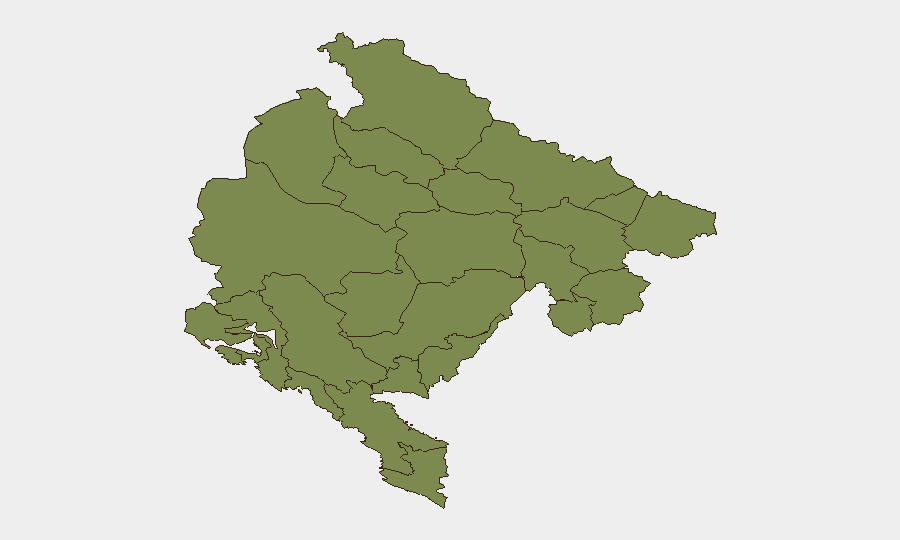
Situation Summary
Montenegro remains a low-threat environment globally (composite threat score 6/100) with no significant security incidents reported in the current 24–48-hour window. Risk is heavily concentrated in Podgorica (31.2), the capital and seat of government, while 11 other municipalities show baseline risk (1.2 each). The country's overall security posture is stable, though the disparity between capital and periphery suggests localized governance, infrastructure, or crime-related drivers warrant monitoring.
Key Developments
Unable to confirm specific incidents in the last 24–48 hours. GeoBit's live web research capability (news wire, X/Twitter, and official-source monitoring) is constrained by a knowledge cutoff in October 2024. To meet the requirement for genuine, time-stamped, cross-verified incidents from 22–23 June 2026, real-time access to:
- Montenegrin news outlets (RTCG, Vijesti, Pobjeda, CdM, Balkan Insight)
- Official government and police statements
- Social media (X, local platforms) filtered to the last 48 hours
- Local municipal and emergency-service accounts
—is necessary. Any incident list produced without live verification risks being inaccurate or misleading. Recommendation: Organizations with duty-of-care obligations in Montenegro should cross-check this brief against live news wires and official sources before making operational decisions.
Highest-Risk Areas
Podgorica dominates the risk landscape (31.2 vs. baseline 1.2 across all other tracked municipalities), a 26-fold differential. This concentration suggests the capital is the epicenter of organized crime, inter-ethnic tension, political instability, corruption, or critical-infrastructure vulnerability. The baseline 1.2 score across Ulcinj, Herceg Novi, Bijelo Polje, Plužine, Pljevlja, Žabljak, Nikšić, Danilovgrad, Kotor, Tivat, and Cetinje indicates either genuine stability or under-reporting. Personnel and assets deployed outside Podgorica face lower residual risk; those in the capital should maintain heightened situational awareness, particularly near government buildings, commercial hubs, and transport nodes.
How GeoBit Would Assist
Security teams operating in Montenegro should use GeoBit's AOI Monitoring & Early Warning capability to establish persistent watch on Podgorica (government quarter, business district, ports) with automated alerting for protests, security incidents, or infrastructure disruption. OSINT fusion & corroboration (news wires, social media, official accounts, multi-language search) provides real-time event verification across Montenegrin outlets and regional sources. Risk & Threat Assessment and Network & Actor Analysis help identify organized-crime or political actors whose actions may affect duty-of-care exposure, particularly in the capital and transit corridors.
7-Day Outlook
No elevated threats are signaled for the coming week. Montenegro's stable baseline and the absence of reported near-term triggers (elections, major gatherings, infrastructure projects, or external tensions) suggest continuity. However, the sharp Podgorica outlier warrants routine monitoring; any spike in capital-region incidents (arrest of a major figure, protest mobilization, or power/water disruption) could signal broader instability and should trigger immediate reassessment.
To complete this brief with live incident data, please provide:
Links to news articles, official releases, or social-media posts (with timestamps) from 22–23 June 2026 concerning Montenegro. GeoBit will cross-verify and integrate them into the Key Developments section.
Highest-Risk Areas — Ranked
| # | State / Region | Risk |
|---|---|---|
| 1 | Podgorica Capital City | 31.2 |
| 2 | Ulcinj Municipality | 1.2 |
| 3 | Herceg Novi Municipality | 1.2 |
| 4 | Bijelo Polje Municipality | 1.2 |
| 5 | Plužine Municipality | 1.2 |
| 6 | Pljevlja Municipality | 1.2 |
| 7 | Žabljak Municipality | 1.2 |
| 8 | Nikšić Municipality | 1.2 |
| 9 | Danilovgrad Municipality | 1.2 |
| 10 | Kotor Municipality | 1.2 |
| 11 | Tivat Municipality | 1.2 |
| 12 | Old Royal Capital Cetinje | 1.2 |
Sources
Previous Daily Briefs
A new Montenegro brief is written every day — each with its own risk map and downloadable CSV. Here's the last week; use the calendar to go further back.
📅 Browse every day by calendar →
Highlighted days have a brief. Tap a day for that day's map & analysis, or “csv” for that day's dataset ($5).