Situation Summary
North Korea's threat posture remains elevated and multidirectional, driven by accelerating nuclear weapons production, sustained missile testing, and deepening military integration with Russia. The DPRK's constitutional removal of unification goals and formal redesignation of South Korea as a "hostile state" signal entrenchment of long-term confrontation rather than diplomatic off-ramps. Recent advances in uranium enrichment capacity and naval strike systems compound regional maritime and strategic risk. The renewed U.S. push for enhanced UN sanctions is likely to provoke additional DPRK weapons demonstrations and cyber activity in the near term.
Key Developments
- Rajin Port, Rason Special City (South Pyongan) – Satellite analysis confirms a Russian cargo vessel conducted night-time clandestine delivery operations in late May, indicating active Russia–DPRK sanctions-evasion trade supporting Russian war logistics.
- Sinpo South Shipyard (South Hamgyong) – New modular missile-system testing detected on a North Korean warship, including visible launch canisters and support equipment, marking progression of naval strike capabilities.
- East Sea/Sea of Japan – Multiple short-range ballistic missile launches recorded by South Korean Joint Chiefs of Staff, sustaining 2026's high operational tempo and elevating miscalculation and air/sea navigation risk.
- Yongbyon Nuclear Complex & undeclared enrichment sites (North Pyongan) – IAEA assessment reports "very serious" advances in weapons production, likely including a new uranium enrichment facility and increased Yongbyon activity, expanding fissile-material capacity.
- Pyongyang (Strategic messaging) – DPRK statements reject QUAD denuclearization calls, reaffirm no-surrender nuclear posture, and frame multilateral pressure as U.S. dominance—signaling zero movement toward arms control.
- UN Security Council/Pyongyang (Sanctions escalation) – U.S. pursuit of updated/strengthened DPRK sanctions tabled at the UNSC; DPRK historically responds with weapons tests or cyber operations.
- Russia–DPRK military axis (Strategic partnership) – Russian pledges of 2027–2031 defense-cooperation plan under discussion, institutionalizing arms transfers and training and deepening Northeast Asia strategic risk.
- Constitutional reform (Political posture) – North Korea formally excised unification from its constitution and redesignated South Korea as "neighboring country" and "most hostile" state, codifying long-term confrontation.
Highest-Risk Areas
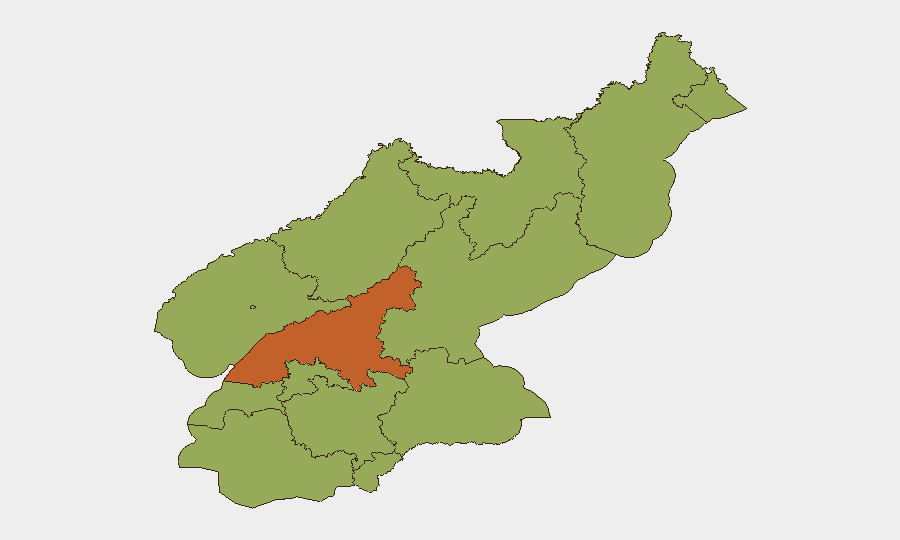
South Pyongan (risk 74.1) stands substantially above all other provinces, driven by Rason's role as a sanctions-evasion hub and active Russia–DPRK trade logistics. Pyongyang (44.8) and the eastern provinces—Ryanggang, North Hamgyong, and South Hamgyong (all 44.1)—concentrate nuclear-weapons development, missile testing, and strategic military infrastructure. The significant gap between South Pyongan and the second-tier cluster reflects the criticality of Rason's illicit trade networks to sustaining both the Russian partnership and DPRK weapons programs; disruption or escalation at Rajin would amplify regional instability.
How GeoBit Would Assist
Corporate security teams with personnel or assets in North Korea should deploy AOI Monitoring & Early Warning on Rajin Port, Sinpo Shipyard, and Yongbyon to detect operational changes and sanctions-evasion activity. Satellite & Imagery analysis paired with Conflict & Military capabilities enable continuous tracking of weapons-system advancement and Russian supply shipments. Network & Actor Analysis and Economic & Trade intelligence illuminate DPRK–Russia logistics networks and sanctions workarounds, informing supply-chain and sanctions-compliance risk.
7-Day Outlook
Renewed U.S. sanctions pressure at the UNSC is likely to trigger a DPRK weapons demonstration or cyber operation within 5–10 days, consistent with historical response patterns. Russia–DPRK military coordination is expected to intensify, with additional clandestine deliveries likely via Rason. Regional maritime and air-space risk remains elevated.
Highest-Risk Areas — Ranked
| # | State / Region | Risk |
|---|---|---|
| 1 | South Pyongan | 74.1 |
| 2 | P'yŏngyang | 44.8 |
| 3 | Ryanggang | 44.1 |
| 4 | North Hamgyong | 44.1 |
| 5 | North Pyongan | 44.1 |
| 6 | Chagang | 44.1 |
| 7 | Nampo | 44.1 |
| 8 | South Hwanghae | 44.1 |
| 9 | North Hwanghae | 44.1 |
| 10 | South Hamgyong | 44.1 |
| 11 | Kaesong | 44.1 |
| 12 | Kangwon | 44.1 |
Previous Daily Briefs
A new North Korea brief is written every day — each with its own risk map and downloadable CSV. Here's the last week; use the calendar to go further back.
📅 Browse every day by calendar →
Highlighted days have a brief. Tap a day for that day's map & analysis, or “csv” for that day's dataset ($5).